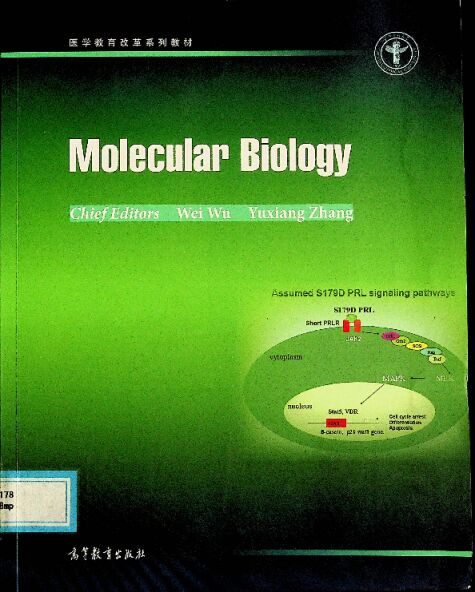
书名:Molecular biology
责任者:chief reviewer: Hongti Jia ; chief : Wei Wu | Yuxiang Zhang ; associate chief : Wangwei Cai | Wei Ding | Junqi He ; contributors: Wangwei Cai … [et al.]. | Wu, Wei.
前言
With the development of biology and biological techniques, a new edged discipline, called molecular biology, began to emerge in the mid-1900s. It is, however, an elusive term that has different definition dependent of who is doing the defining. In this textbook we adopted the definition by Dr. Rob Weaver, a professor of biochemistry and the Dean of the College of Liberal Arts and Sciences, University of Kansas, that molecular biology is the study of genes and their activities at the molecular terms, including transcription, translation, DNA replication, recombination and translocation, and related technologies. As a new period, during which experimental researches focus on the roles of macromolecules such as nucleic acids (including gene/DNA and RNAs) and proteins (including enzymes) in genetic transmission, molecular biology is often described as the third stage of biochemical development. Sometimes, it is also referred to as biochemical genetics. Therefore, it is easily recognized that the emphasis of molecular biology focuses on structure, organization, and regulation of genes, by which scientists study the nature of life processes. Its ultimate purpose is to discover how and to what extent such characteristic manifestations of life as heredity, reproduction, biosynthesis of proteins, excitation, growth and development, storage and transfer of information are determined by the molecular structure, properties, and interactions of biologically important substances, primarily of the two principal classes of macromolecules—proteins and nucleic acids.
This book begins with a briefly historical review of molecular biology in Chapter 1. Chapters 2 and 3 involve genetic materials and genetic information transmission and its regulation. Chapter 4 focuses on DNA damage and repair. Chapter 5 focuses on protein sorting and processing. Chapters 6-8 present the useful methods in molecular biology. Chapter 9 involves the concepts of gene transfer and gene targeting. Indeed, one of the most important practical problems that molecular biology is expected to provide answers for is the molecular basis of malignant growth. This book, therefore, is ended by Chapter 10, molecular biology of cancer, which gives students examples of how molecular biology is implicated in medical sciences. It is hoped that molecular biology will also discover ways of preventing and perhaps conquering "molecular diseases". The prospects in molecular biology are quite huge today. It covers a wide variety of fields and provides answer to almost every area of sciences such as molecular evolution, molecular virology, molecular immunology, and biomedicine.
As the bioinformatics and microarray develop (see Chapter 8), molecular biology comes to a big stride in screening and diagnosis of genetic and molecular diseases, gene targeting, transgenic animals and gene therapy. Thus, it is essential to study those techniques for undergraduates and graduates to have a good understanding in contemporary medicine and biology. This book is just for meeting these requirements.
Finally, we thank all members of our project team. Thanks to the Administration of Teaching and Education Management, CCMU and Higher Education Press, China, for their supporting in writing and publishing this book. In particular, we thank the readers for improving suggestions for next edition.
查看更多
目录
Chapter I Historical Review of Molecular Biology 1
1.1 Definition of Molecular Biology 1
1.2 Brief History of Molecular Biology 2
1.3 Basic Content of Molecular Biology
1.4 Role of Molecular Biology in Medical Science 5
Chapter 2 Transmission of Genetic Information 8
2.1 DNA Replication 9
2.2 Transcription 13
2.3 Translation 18
Chapter 3 Gene Regulation 25
3.1 Gene Regulation in Prokaryotes 26
3.2 Gene Regulation in Eukaryotes 28
3.3 Non-coding RNA and RNA Interference 30
3.4 Epigenetic Regulation of Gene Expression 33
3.5 Gene Regulatory Network 35
Chapter 4 DNA Damage and Repair 38
4.1 Factors Causing DNA Damage 39
4.2 Types of DNA Damage 39
4.3 DNA Repair Mechanisms 41
4.4 DNA Damage Caused Effects 45
Chapter 5 Protein Modification, Trafficking and Degradation 48
5.1 Folding of Nascent Polypeptide Chains 49
5.2 Assembly of Protein Subunits 50
5.3 Post-translational Modifications of Proteins 51
5.4 Transport and Localization of Proteins 55
5.5 Degradation of Cellular Proteins 58
5.6 Clinical Significance of Protein Modification, Trafficking and
Degradation 59
Chapter 6 Molecular Cloning and Genetic Engineering 62
6.1 Cloning Enzymes 63
6.2 Cloning Vectors 66
6.3 Principle and Procedures of Molecular Cloning 68
6.4 Genetic Engineering 72
Chapter 7 Gene Characterization and Functional Analysis 77
7.1 Nucleic Acid Molecular Hybridization 78
7.2 Polymerase Chain Reaction 82
7.3 Nucleic Acid Sequencing 87
Chapter 8 Omics and System Biology 95
8.1 Genomics 96
8.2 Transcriptomics 98
8.3 Proteomics 99
8.4 Metabolomics 101
Chapter 9 Gene Transfer and Gene Targeting 104
9.1 Gene Recombination 105
9.2 Gene Transfer and Transgenic 106
9.3 Gene Targeting by Homologous Recombination 112
9.4 Transgenic and Its Application 114
Chapter 10 Molecular Biology of Cancer 117
10.1 Cell Cycle and Apoptosis 118
10.2 Oncogenes and Tumor Suppressor Genes 120
10.3 Molecular Basis of Cancer Development 124
查看PDF
查看更多
馆藏单位
中科院文献情报中心