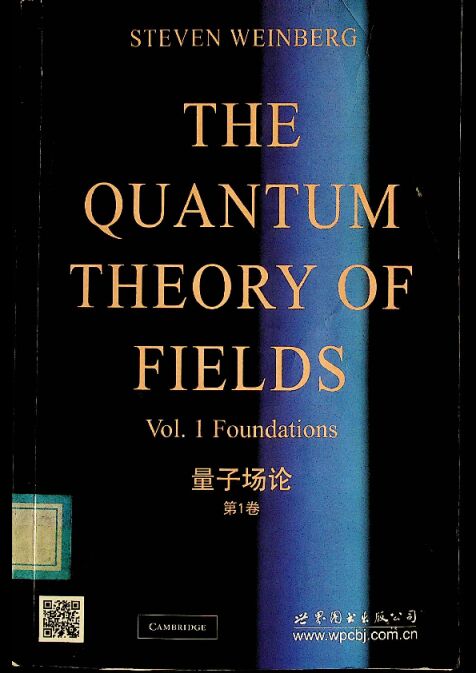
书名:The quantum theory of fields. Volume I, Foundations = 第1卷
出版时间:2014
出版社:世界图书出版公司北京公司,
分类号:物理学
版次:[Reprinted ed.].
摘要
Available for the first time in paperback, The Quantum Theory of Fields is a self-contained, comprehensive, and up-to-date introduction to quantum field theory from Nobel Laureate Steven Weinberg. Volume I introduces the foundations of quantum field theory. The development is fresh and logical throughout, with each step carefully motivated by what has gone before. After a brief historical outline, the book begins with the principles of relativity and quantum mechanics, and the properties of particles that follow. Quantum field theory emerges from this as a natural consequence. The classic calculations of quantum electrodynamics are presented in a thoroughly modern way, showing the use of path integrals and dimensional regularization. It contains much original material, and is peppered with examples and insights drawn from the author's experience as a leader of elementary particle research. Exercises are included at the end of each chapter.
查看更多
目录
Sections marked with an asterisk are somewhat out of the book's main line of development and may be omitted in a first reading.
PREFACE xx
NOTATION xxv
1 HISTORICAL INTRODUCTION 1
1.1 Relativistic Wave Mechanics De Broglie waves □ Schrödinger-Klein-Gordon wave equation □ Fine structure □ Spin □ Dirac equation □ Negative energies □ Exclusion principle □ Positrons □ Dirac equation reconsidered 3
1.2 The Birth of Quantum Field Theory Born, Heisenberg, Jordan quantized field □ Spontaneous emission □ Anticom-mutators □ Heisenberg-Pauli quantum field theory □ Furry-Oppenheimer quantization of Dirac field □ Pauli-Weisskopf quantization of scalar field □ Early calculations in quantum electrodynamics □ Neutrons □ Mesons 15
1.3 The Problem of Infinities Infinite electron energy shifts □ Vacuum polarization □ Scattering of light by light □ Infrared divergences □ Search for alternatives □ Renormalization □ Shelter Island Conference □ Lamb shift □ Anomalous electron magnetic moment □ Schwinger, Tomonaga, Feynman, Dyson formalisms □ Why not earlier? 31
Bibliography 39
References 40
2 RELATIVISTIC QUANTUM MECHANICS 49
2.1 Quantum Mechanics Rays □ Scalar products □ Observables □ Probabilities 49
2.2 Symmetries Wigner's theorem □ Antilinear and antiunitary operators □ Observables □ Group structure □ Representations up to a phase □ Superselection rules □ Lie groups □ Structure constants □ Abelian symmetries 50
2.3 Quantum Lorentz Transformations Lorentz transformations □ Quantum operators □ Inversions 55
2.4 The Poincaré Algebra Jμυ and Pμ □ Transformation properties □ Commutation relations □ Conserved and non-conserved generators □ Finite translations and rotations □ Inönü-Wigner contraction □ Galilean algebra 58
2.5 One-Particle States Transformation rules □ Boosts □ Little groups □ Normalization □ Massive particles □ Massless particles □ Helicity and polarization 62
2.6 Space Inversion and Time-Reversal Transformation of Jμυ and Pμ □ P is unitary and T is antiunitary □ Massive particles □ Massless particles □ Kramers degeneracy □ Electric dipole moments 74
2.7 Projective Representations' Two-cocyles □ Central charges □ Simply connected groups □ No central charges in the Lorentz group □ Double connectivity of the Lorentz group □ Covering groups □ Superselection rules reconsidered 81
Appendix A The Symmetry Representation Theorem 91
Appendix B Group Operators and Homotopy Classes 96
Appendix C Inversions and Degenerate Multiplets 100
Problems 104
References 105
3 SCATTERING THEORY 107
3.1 'In' and 'Out' States Multi-particle states □ Wave packets □ Asymptotic conditions at early and late times □ Lippmann-Schwinger equations □ Principal value and delta functions 107
3.2 The S-matrix Definition of the S-matrix □ The T-matrix □ Born approximation □ Unitarity of the S-matrix 113
3.3 Symmetries of the S-Matrix Lorentz invariance □ Sufficient conditions □ Internal symmetries □ Electric charge, strangeness, isospin, SU(3) □ Parity conservation □ Intrinsic parities □ Pion parity □ Parity non-conservation □ Time-reversal invariance □ Watson's theorem □ PT non-conservation □ C, CP, CPT □ Neutral K-mesons □ CP non- conservation 116
3.4 Rates and Cross-Sections Rates in a box □ Decay rates □ Cross-sections □ Lorentz invariance □ Phase space □ Dalitz plots 134
3.5 Perturbation Theory Old-fashioned perturbation theory □ Time-dependent perturbation theory □ Time-ordered products □ The Dyson series □ Lorentz-invariant theories □ Distorted wave Born approximation 141
3.6 Implications of Unitarity Optical theorem □ Diffraction peaks □ CPT relations □ Particle and antiparticle decay rates □ Kinetic theory □ Boltzmann H-theorem 147
3.7 Partial-Wave Expansions' Discrete basis □ Expansion in spherical harmonics □ Total elastic and inelastic cross-sections □ Phase shifts □ Threshold behavior: exothermic, endothermic, and elastic reactions □ Scattering length □ High-energy elastic and inelastic scattering 151
3.8 Resonances' Reasons for resonances: weak coupling, barriers, complexity □ Energy-dependence □ Unitarity □ Breit-Wigner formula □ Unresolved resonances □ Phase shifts at resonance □ Ramsauer-Townsend effect 159 Problems 165
References 166
4 THE CLUSTER DECOMPOSITION PRINCIPLE 169
4.1 Bosons and Fermions Permutation phases □ Bose and Fermi statistics □ Normalization for identical particles 170
4.2 Creation and Annihilation Operators Creation operators □ Calculating the adjoint □ Derivation of commutation/ anticommutation relations □ Representation of general operators □ Free-particle Hamiltonian □ Lorentz transformation of creation and annihilation operators □ C, P, T properties of creation and annihilation operators 173
4.3 Cluster Decomposition and Connected Amplitudes Decorrelation of distant experiments □ Connected amplitudes □ Counting delta functions 177
4.4 Structure of the Interaction Condition for cluster decomposition □ Graphical analysis □ Two-body scattering implies three-body scattering 182
Problems 189
References 189
5 QUANTUM FIELDS AND ANTIPARTICLES 191
5.1 Free Fields Creation and annihilation fields □ Lorentz transformation of the coefficient functions □ Construction of the coefficient functions □ Implementing cluster decomposition □ Lorentz invariance requires causality □ Causality requires antiparticles □ Field equations □ Normal ordering 191
5.2 Causal Scalar Fields Creation and annihilation fields □ Satisfying causality □ Scalar fields describe bosons □ Antiparticles □ P, C, T transformations □ π0 201
5.3 Causal Vector Fields Creation and annihilation fields □ Spin zero or spin one □ Vector fields describe bosons □ Polarization vectors □ Satisfying causality □ Antiparticles □ Mass zero limit □ P, C, T transformations 207
5.4 The Dirac Formalism Clifford representations of the Poincaré algebra □ Transformation of Dirac matrices □ Dimensionality of Dirac matrices □ Explicit matrices □ γς □ Pseudounitarity □ Complex conjugate and transpose 213
5.5 Causal Dirac Fields Creation and annihilation fields □ Dirac spinors □ Satisfying causality □ Dirac fields describe fermions □ Antiparticles □ Space inversion □ Intrinsic parity of particle-antiparticle pairs □ Charge-conjugation □ Intrinsic C-phase of particle-antiparticle pairs □ Majorana fermions □ Time-reversal □ Bilinear covariants □ Beta decay interactions 219
5.6 General Irreducible Representations of the Homogeneous Lorentz Group' Isomorphism with SU(2) ○× SU(2) □ (A, B) representation of familiar fields □ Rarita-Schwinger field □ Space inversion 229
5.7 General Causal Fields' Constructing the coefficient functions □ Scalar Hamiltonian densities □ Satisfying causality □ Antiparticles □ General spin-statistics connection □ Equivalence of different field types □ Space inversion □ Intrinsic parity of general particle-antiparticle pairs □ Charge-conjugation □ Intrinsic C-phase of antiparticles □ Self-charge-conjugate particles and reality relations □ Time-reversal □ Problems for higher spin? 233
5.8 The CPT Theorem CPT transformation of scalar, vector, and Dirac fields □ CPT transformation of scalar interaction density □ CPT transformation of general irreducible fields □ CPT invariance of Hamiltonian 244
5.9 Massless Particle Fields Constructing the coefficient functions □ No vector fields for helicity ±1 □ Need for gauge invariance □ Antisymmetric tensor fields for helicity ±1 □ Sums over helicity □ Constructing causal fields for helicity ±1 □ Gravitons □ Spin≥3 □ General irreducible massless fields □ Unique helicity for (A, B) fields 246
Problems 255
References 256
6 THE FEYNMAN RULES 259
6.1 Derivation of the Rules Pairings □ Wick's theorem □ Coordinate space rules □ Combinatoric factors □ Sign factors □ Examples 259
6.2 Calculation of the Propagator Numerator polynomial □ Feynman propagator for scalar fields □ Dirac fields □ General irreducible fields □ Covariant propagators □ Non-covariant terms in time-ordered products 274
6.3 Momentum Space Rules Conversion to momentum space □ Feynman rules □ Counting independent momenta □ Examples □ Loop suppression factors 280
6.4 Off the Mass Shell Currents □ Off-shell amplitudes are exact matrix elements of Heisenberg-picture operators □ Proof of the theorem 286
Problems 290
References 291
7 THE CANONICAL FORMALISM 292
7.1 Canonical Variables Canonical commutation relations □ Examples: real scalars, complex scalars, vector fields, Dirac fields □ Free-particle Hamiltonians □ Free-field Lagrangian □ Canonical formalism for interacting fields 293
7.2 The Lagrangian Formalism Lagrangian equations of motion □ Action □ Lagrangian density □ Euler-Lagrange equations □ Reality of the action □ From Lagrangians to Hamiltonians □ Scalar fields revisited □ From Heisenberg to interaction picture □ Auxiliary fields □ Integrating by parts in the action 298
7.3 Global Symmetries Noether's theorem □ Explicit formula for conserved quantities □ Explicit formula for conserved currents □ Quantum symmetry generators □ Energy-momentum tensor □ Momentum □ Internal symmetries □ Current commutation relations 306
7.4 Lorentz Invariance Currents μρμυ □ Generators Jμυ □ Belinfante tensor □ Lorentz invariance of S-matrix 314
7.5 Transition to Interaction Picture: Examples Scalar field with derivative coupling □ Vector field □ Dirac field 318
7.6 Constraints and Dirac Brackets Primary and secondary constraints □ Poisson brackets □ First and second class constraints □ Dirac brackets □ Example: real vector field 325
7.7 Field Redefinitions and Redundant Couplings' Redundant parameters □ Field redefinitions □ Example: real scalar field 331
Appendix Dirac Brackets from Canonical Commutators 332
Problems 337
References 338
8 ELECTRODYNAMICS 339
8.1 Gauge Invariance Need for coupling to conserved current □ Charge operator □ Local symmetry □ Photon action □ Field equations □ Gauge-invariant derivatives 339
8.2 Constraints and Gauge Conditions Primary and secondary constraints □ Constraints are first class □ Gauge fixing □ Coulomb gauge □ Solution for A0 343
8.3 Quantization in Coulomb Gauge Remaining constraints are second class □ Calculation of Dirac brackets in Coulomb gauge □ Construction of Hamiltonian □ Coulomb interaction 346
8.4 Electrodynamics in the Interaction Picture Free-field and interaction Hamiltonians □ Interaction picture operators □ Normal mode decomposition 350
8.5 The Photon Propagator Numerator polynomial □ Separation of non-covariant terms □ Cancellation of non-covariant terms 353
8.6 Feynman Rules for Spinor Electrodynamics Feynman graphs □ Vertices □ External lines □ Internal lines □ Expansion in α/4π □ Circular, linear, and elliptic polarization □ Polarization and spin sums 355
8.7 Compton Scattering S-matrix □ Differential cross-section □ Kinematics □ Spin sums □ Traces □ Klein-Nishina formula □ Polarization by Thomson scattering □ Total cross-section 362
8.8 Generalization: p-form Gauge Fields' Motivation □ p-forms □ Exterior derivatives □ Closed and exact p-forms □ p-form gauge fields □ Dual fields and currents in D spacetime dimensions □ p-form gauge fields equivalent to(D-p-2-form gauge fields □ Nothing new in four spacetime dimensions 369
Appendix Traces 372
Problems 374
References 375
9 PATH-INTEGRAL METHODS 376
9.1 The General Path-Integral Formula Transition amplitudes for infinitesimal intervals □ Transition amplitudes for finite intervals □ Interpolating functions □ Matrix elements of time-ordered products □ Equations of motion 378
9.2 Transition to the S-Matrix Wave function of vacuum □ iε terms 385
9.3 Lagrangian Version of the Path-Integral Formula Integrating out the 'momenta' □ Derivatively coupled scalars □ Non-linear sigma model □ Vector field 389
9.4 Path-Integral Derivation of Feynman Rules Separation of free-field action □ Gaussian integration □ Propagators: scalar fields, vector fields, derivative coupling 395
9.5 Path Integrals for Fermions Anticommuting c-numbers □ Eigenvectors of canonical operators □ Summing states by Berezin integration □ Changes of variables □ Transition amplitudes for infinitesimal intervals □ Transition amplitudes for finite intervals □ Derivation of Feynman rules □ Fermion propagator □ Vacuum amplitudes as determinants 399
9.6 Path-Integral Formulation of Quantum Electrodynamics Path integral in Coulomb gauge □ Reintroduction of ɑ0 □ Transition to covariant gauges 413
9.7 Varieties of Statistics' Preparing 'in' and 'out' states □ Composition rules □ Only bosons and fermions in ≥ 3 dimensions □ Anyons in two dimensions 418
Appendix Gaussian Multiple Integrals 420
Problems 423
References 423
10 NON-PERTURBATIVE METHODS 425
10.1 Symmetries Translations □ Charge conservation □ Furry's theorem 425
10.2 Polology Pole formula for general amplitudes □ Derivation of the pole formula □ Pion exchange 428
10.3 Field and Mass Renormalization LSZ reduction formula □ Renormalized fields □ Propagator poles □ No radiative corrections in external lines □ Counterterms in self-energy parts 436
10.4 Renormalized Charge and Ward Identities Charge operator □ Electromagnetic field renormalization □ Charge renormalization □ Ward-Takahashi identity □ Ward identity 442
10.5 Gauge Invariance Transversality of multi-photon amplitudes □ Schwinger terms □ Gauge terms in photon propagator □ Structure of photon propagator □ Zero photon renormalized mass □ Calculation of Z3 □ Radiative corrections to choice of gauge 448
10.6 Electromagnetic Form Factors and Magnetic Moment Matrix elements of J0 □ Form factors of Jμ: spin zero □ Form factors of Jμ: spin 1/2 □ Magnetic moment of a spin 1/2 particle □ Measuring the form factors 452
10.7 The Källen-Lehmann Representation' Spectral functions □ Causality relations □ Spectral representation □ Asymptotic behavior of propagators □ Poles □ Bound on field renormalization constant □ Z=0 for composite particles 457
10.8 Dispersion Relations' History □ Analytic properties of massless boson forward scattering amplitude □ Subtractions □ Dispersion relation □ Crossing symmetry □ Pomeranchuk's theorem □ Regge asymptotic behavior □ Photon scattering 462
Problems 469
References 470
11 ONE-LOOP RADIATIVE CORRECTIONS IN QUANTUM ELECTRODYNAMICS 472
11.1 Counterterms Field, charge, and mass renormalization □ Lagrangian counterterms 472
11.2 Vacuum Polarization One-loop integral for photon self-energy part □ Feynman parameters □ Wick rotation □ Dimensional regularization □ Gauge invariance □ Calculation of Z3 □ Cancellation of divergences □ Vacuum polarization in charged particle scattering □ Uehling effect □ Muonic atoms 473
11.3 Anomalous Magnetic Moments and Charge Radii One-loop formula for vertex function □ Calculation of form factors □ Anomalous lepton magnetic moments to order α □ Anomalous muon magnetic moment to order α² In(mμ/me) □ Charge radius of leptons 485
11.4 Electron Self-Energy One-loop formula for electron self-energy part □ Electron mass renormalization □ Cancellation of ultraviolet divergences 493
Appendix Assorted Integrals 497
Problems 498
References 498
12 GENERAL RENORMALIZATION THEORY 499
12.1 Degrees of Divergence Superficial degree of divergence □ Dimensional analysis □ Renormalizability □ Criterion for actual convergence 500
12.2 Cancellation of Divergences Subtraction by differentiation □ Renormalization program □ Renormalizable theories □ Example: quantum electrodynamics □ Overlapping divergences □ BPHZ renormalization prescription □ Changing the renormalization point: φ4 theory 505
12.3 Is Renormalizability Necessary? Renormalizable interactions cataloged □ No renormalizable theories of gravitation □ Cancellation of divergences in non-renormalizable theories □ Suppression of non-renormalizable interactions □ Limits on new mass scales □ Problems with higher derivatives? □ Detection of non-renormalizable interactions □ Low-energy expansions in non-renormalizable theories □ Example: scalar with only derivative coupling □ Saturation or new physics? □ Effective field theories 516
12.4 The Floating Cutoff' Wilson's approach □ Renormalization group equation □ Polchinski's theorem □ Attraction to a stable surface □ Floating cutoff vs renormalization 525
12.5 Accidental Symmetries' General renormalizable theory of charged leptons □ Redefinition of the lepton fields □ Accidental conservation of lepton flavors, P, C, and T 529
Problems 531
References 532
13 INFRARED EFFECTS 534
13.1 Soft Photon Amplitudes Single photon emission □ Negligible emission from internal lines □ Lorentz invariance implies charge conservation □ Single graviton emission □ Lorentz invariance implies equivalence principle □ Multi-photon emission □ Factorization 534
13.2 Virtual Soft Photons Effect of soft virtual photons □ Radiative corrections on internal lines 539
13.3 Real Soft Photons; Cancellation of Divergences Sum over helicities □ Integration over energies □ Sum over photon number □ Cancellation of infrared cutoff factors □ Likewise for gravitation 544
13.4 General Infrared Divergences Massless charged particles □ Infrared divergences in general □ Jets □ Lee-Nau-enberg theorem 548
13.5 Soft Photon Scattering' Poles in the amplitude □ Conservation relations □ Universality of the low-energy limit 553
13.6 The External Field Approximation' Sums over photon vertex permutations □ Non-relativistic limit □ Crossed ladder exchange 556
Problems 562
References 562
Contents
14 BOUND STATES IN EXTERNAL FIELDS 564
14.1 The Dirac Equation Dirac wave functions as field matrix elements □ Anticommutators and completeness □ Energy eigenstates □ Negative energy wave functions □ Orthonormalization □ 'Large' and 'small' components□ Parity □ Spin-and angle-dependence □ Radial wave equations □ Energies □ Fine structure □ Non-relativistic approximations 565
14.2 Radiative Corrections in External Fields Electron propagator in an external field □ Inhomogeneous Dirac equation □ Effects of radiative corrections □ Energy shifts 572
14.3 The Lamb Shift in Light Atoms Separating high and low energies □ High-energy term □ Low-energy term □ Effect of mass renormalization □ Total energy shift □ ι=0 □ ι≠0 Numerical results □ Theory vs experiment for classic Lamb shift □ Theory vs experiment for 1s energy shift 578
Problems 594
References 595
AUTHOR INDEX 597
SUBJECT INDEX 602
查看更多
馆藏单位
中科院文献情报中心