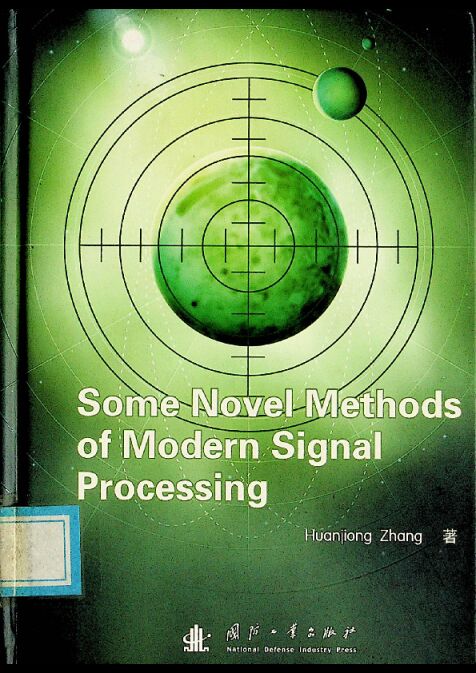
书名:Some novel methods of modern signal processing
前言
The modern signal processing includes a lot of different subjects, regarded as the further development of the traditional signal processing, not only in the width, but also in the depth. The modern signal processing is developing and expanding in all kinds of relative domains of IT, such as Electrical Engineering, Communicational Engineering, Automation Control, Computer Science, and it is also expanding to the subjects of Medicine, Literature and Economy. The researching range of modern signal processing is expanding more and more, which embodies more different signals to be studied and proceeded, besides the traditional stationary signal with linear processing, the new pattern signals with non-stationary, non-linear and non- Gaussian are dealt with. What the range of modern signal processing is expanding is also embodied that the concrete processing methods become more and more, and the level of signal processing expresses deeper than that of the traditional processing. The processing methods and technologies of modern signal processing are also expanding more and more, besides the traditional Fourier analysis, some new methods include short time Fourier Analysis, Fractional Fourier Transform, Wavelet Analysis, Radon-Wigner Transform Analysis, Gabor Analysis and the analysis based on Information Theory and Abstract Algebra Theory. Then with the methods of modern signal processing, the description of the signal properties can be received from more different aspects, and the optimum processing effect can be obtained. Especially, the signal is researched with the transformed domains, then more properties of researched signal can be got, because transformed domains offer different views and treating forms to treat signal. Furthermore, the ranges of application of modern signal processing is also developing more and more, new technologies in different domains usually come forth, and some intersect subjects and new subjects appear too. All above become the driving force to make the subject of modern signal processing develo Prapidly, also offer some new developing directions of this subject.
In this book of monograph, some novel methods in three concrete domains of modern signal processing are researched and analyzed, the concrete contents of them are the new methods of treating the signal with the constructed interferences, the new methods of analyzing signal based on Information Theory and the some novel methods of dealing with signal based on the theories of abstract algebra.
This book of monograph can be divided into five chapters Chapter 1 is a general outline. In this chapter, the basic conceptions and characters of modern signal processing are discussed, especially, the properties of non-linear, non-stationary, non-Gaussian and activity of this subject are illuminated. Chapter 2 treats signal united detective methods under the condition of the constructed interferences, based on analyzing the divergence of the signal properties under the different conditions between the synchronous receiving and the asynchronous receiving, then some novel detective methods are designed with the structural properties of the interference, the related interferences can be decreased or thoroughly cancelled, and the detective result is to tend the optimum solution. Besides some novel union detection methods treated, a kind of diversity method and a new △m are also included in this chapter. Chapter 3 is focused on modern signal processing with Information Theory. This chapter includes three kinds of different novel methods with different informational criteria, these criteria are the maximum entropy criterion, the minimum discriminating information criterion and the minimum error entropy criterion respectively. Though these novel methods are more complicated than that of the traditional signal processing, they need not to be corresponded with the energy analysis, the advantages of these methods are notable. Chapter 4 treats the novel signal processing methods with the theories of abstract algebra. The emphasis is on some novel methods which is used the properties of Group, Ring and Field. These novel methods are adapted to being used in the domains of signal classification, detection, discrimination, estimation, signal evaluation. Besides them, a new method based on the theories of the linear operator Semigroup is also discussed. The last chapter is about the brief conclusion and expectation. In here, the conclusion of all the book of monograph is made and some new developing directions of modern signal processing are predicted and sketched.
This book of monograph is a conclusion that I have researched in these domains for long time, I thank the persons who offer some excellent materials and wonderful description. I also thank my tutors, teachers and friends, who have been made useful discussion with me. At last, I thank to my family members, they understand my arduous researching and studying, their warm support and keeping watch are the most important consolation that let me overcome difficulties and go ahead, so I piously devote this book of monograph which is regarded as a beginning mature fruit to my family.
查看更多
目录
Chapter 1 Introduction 1
1.1 Summaries of modern signal processing 1
1.2 Characters analysis of the treating methods in modern signal processing 4
1.3 Characters and construction arrangements of this book of monograph 7
1.4 Summary of this chapter 10
Chapter 2 Some novel methods under the conditions of the structural interferences 11
2.1 Introduction 11
2.2 Analysis the influence of the receiving signals with structural interferences under the conditions between synchronous and asynchronous 24
2.2.1 The model of receiving signal 27
2.2.2 Analysis the structure of the baseband signal under the synchronous and asynchronous receiving conditions 29
2.2.3 Analysis of signal structure under the synchronous and asynchronous conditions of the carrier Phase 38
2.2.4 Analysis of the numerical simulation 43
2.2.5 Summary of this section 47
2.3 Analysis of the united detective methods base on the theory of the definite linear operator 47
2.3.1 System model 48
2.3.2 Related conclusions of the definite linear operator theory and the application in the united detection 50
2.3.3 The united detective method based on the theory of definite linear operator under the non-strict power control 52
2.3.4 Realization and correlated performances analysis 55
2.3.5 Two examples 59
2.3.6 Simulative analysis 65
2.3.7 the Summary in this section 68
2.4 The united detection based on solving the reverse of hermite matrix 68
2.4.1 The realization of the united detective method based on the theory of hermite matrix 69
2.4.2 Computing complexity analysis and simulation 72
2.4.3 The summary of this section 73
2.5 The novel decorrelating decision feedback united detective method 74
2.5.1 System model 74
2.5.2 Derivation of new decorrelating decision feedback method 76
2.5.3 Simulation analysis and case 78
2.5.4 The summary of this section 81
2.6 A novel united detective method under the asynchronous receiving condition 82
2.6.1 Introduction 82
2.6.2 Signal model 83
2.6.3 The derivation of this new united detective method 85
2.6.4 Properties analysis and simulation 88
2.6.5 The conclusion of this section 90
2.7 Blind united detective technologies 91
2.7.1 Introduction 91
2.7.2 The common model of the blind united detection 92
2.7.3 Some concrete blind united detective methods 93
2.7.4 The summary of this section 99
2.8 The diversity technology based on the fractional Fourier Transformation 101
2.8.1 Introduction 101
2.8.2 Some corresponding theoretical conclusions of fractional Fourier Transformation 102
2.8.3 The concrete analysis of the diversity realization based on the theory of FRFT 105
2.8.4 A cryptosystem scheme based on the theory of FRFT 107
2.8.5 The summary of this section 109
2.9 A modified method of delta modulation 109
2.9.1 Introduction 109
2.9.2 Delta modulation principle analysis 110
2.9.3 Derivation of the modified delta modulation method 112
2.9.4 Property analysis and an example 114
2.9.5 Conclusion of this section 115
2.10 Summary of this chapter 116
References 117
Chapter 3 Some novel methods of modern signal procssing based on Information Theories 125
3.1 Introduction 126
3.2 Some conclusions in theories of information 129
3.2.1 Some basic conceptions 129
3.2.2 Some related properties of Shannon entropy and discrimination entropy 140
3.2.3 Some important principles and criteria 147
3.3 Signal detective models based on the information extreme value criteria 151
3.3.1 Signal detective model based on the maximum entropy criterion 152
3.3.2 Signal detective model based on the minimum discrimination entropy criterion 155
3.3.3 Signal detective model based on the minimum error entropy criterion 158
3.4 Analysis of some concrete examples 162
3.4.1 Application in the domain of spectra estimation 163
3.4.2 Application in the field of blind source separation 166
3.4.3 Analysis of the example based on the criterion of the minimum error entropy 173
3.5 Conception of information matched filtering 174
3.6 Summary of this chapter 179
References 180
Chapter 4 Some new methods about signal analysis based on the theories of abstract algebra 182
4.1 Introduction 182
4.2 The basic ideas and models of the signal classification, detection and recognition 185
4.3 New methods of signal classification, detection and recognition based on group theory 188
4.3.1 The related conceptions and conclusions of group theory 188
4.3.2 The concrete application in the domain of signal classification, detection and pattern recognition 194
4.3.3 Analysis of a concrete example 200
4.4 Some novel methods of signal classification, signal detection and pattern recognition based on the theories of ring and field 203
4.4.1 The definition and related properties of ring 202
4.4.2 Some related properties of field structure 205
4.4.3 the concrete application in the domains of signal classification, detection and recognition 207
4.4.4 An example analysis based on field theory 208
4.5 The current methods of signal classification, detection and pattern recognition based on the common algebra theories 210
4.6 A novel methods based on the theory of linear operator semigroup 212
4.6.1 The related theory of linear operator semigroup 212
4.6.2 The concrete processing based on theories of linear operator semigroup 215
4.7 Summary of this chapter 219
References 220
Chapter 5 Conclusions and Prospects 222
5.1 The conclusions of the whole book monograph 222
5.2 The expectation of the future researching 227
References 229
Postscript 230
Brief Introduction about this Book of Monograph 232
查看更多
馆藏单位
中科院文献情报中心