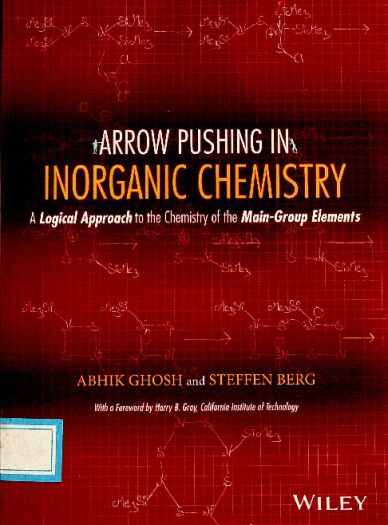
书名:Arrow pushing in inorganic chemistry
责任者:Abhik Ghosh | Steffen Berg.
ISBN\ISSN:9781118173985,1118173988
出版时间:2014
出版社:John Wiley & Sons, Ltd,
前言
Inorganic chemistry at core consists of a vast array of molecules and chemical reactions. To master the subject, students need to think intelligently about this body of facts, a feat that is seldom accomplished in an introductory course. All too often, young students perceive the field as an amorphous body of information that has to be memorized. We have long been intrigued by the possibility of changing this state of affairs by means of a mechanistic approach, specifically organic-style arrow pushing. We found that such an approach works well for all main-group elements, that is, elements from the s and p blocks of the periodic table. In particular, we found that arrow pushing works well for hypervalent compounds, where the central atom has more than eight electrons in its valence shell in the Lewis struc-ture. Over time, we came to appreciate that full implementation of a mechanistic approach had the potential to transform the teaching of a substantial part of the undergraduate inor-ganic curriculum. This book is a realization of that vision.
Arrow Pushing in Inorganic Chemistry is designed as a companion to a standard inor-ganic text. In general, we have devoted one chapter to each group of the main-group ele-ments. Each chapter in this book is designed to supplement the corresponding chapter in a regular inorganic text. A student using this book is expected to have taken general chemistry and a good, introductory course in organic chemistry at the university level. Key prerequi-sites include elementary structure and bonding theory, a good command of Lewis structures, VSEPR theory, elementary thermodynamics (as usually outlined in general chemistry), simple acid—base calculations, basic organic nomenclature, and a good but elementary understanding of organic mechanisms. Because a basic knowledge of organic chemistry has been assumed, the general level of this book is somewhat higher than that of an undergradu-ate organic text. The material included in this book (along with related content from a stan-dard inorganic text) has been regularly taught at the University of Tromso in about 30 h of class time, roughly half of which has been devoted to problem-solving by students. A small number of somewhat specialized topics and review problems have been marked with an asterisk, to indicate that they may be skipped on first reading. We usually take up a few of these at the end of our course and in conjunction with a second or more specialized course.
查看更多
目录
FOREWORD xi
PREFACE xiii
ACKNOWLEDGMENTS lag
1. A Collection of Basic Concepts 1
1.1 Nucleophiles and Electrophiles: The SN2 Paradigm 2
1.2 What Makes for a Good Nucleophile? 5
1.3 Hard and Soft Acids and Bases: The HSAB Principle 8
1.4 pKa Values: What Makes for a Good Leaving Group? 9
1.5 Redox Potentials 11
1.6 Thermodynamic Control: Bond Dissociation Energies (BDEs) 11
1.7 Bimolecular P-Elimination (E2) 14
1.8 Proton Transfers (PTs) 15
1.9 Elementary Associative and Dissociative Processes (A and D) 16
1.10 Two-Step Ionic Mechanisms: The SN2-Si Pathway 19
1.11 Two-Step Ionic Mechanisms: The SN1 and E 1 Pathways 20
1.12 Electrophilic Addition to Carbon—Carbon Multiple Bonds 22
1.13 Electrophilic Substitution on Aromatics: Addition—Elimination 23
1.14 Nucleophilic Addition to Carbon—Heteroatom Multiple Bonds 24
1.15 Carbanions and Related Synthetic Intermediates 26
1.16 Carbenes 29
1.17 Oxidative Additions and Reductive Eliminations 30
1.18 Migrations 32
1.19 Ligand Exchange Reactions 33
1.20 Radical Reactions 35
1.21 Pericyclic Reactions 37
1.22 Arrow Pushing: Organic Paradigms 38
1.23 Inorganic Arrow Pushing: Thinking Like a Lone Pair 38
1.24 Definitions: Valence, Oxidation State, Formal Charge, and Coordination Number 40
1.25 Elements of Bonding in Hypervalent Compounds 41
1.26 The λ Convention 45
1.27 The Inert Pair Effect 46
1.28 Summary 47
Further Reading 48
2.The s-Block Elements: Alkali and Alkaline Earth Metals 50
2.1 Solubility 51
2.2 The s-Block Metals as Reducing Agents 52
2.3 Reductive Couplings 53
2.4 Dissolving Metal Reactions 56
2.5 Organolithium and Organomagnesium Compounds 58
2.6 Dihydrogen Activation by Frustrated Lewis Pairs (FLPs) 61
2.7 A MgI-MgI Bond 63
2.8 Summary 64
Further Reading 65
3.Group 13 Elements 66
3.1 Group 13 Compounds as Lewis Acids 67
3.2 Hydroboration 70
3.3 Group 13-Based Reducing Agents 73
3.4 From Borazine to Gallium Arsenide: 13-15 Compounds 76
3.5 Low-Oxidation-State Compounds 80
3.6 The Boryl Anion 87
3.7 Indium-Mediated Allylations 88
3.8 Thallium Reagents 89
3.9 Summary 94
Further Reading 94
4.Group 14 Elements 96
4.1 Silyl Protecting Groups 98
4.2 A Case Study: Peterson Olefination 103
4.3 Silanes 104
4.4 The fl-Silicon Effect: Allylsilanes 106
4.5 Silyl Anions 109
4.6 Organostannanes 112
4.7 Polystannanes 113
4.8* Carbene and Alkene Analogs 115
4.9* Alkyne Analogs 120
4.10 Silyl Cations 122
4.11 Glycol Cleavage by Lead Tetraacetate 124
4.12 Summary 127
Further Reading 128
5A.Nitrogen 129
5A.1 Ammonia and Some Other Common Nitrogen Nucleophiles 130
5A.2 Some Common Nitrogen Electrophiles: Oxides, Oxoacids,and Oxoanions 131
5A.3 N-N Bonded Molecules: Synthesis of Hydrazine 133
5A.4 Multiple Bond Formation: Synthesis of Sodium Azide 135
5A.5 Thermal Decomposition of NH4NO2 and NH4NO3 137
5A.6 Diazonium Salts 138
5A.7 Azo Compounds and Diazene 140
5A.8* Imines and Related Functional Groups: The Wolff-Kishner
Reduction and the Shapiro Reaction 144
5A.9 Diazo Compounds 146
5A.10 Nitrenes and Nitrenoids: The Curtius Rearrangement 149
5A.11 Nitric Oxide and Nitrogen Dioxide 151
5A.12 Summary 155
Further Reading 155
5B.The Heavier Pnictogens 156
5B.1 Oxides 158
5B.2 Halides and Oxohalides 160
5B.3 Phosphorus in Biology: Why Nature Chose Phosphate 163
5B.4 Arsenic-Based DNA 166
5B.5 Arsenic Toxicity and Biomethylation 168
5B.6 Alkali-Induced Disproportionation of Phosphorus 171
5B.7 Disproportionation of Hypophosphorous Acid 173
5B.8 The Arbuzov Reaction 175
5B.9 The Wittig and Related Reactions: Phosphorus Ylides 176
5B.10 Phosphazenes 180
5B.11* The Corey-Winter Olefination 185
5B.12 Triphenylphosphine-Mediated Halogenations 187
5B.13* The Mitsunobu Reaction 188
5B.14* The Vilsmeier-Haack Reaction 191
5B.15 SbF5 and Superacids 193
5B.16 Bismuth in Organic Synthesis: Green Chemistry 195
5B.17 Summary 200
Further Reading 200
6.Group 16 Elements: The Chalcogens 202
6.1 The Divalent State: Focus on Sulfur 204
6.2 The Divalent State: Hydrogen Peroxide 205
6.3 S2C12 and SC12 209
6.4 Nucleophilic Breakdown of Cyclopolysulfur Rings 211
6.5 Cyclooctachalcogen Ring Formation 213
6.6 Higher-Valent States: Oxides and Oxoacids 215
6.7 Sulfur Oxochlorides 219
6.8 Ozone 222
6.9 Swern and Related Oxidations 226
6.10 Sulfur Ylides and Sulfur-Stabilized Carbanions 228
6.11 * Hydrolysis of S2F2: A Mechanistic Puzzle 231
6.12 Higher-Valent Sulfur Fluorides 234
6.13 Martin Sulfurane 236
6.14 Lawesson's Reagent 238
6.15 Sulfur Nitrides 240
6.16* Selenium-Mediated Oxidations 243
6.17 Higher-Valent Tellurium: A Mechanistic Puzzle 247
6.18 Summary 250
Further Reading 251
7.The Halogens 252
7.1 Some Notes on Elemental Halogens 254
7.2 Alkali-Induced Disproportionation of Molecular Halogens 258
7.3 Acid-Induced Comproportionation of Halate and Halide 260
7.4 Hypofluorous Acid, HOF 261
7.5 Electrophilic Fluorinating Agents: N-Fluoro Compounds 264
7.6 Oxoacids and Oxoanions 268
7.7 Heptavalent Chlorine 271
7.8 Interhalogen Compounds 275
7.9* Halogens in Organic Synthesis: Some Classical Reactions 276
7.10 An Introduction to Higher-Valent Organoiodine Compounds 283
7.11 23-lodanes 284
7.12 25-Iodanes: IBX and Dess-Martin Periodinane 288
7.13 Periodic Acid Oxidations 290
7.14 Bromine Trifluoride 291
7.15* Aryl-A3-Bromanes 294
7.16 Summary 298
Further Reading 299
8. The Noble Gases 300
8.1 The Xenon Fluorides: Fluoride Donors and Acceptors 302
8.2 0/F Ligand Exchanges 303
8.3 Xenon Fluorides as F+ Donors and Oxidants 304
8.4 Hydrolysis of XeF2 and XeF4 306
8.5 Xenate and Perxenate 307
8.6 Disproportionation of Xenate 308
8.7 Hydrolysis of XeF4 310
8.8 Other Compounds Containing Xe—O Bonds 311
8.9 Xe—N Bonds 312
8.10 Xe—C Bonds 313
8.11 Krypton Difluoride 314
8.12 Plus Ultra 316
8.13 Summary 316
Further Reading 316
Epilogue 318
Appendix A. Inorganic Chemistry Textbooks, with a Descriptive-Inorganic
Focus 319
A.1 Introductory Texts 319
A.2 Advanced Texts 319
Appendix B. A Short List of Advanced Organic Chemistry Textbooks 320
Index 321
查看更多
馆藏单位
中科院文献情报中心