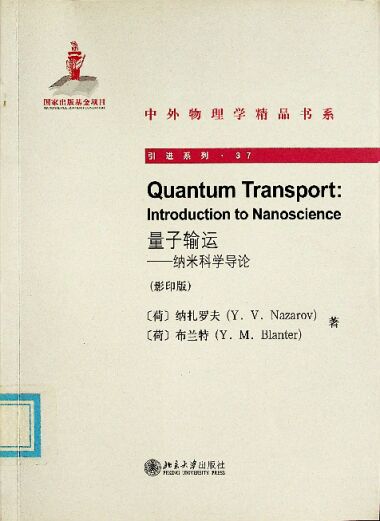
书名:Quantum transport
责任者:Y. V. Nazarov | Y. M. Blanter = 量子输运 : 纳米科学导论/纳扎罗夫 | 布兰特著. | Blanter, Yaroslav M.,
出版时间:2014
出版社:Peking University Press,
分类号:物理学
版次:[Reprinted ed.].
前言
This book provides an introduction to the rapidly developing field of quantum transport.Quantum transport is an essential and intellectually challenging part of nanoscience; itcomprises a major research and technological effort aimed at the control of matter anddevice fabrication at small spatial scales. The book is based on the master course that hasbeen given by the authors at Delft University of Technology since 2002. Most of the mat-erial is at master student level (comparable to the first years of graduate studies in theUSA). The book can be used as a textbook: it contains exercises and control questions.The program of the course, reading schemes, and education-related practical informationcan be found at our website www.hbar-transport.org.
We believe that the field is mature enough to have its concepts — the key principlesthat are equally important for theorists and for experimentalists — taught. We present at acomprehensive level a number of experiments that have laid the foundations of the field,skipping the details of the experimental techniques, however interesting and importantthey are. To draw an analogy with a modern course in electromagnetism, it will discussthe notions of electric and magnetic field rather than the techniques of coil winding andelectric isolation.
We also intended to make the book useful for Ph.D. students and researchers, includ-ing experts in the field. We can liken the vast and diverse field of quantum transport to amountain range with several high peaks, a number of smaller mountains in between, andmany hills filling the space around the mountains. There are currently many good reviews concentrating on one mountain, a group of hills, or the face of a peak. There are severalbooks giving a view of a couple of peaks visible from a particular point. With this book, weattempt to perform an overview of the whole mountain range. This comes at the expenseof detail: our book is not at a monograph level and omits some tough derivations. The levelof detail varies from topic to topic, mostly reflecting our tastes and experiences rather thanthe importance of the topic.
We provide a significant number of references to current research literature: more than acommon textbook does. We do not give a representative bibliography of the field. Nor dothe references given indicate scientific precedences, priorities, and relative importance ofthe contributions. The presence or absence of certain citations does not necessarily reflectour views on these precedences and their relative importance.
This book results from a collective effort of thousands of researchers and studentsinvolved in the field of quantum transport, and we are pleased to acknowledge them here.We are deeply and personally indebted to our Ph.D. supervisors and to distinguished seniorcolleagues who introduced us to quantum transport and guided and helped us, and tocomrades-in-research working in universities and research institutions all over the world.
This book would never have got underway without fruitful interactions with our students. Parts of the book were written during our extended stays at Weizmann Institute of Science, Argonne National Laboratory, Aspen Center of Physics, and Institute of Advanced Studies, Oslo.
It is inevitable that, despite our efforts, this book contains typos, errors, and less com-prehensive discourses. We would be happy to have your feedback, which can be submitted via the website www.hbar-transport.org. We hope that it will be possible thereby to provide some limited "technical" support.
查看更多
目录
Preface page vii
Introduction 1
1 Scattering 7
1.1 Wave properties of electrons 7
1.2 Quantum contacts 17
1.3 Scattering matrix and the Landauer formula 29
1.4 Counting electrons 41
1.5 Multi-terminal circuits 49
1.6 Quantum interference 63
1.7 Time-dependent transport 81
1.8 Andreev scattering 98
1.9 Spin-dependent scattering 114
2 Classical and semiclassical transport 124
2.1 Disorder, averaging, and Ohm's law 125
2.2 Electron transport in solids 130
2.3 Semiclassical coherent transport 137
2.4 Current conservation and Kirchhoff rules 155
2.5 Reservoirs, nodes, and connectors 165
2.6 Ohm's law for transmission distribution 175
2.7 Spin transport 187
2.8 Circuit theory of superconductivity 193
2.9 Full counting statistics 205
3 Coulomb blockade 211
3.1 Charge quantization and charging energy 212
3.2 Single-electron transfers 223
3.3 Single-electron transport and manipulation 237
3.4 Co-tunneling 248
3.5 Macroscopic quantum mechanics 264
3.6 Josephson arrays 278
3.7 Superconducting islands beyond the Josephson limit 287
4 Randomness and interference 299
4.1 Random matrices 299
4.2 Energy-level statistics 309
4.3 Statistics of transmission eigenvalues 324
4.4 Interference corrections 336
4.5 Strong localization 363
5 Qubits and quantum dots 374
5.1 Quantum computers 375
5.2 Quantum goodies 386
5.3 Quantum manipulation 397
5.4 Quantum dots 406
5.5 Charge qubits 427
5.6 Phase and flux qubits 436 [1]
5.7 Spin qubits 445
6 Interaction, relaxation, and decoherence 457
6.1 Quantization of electric excitations 458
6.2 Dissipative quantum mechanics 470
6.3 Tunneling in an electromagnetic environment 487
6.4 Electrons moving in an environment 499
6.5 Weak interaction 513
6.6 Fermionic environment 523
6.7 Relaxation and decoherence of qubits 538
6.8 Relaxation and dephasing of electrons 549
Appendix A Survival kit for advanced quantum mechanics 562
Appendix B Survival kit for superconductivity 566
Appendix C Unit conversion 569
References 570
Index 577
查看更多
馆藏单位
中科院文献情报中心