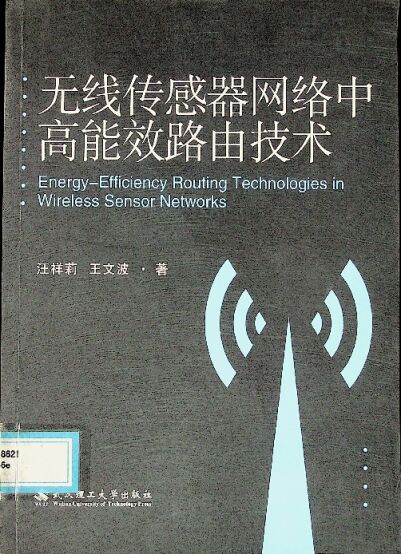
书名:Energy-efficiency routing technologies in wireless sensor networks
责任者:汪祥莉 | 王文波著. | Wang, Wenbo, | Wang, xiangli,
前言
Wireless sensor network is currently of concern in the international arena, involving ahigh degree of cross-multidisciplinary, cutting-edge knowledge and highly integrated hot areaof research. In the national defense, the environmental monitoring, the medical health andother fields, it has very broad application prospects. The resource of wireless sensor networkis very limited, such as its power, computing and communication capability, and storagespace. Therefore, it is very important to design energy-efficient routing algorithms so as toimprove the survival time of the node and the network performance.
This book mainly studied the routing technologies of wireless sensor network. Thewhole book is divided into six chapters, and the main innovative research results and the re-lated conclusions are as follows:
Chapter 1 introduces the foundation knowledge of wireless sensor networks, inclu-ding basic concepts, research contents, applications and performance evaluation index ofwireless sensor networks. ② Chapter 2 introduces the routing problems in wireless sensornetworks, including the design constraints for routing, the classification of routing proto-cols, analysis and comparison of typical routing protocols, energy consumption characteris-tics and model analysis of sensor node, and key technologies of building energy-efficient rou-ting. ③Chapter 3 proposes a clustering heterogeneous network routing algorithm based onmixed integer programming. This algorithm can solve the optimal deployment of heterogene-ous nodes and energy-efficient routing problem. ④ Chapter 4 puts forward the adaptive ag-gregation routing and data fusion algorithms in the wireless multimedia sensor networks.
⑤ Chapter 5 proposes three different optimal routing algorithms on the basis of dynamic pro-gramming method to satisfy different application demands: the lowest energy consumptionrouting algorithm, the energy balancing and lowest energy-consumption routing algorithm,and the least delay and low energy-consumption routing algorithm. These three algorithmshave the advantages of high efficiency, and can overcome the higher computational complexi-ty in traditional optimization routing algorithms. ⑥ Chapter 6 makes a summary to the re-search contents of the book, and points out the future improvement and the research work.
In the process of writing this book, teacher Wang Xiangli, working in the school of com-puter science and technology, Wuhan University of Technology, is responsible for the writ-ing of the chapters 1, 2, 3, 5, 6 and part of chapter 4; teacher Wang Wenbo, working in theschool of science, Wuhan University of Science and Technology, is responsible for the writ-ing of another part of chapter 4; teacher Xuyi, working in the school of computer science andtechnology, Wuhan University of Technology, participates in the programming debugging ofalgorithms.
This book is supported by the National Natural Science Foundation of China (No.61171075), the Fundamental Research Funds for the Central Universities (No. 2012-IV-043), the Open Fund of State Key Laboratory of Satellite Ocean Environment Dynamic(No.SOED1405), the Open Fund of Metallurgical Industry in Hubei Province Key Laboratory ofProcess Systems (No. Z201303), the Natural Science Fund of Hubei Province (No.2012FFB05006), the teaching research project of Wuhan University of Technology (No.2013009). In addition, at home and abroad, there are thousands of papers on routing algo-rithms for wireless sensor network every year. In this book, a large number of existing aca-demic papers have been consulted, and more than one hundred papers have been directly ci-ted. Here, express our heartfelt thanks to these authors of these papers!
Due to the limited knowledge and ability of the authors, there is still much room for im-provement in this book. We pled the readers to criticism correction.
查看更多
目录
Chapter 1 Introduction of Wireless Sensor Networks 1
1.1 Basic concepts of wireless sensor networks 1
1.2 Applications of WSNs 9
1.3 Research contents of WSNs 13
1.4 Performance evaluation index in WSN 15
References 17
Chapter 2 Routing Problems in Wireless Sensor Networks 20
2.1 Design constraints for routing in WSNs 20
2.2 Classification of routing protocols for WSNs 23
2.3 Analysis and comparison of typical routing protocols in WSNs 24
2.4 Energy consumption characteristics and model analysis of sensor node 33
2.5 Key technologies of building energy-efficient routing in WSNs 36
References 39
Chapter 3 Optimal Clustering Routing Algorithm for Wireless Sensor Networks with Small-world Property 42
3.1 Introduction of complex networks 42
3.2 Models of complex networks 43
3.3 Optimal clustering routing algorithm for wireless sensor networks with small-world property 48
References 68
Chapter 4 Adaptive Aggregation Routing and Data Fusion Algorithms in Wireless Sensor Networks 71
4.1 Introduction of aggregation routing 71
4.2 An adaptive aggregation routing algorithm in WSNs 74
4.3 An energy balance mobile agent routing algorithm based on ant colony optimization in WSNs 83
4.4 De-noising preprocessing before data fusion in WSNs 88
4.5 Data fusion algorithm of wireless multimedia sensor network based on nonsubsam- pled pyramid and bidimensional empirical decomposition 104
References 114
Chapter 5 Efficient Energy Routing Algorithm Based on Dynamic Programming in Wireless Sensor Networks 119
5.1 Basic concepts of dynamic programming method 120
5.2 Establishment of standard dynamic programming model for WSNs 124
5.3 LECR based on dynamic programming 125
5.4 EB-LECR based on dynamic programming 128
5.5 LD-LECR based on the dynamic programming 130
5.6 Simulation and analysis 133
5.7 Conclusion 136
References 136
Chapter 6 Summary and Outlook 138
6.1 Research work summary 138
6.2 The next research work 140
查看更多
馆藏单位
中科院文献情报中心