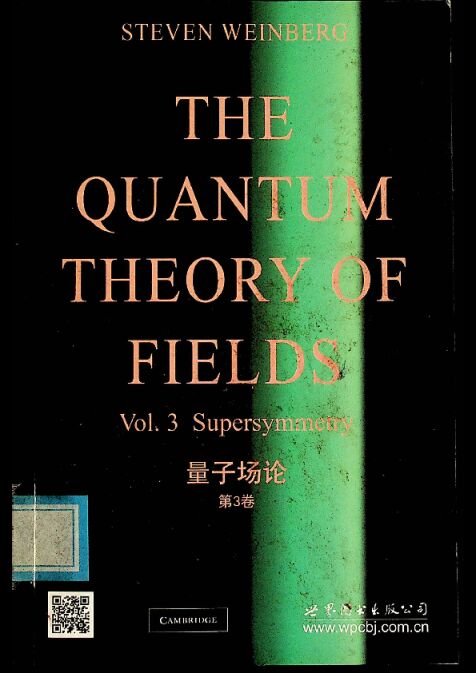
书名:The quantum theory of fields. Volume III, Supersymmetry = 第3卷
出版时间:2014
出版社:世界图书出版公司北京公司,
分类号:物理学
版次:[Reprinted ed.].
摘要
In this third volume of The Quantum Theory of Fields, available for the first time in paperback, Nobel Laureate Steven Weinberg continues his masterly exposition of quantum field theory. This volume presents a self-contained, up-to-date and comprehensive introduction to supersymmetry, a highly active area of theoretical physics. The text introduces and explains a broad range of topics, including supersymmetric algebras, supersymmetric field theories, extended supersymmetry, supergraphs, non-perturbative results, theories of supersymmetry in higher dimensions, and supergravity. A thorough review is given of the phenomenological implications of supersymmetry, including theories of both gauge and gravitationally-mediated supersymmetry breaking. Also provided is an introduction to mathematical techniques, based on holomorphy and duality, that have proved so fruitful in recent developments. This book contains much material not found in other books on supersymmetry, including previously unpublished results. Exercises are included.
查看更多
目录
Sections marked with an asterisk are somewhat out of the book's main line of development and may be omitted in a first reading.
PREFACE TO VOLUME III xvi
NOTATION xx
24 HISTORICAL INTRODUCTION 1
24.1 Unconventional Symmetries and 'No-Go' Theorems SU (6) symmetry Elementary no-go theorem for unconventional semi-simple compact Lie algebras Role of relativity 1
24.2 The Birth of Supersymmetry Bosonic string theory Fermionic coordinates Worldsheet supersymmetry Wess-Zumino model Precursors 4
Appendix A SU (6) Symmetry of Non-Relativistic Quark Models 8
Appendix B The Coleman-Mandula Theorem 12
Problems 22
References 22
25 SUPERSYMMETRY ALGEBRAS 25
25.1 Graded Lie Algebras and Graded Parameters Fermionic and bosonic generators Super-Jacobi identity Grassmann parameters Structure constants from supergroup multiplication rules Complex conjugates 25
25.2 Supersymmetry Algebras Haag-Lopuszanski-Sohnius theorem Lorentz transformation of fermionic generators Central charges Other bosonic symmetries R-symmetry Simple and extended supersymmetry Four-component notation Superconformal algebra 29
25.3 Space Inversion Properties of Supersymmetry Generators Parity phases in simple supersymmetry Fermions have imaginary parity Parity matrices in extended supersymmetry Dirac notation 40
25.4 Massless Particle Supermultiplets Known particles are massless for unbroken supersymmetry Helicity raising and lowering operators Simple supersymmetry doublets Squarks, sleptons, and gauginos Gravitino Extended supersymmetry multiplets Chirality problem for extended supersymmetry 43
25.5 Massive Particle Supermultiplets Raising and lowering operators for spin 3-component General massive multiplets for simple supersymmetry Collapsed supermultiplet Mass bounds in extended supersymmetry BPS states and short supermultiplets 48
Problems 53
References 55
26 SUPERSYMMETRIC FIELD THEORIES 55
26.1 Direct Construction of Field Supermultiplets Construction of simplest N=1 field multiplet Auxiliary field Infinitesimal supersymmetry transformation rules Four-component notation Wess-Zumino supermultiplets regained 55
26.2 General Superfields Superspace spinor coordinates Supersymmetry generators as superspace differential operators Supersymmetry transformations in superspace General superfields Multiplication rules Supersymmetric differential operators in superspace Supersymmetric actions for general superfields Parity of component fields Counting fermionic and bosonic components 59
26.3 Chiral and Linear Superfields Chirality conditions on a general superfield Left- and right-chiral superfields Coordinates xu± Differential constraints Product rules Supersymmetric F-terms F-terms equivalent to D-terms Superpotentials Kahler potentials Partial integration in superspace Space inversion of chiral superfields R-symmetry again Linear superfields 68
26.4 Renormalizable Theories of Chiral Superfields Counting powers Kinematic Lagrangian F-term of the superpotential Complete Lagrangian Elimination of auxiliary fields On-shell superalgebra Vacuum solutions Masses and couplings Wess-Zumino Lagrangian regained 75
26.5 Spontaneous Supersymmetry Breaking in the Tree Approximation O'Raifeartaigh mechanism R-symmetry constraints Flat directions Goldstino 83
26.6 Superspace Integrals, Field Equations, and the Current Superfield Berezin integration D-and F-terms as superspace integrals Potential superfields Superspace field equations Conserved currents as components of linear superfields Conservation conditions in superspace 86
26.7 The Supercurrent Supersymmetry current Superspace transformations generated by the supersymmetry current Local supersymmetry transformations Construction of the supercurrent Conservation of the supercurrent Energy-momentum ten-sor and R-current Scale invariance and R conservation Non-uniqueness of supercurrent 90
26.8 General Kahler Potentials' Non-renormalizable non-derivative actions D-term of Kahler potential Kahler metric Lagrangian density Non-linear σ-models from spontaneous internal symmetry breaking Kahler manifolds Complexified coset spaces 102
Appendix Majorana Spinors 107
Problems 111
References 112
27 SUPERSYMMETRIC GAUGE THEORIES 113
27.1 Gauge-Invariant Actions for Chiral Superfields Gauge transformation of chiral superfields Gauge superfield V Extended gauge invariance Wess-Zumino gauge Supersymmetric gauge-invariant kinematic terms for chiral superfields 113
27.2 Gauge-Invariant Action for Abelian Gauge Superfelds Field strength supermultiplet Kinematic Lagrangian density for Abelian gauge supermultiplet Fayet-Iliopoulos terms Abelian field-strength spinor superfield Wz Left- and right-chiral parts of Wz WZ as a superspace derivative of V Gauge invariance of Wz 'Bianchi' identities in superspace 122
27.3 Gauge-Invariant Action for General Gauge Superfields Kinematic Lagrangian density for non-Abelian gauge supermultiplet Non-Abelian field-strength spinor superfield WAz Left- and right-chiral parts of WAz -term Complex coupling parameter τ 127
27.4 Renormalizable Gauge Theories with Chiral Superfields Supersymmetric Lagrangian density Elimination of auxiliary fields Conditions for unbroken supersymmetry Counting independent conditions and field variables Unitarity gauge Masses for spins 0, 1/2, and 1 Supersymmetry current Non-Abelian gauge theories with general Kahler potentials Gaugino mass 132
27.5 Supersymmetry Breaking in the Tree Approximation Resumed Supersymmetry breaking in supersymmetric quantum electrodynamics General case∶masses for spins 0, 1/2, and 1 Mass sum rule Goldstino component of gaugino and chiral fermion fields 144
27.6 Perturbative Non-Renormalization Theorems Non-renormalization of Wilsonian superpotential One-loop renormalization of terms quadratic in gauge superfields Proof using holomorphy and new symmetries with external superfields Non-renormalization of Fayet-Iliopoulos constants ξA For ξA=0, supersymmetry breaking depends only on super-potential Non-renormalizable theories 148
27.7 Soft Supersymmetry Breaking' Limitation on supersymmetry-breaking radiative corrections Quadratic divergences in tadpole graphs 155
27.8 Another Approach: Gauge-Invariant Supersymmetry Transformations De Wit-Freedman transformation rules Preserving Wess-Zumino gauge with combined supersymmetry and extended gauge transformations 157
27.9 Gauge Theories with Extended Supersymmetry' N=2 supersymmetry from N=1 supersymmetry and R-symmetry Lagrangian for N=2 supersymmetric gauge theory Eliminating auxiliary fields Supersymmetry currents Witten-Olive calculation of central charge Non-renormalization of masses BPS monopoles Adding hypermultiplets N=4 supersymmetry Calculation of beta function N=4 theory is finite Montonen-Olive duality 160
Problems 175
References 176
28 SUPERSYMMETRIC VERSIONS OF THE STANDARD MODEL 179
28.1 Superfields, Anomalies, and Conservation Laws Quark, lepton, and gauge superfields At least two scalar doublet superfields F-term Yukawa couplings Constraints from anomalies Unsuppressed violation of baryon and lepton numbers R-symmetry R parity u-term Hierarchy problem Sparticle masses Cosmological constraints on lightest superparticle 180
28.2 Supersymmetry and Strong-Electroweak Unification Renormalization group equations for running gauge couplings Effect of supersymmetry on beta functions Calculation of weak mixing angle and unification mass Just two scalar doublet superfields Coupling at unification scale 188
28.3 Where is Supersymmetry Broken? Tree approximation supersymmetry breakdown ruled out Hierarchy from non-perturbative effects of asymptotically free gauge couplings Gauge and gravitational mediation of supersymmetry breaking Estimates of supersymmetry- breaking scale Gravitino mass Cosmological constraints 192
28.4 The Minimal Supersymmetric Standard Model Supersymmetry breaking by superrenormalizable terms General Lagrangian Flavor changing processes Calculation of K0←→-K0 Degenerate squarks and sleptons CP violation Calculation of quark chromoelectric dipole moment 'Naive dimensional analysis' Neutron electric dipole moment Constraints on masses and/or phases 198
28.5 The Sector of Zero Baryon and Lepton Number D-term contribution to scalar potential u-term contribution to scalar potential Soft supersymmetry breaking terms Vacuum stability constraint on parameters Finding a minimum of potential Bu≠0 Masses of CP-odd neutral scalars Masses of CP-even neutral scalars Masses of charged scalars Bounds on masses Radiative corrections Conditions for electroweak symmetry breaking Charginos and neutralinos Lower bound on |u| 209
28.6 Gauge Mediation of Supersymmetry Breaking Messenger superfields Supersymmetry breaking in gauge supermultiplet propagators Gaugino masses Squark and slepton masses Derivation from holomorphy Radiative corrections Numerical examples Higgs scalar masses u problem Aij and Cij parameters Gravitino as lightest sparticle Next-to-lightest sparticle 220
28.7 Baryon and Lepton Non-Conservation Dimensionality five interactions Gaugino exchange Gluino exchange suppressed Wino and bino exchange effects Estimate of proton lifetime Favored modes of proton decay 235
Problems 240
References 241
29 BEYOND PERTURBATION THEORY 248
29.1 General Aspects of Supersymmetry Breaking Finite volume Vacuum energy and supersymmetry breaking Partially broken extended supersymmetry? Pairing of bosonic and fermionic states Pairing of vacuum and one-goldstino state Witten index Supersymmetry unbroken in the Wess-Zumino model Models with unbroken supersymmetry and zero Witten index Large field values Weighted Witten indices 248
29.2 Supersymmetry Current Sum Rules Sum rule for vacuum energy density One-goldstino contribution The supersymmetry-breaking parameter F Soft goldstino amplitudes Sum rule for supersymmetry current-fermion spectral functions One-goldstino contribution Vacuum energy density in terms of F and D vacuum values Vacuum energy sum rule for infinite volume 256
29.3 Non-Perturbative Corrections to the Superpotential Non-perturbative effects break external field translation and R-conservation Remaining symmetry Example: generalized supersymmetric quantum chromodynamics Structure of induced superpotential for C1>C2 Stabilizing the vacuum with a bare superpotential Vacuum moduli in generalized supersymmetric quantum chromodynamics for Nc>Nf Induced superpotential is linear in bare superpotential parameters for C1=C2 One-loop renormalization of[Wz Wz]F term for all C1, C2 266
29.4 Supersymmetry Breaking in Gauge Theories Witten index vanishes in supersymmetric quantum electrodynamics C-weighted Witten index Supersymmetry unbroken in supersymmetric quantum electrodynamics Counting zero-energy gauge field states in supersymmetric quantum electrodynamics Calculating Witten index for general supersymmetric pure gauge theories Counting zero-energy gauge field states for general supersymmetric pure gauge theories Weyl invariance Supersymmetry unbroken in general supersymmetric pure gauge theories Witten index and R anomalies Adding chiral scalars Model with spontaneously broken supersymmetry 276
29.5 The Seiberg-Witten Solution' Underlying N=2 supersymmetric Lagrangian Vacuum modulus Leading non-renormalizable terms in the effective Lagrangian Effective Lagrangian for component fields Kahler potential and gauge coupling from a function h(Φ) SU(2) R-symmetry Prepotential Duality transformation h(Φ) translation Z8 R-symmetry SL(2, Z)-symmetry Central charge Charge and magnetic monopole moments Perturbative behavior for large |a| Monodromy at infinity Singularities from dyons Monodromy at singularities Seiberg-Witten solution Uniqueness proof 287
Problems 305
References 305
30 SUPERGRAPHS 307
30.1 Potential Superfields Problem of chiral constraints Corresponding problem in quantum electrodynamics Path integrals over potential superfields 308
30.2 Superpropagators A troublesome invariance Change of variables Defining property of super-propagator Analogy with quantum electrodynamics Propagator for potential superfields Propagator for chiral superfields 310
30.3 Calculations with Supergraphs Superspace quantum effective action Locality in fermionic coordinates D- terms and F-terms in effective action Counting superspace derivatives No renormalization of F-terms 313
Problems 316
References 316
31 SUPERGRAVITY 318
31.1 The Metric Superfield Vierbein formalism Transformation of gravitational field Transformation of gravitino field Generalized transformation of metric superfield Hu Interaction of Hu with supercurrent Invariance of interaction Generalized transformation of Hu components Auxiliary fields Counting components Interaction of Hu component fields Normalization of action 319
31.2 The Gravitational Action Einstein superfield Eu Component fields of Eu Lagrangian for Hu Value of K Total Lagrangian Vacuum energy density Minimum vacuum energy De Sitter and anti-de Sitter spaces Why vacuum energy is negative Stability of flat space Weyl transformation 326
31.3 The Gravitino Irreducibility conditions on gravitino field Gravitino propagator Gravitino kinematic Lagrangian Gravitino field equation Gravitino mass from broken supersymmetry Gravitino mass from s and p 333
31.4 Anomaly-Mediated Supersymmetry Breaking First-order interaction with scale non-invariance superfield X General formula for X General first-order interaction Gaugino masses Gluino mass B parameter Wino and bino masses A parameters 337
31.5 Local Supersymmetry Transformations Wess-Zumino gauge for metric superfield Local supersymmetry transformations Invariance of action 341
31.6 Supergravity to All Orders Local supersymmetry transformation of vierbein, gravitino, and auxiliary fields Extended spin connection Local supersymmetry transformation of general scalar supermultiplet Product rules for general superfields Real matter superfields Chiral matter superfields Product rules for chiral superfields Cosmological constant and gravitino mass Lagrangian for supergravity and chiral fields with general Kahler potential and superpotential Elimination of auxiliary fields Kahler metric Weyl transformation Scalar field potentia Conditions for fiat space and unbroken supersymmetry Complete bosonic Lagrangian Canonical normalization Combining superpotential and Kahler potential No-scale models 343
31.7 Gravity-Mediated Supersymmetry Breaking Early theories with hidden sectors Hidden sector gauge coupling strong at energy First version: Observable and hidden sectors Separable bare superpotential General potential Terms of order K4Λ8≈m4g Λ estimated as ≈ 1011 GeV u- and Bu-terms Squark and slepton masses Gaugino masses A-parameters Second version: Observable, hidden, and modular sectors Dynamically induced superpotential for modular superfields Effective superpotential of observable sector u-term Potential of observable sector scalars Terms of order K8Λ12≈m4g Soft supersymmetry-breaking terms Λ estimated as ≈ 1013 GeV Shifts in modular fields Absence of Cij terms Squark and slepton masses Gaugino masses 355
Appendix The Vierbein Formalism 375
Problems 378
References 379
32 SUPERSYMMETRY ALGEBRAS IN HIGHER DIMENSIONS 382
32.1 General Supersymmetry Aigebras Classification of fermionic generators Definition of weight Fermionic generators in fundamental spinor representation Fermionic generators commute with Pu General form of anticommutation relations Central charges Anti-commutation relations for odd dimensionality Anticommutation relations for even dimensionality R-symmetry groups 382
32.2 Massless Multiplets Little group O(d-2) Definition of 'spin' j Exclusion of j>2 Missing fermionic generators Number of fermionic generators≤32 N=1 supersymmetry for d=11 Three-form massless particle Types 11A、11B and hetenotic supersymmetry for d=10 393
32.3 p-Branes New conserved tensors Fermionic generators still in fundamontial spinor representation Fermionic generators still commute with Pu Symmetry conditions on tensor central charges 2-form and 5-form central charges for d=11 397
Appendix Spinors in Higher Dimensions 401
Problems 407
References 407
AUTHOR INDEX 411
SUBJECT INDEX 416
查看更多
馆藏单位
中科院文献情报中心