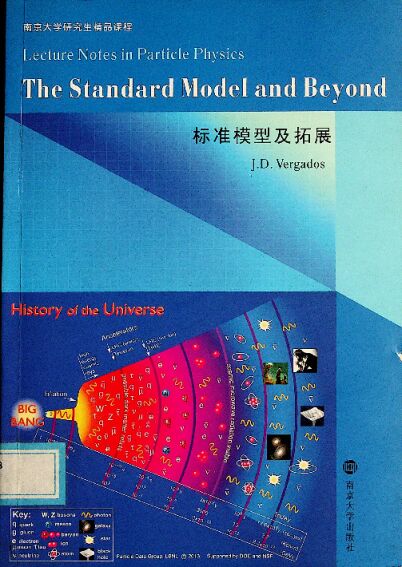
书名:Lecture notes in particle physics
责任者:J.D.Vergados. | Vergados, J. D.
前言
This book contains the material of a set of Lectures on The Standard Model and Beyond,which were delivered to the first year graduate students of the Department of Physics of Nanjing University, during the Fall of 2012.
查看更多
目录
0.1 PREFACE i
1 Introduction to Particle Physics 1
1.1 The natural System of Units 1
1.2 The Planck Natural system of units 4
1.3 Invariants in kinematics 5
1.4 Cross sections and Luminosities 7
1.4.1 Luminosity for fixed target experiments 7
1.4.2 Lmninosity for colliding beam experiments 8
1.5 Kinematics of particle decay 10
1.6 Invariants in the scattering of two particles 11
1.7 Transformation properties of non invariant quantities 14
2 Elements of Group Theory 17
2.1 Definitions 17
2.2 Matrix groups 18
2.2.1 The exponential of a matrix 20
2.2.2 Determination of the independent parameters 23
2.3 The structure constants 26
2.4 Representations 27
2.4.1 The fundamental representation 27
2.4.2 The adjoined representation 30
2.5 Homomorphism-isomorphism 32
2.6 Some further examples 33
2.7 The proper orthogonal groups O(3) and O(4) 35
2.8 Symmetries and conservation laws-Noether's theorem 39
3 The Dirac Theory 45
3.1 Preliminaries-The Klein Gordon equation 45
3.2 The Dirac equation 47
3.2.1 The spinors u and v 49
3.2.2 Projection operators 52
3.2.3 Various representations of the Dirac Matrices 52
3.3 Interpretation of negative energy solutions 53
3.4 The notion of helicity 54
3.5 Charge conjugation for 4-spinors 57
3.6 Types of currents 58
4 The standard Model-Symmetry and particle content 61
4.1 The essential ingredients 61
4.2 The notion of a local symmetry 61
4.3 Non Abelian gauge transformation 63
4.3.1 Transformations associated with a non Abelian group 64
4.3.2 Some Examples 65
4.4 Gauge invariant Lagrangians 67
4.4.1 Only gauge fields 67
4.4.2 Lagrangian in the presence of scalar fields 69
4.4.3 Lagrangian in the presence of fermion fields 70
4.5 The particle content of the SM 70
4.6 The electroweak Lagrangian 71
5 The Higgs Mechanism 73
5.1 The Higgs Mechanism in global gauge transformations 73
5.2 The Higgs Mechanism in gauge theories 79
5.3 Fundamental theorem of Higgs Mechanism 87
6 The Group SU(3)-Quantum Chromodynamics 89
6.1 Quantum chromodynamics QCD 89
6.2 The one gluon exchange potential 92
6.2.1 Process involving only baryons 92
6.2.2 processes involving the creation of a qq pair 93
6.2.3 processes involving interaction of mesons 93
6.3 Low energy formalism 94
6.3.1 The orbital part at the quark level 95
6.3.2 The kinetic energy part 95
6.3.3 The confining potential 95
6.3.4 Fitting the strength of the confining potential 96
6.4 Matrix elements involving two quarks 97
6.4.1 The confining potential 97
6.4.2 The one gluon exchange potential 97
7 Fermion Masses and Currents 99
7.1 Fermion masses 99
7.2 The currents 103
7.2.1 The EM current 105
7.2.2 The charged currents 105
7.2.3 The neutral currents 106
7.3 The contact interaction 108
7.4 Determination of the Standard Model Parameters 109
7.5 Summary 110
8 Rates and Cross Sections in Electroweak Theory 111
8.1 Brief review and formulae 111
8.2 Decay widths and cross section 112
8.2.1 The decay of a vectcr boson 113
8.3 Muon-antimuon production in electron- positron colliders 117
8.4 neutrino electron scatterir 120
9 Supersymmetry for Pedestrians 125
9.1 Introduction 125
9.2 The particle content of MSSM 126
9.2.1 gauge particles 126
9.2.2 Fermions and s-fermions 127
9.2.3 The Higgs content 127
9.3 The Higgs mechanism 127
9.4 The Fermion masses 130
9.5 Supersymmetry breaking 132
9.6 Some remarks about the particle spectrum 132
10 SU(5)-An Example of Grand Unification 137
10.1 Mathematical Introduction 137
10.2 The structure of the GUT SU(5) 137
10.3 The particle content 139
10.3.1 The Fermions 139
10.3.2 The gauge bosons 140
10.3.3 The Higgs content 141
10.4 The Higgs Mechanism 141
10.5 The gauge boson masses 144
10.6 Gauge couplings 144
10.7 Baryon Asymmetry 146
11 A Brief Introduction to Cosmology 151
11.1 Cosmological Principles 151
11.2 The eXpanding Universe-Tie big bang scenario 151
11.2.1 The receding of galaxies 152
11.2.2 The background microwave radiation 155
11.2.3 The abundance of primordial 4/2 He and other light elements in the Universe 156
11.3 Evolution of the Universe 157
11.4 The Cosmological Constant - Dark Energy 161
11.5 The standard cosmological model 164
11.6 The proper length and the horizon 165
11.6.1 The proper length entering the prototype candles 166
11.6.2 The horizon 167
11.7 temperature 168
11.7.1 The relic neutrinos 170
11.8 The role of dark matter 174
11.8.1 The rotational velocities 174
11.8.2 Gravitational lensing 178
11.8.3 The observation of bullet cluster 178
11.9 Dark energy 181
11.9.1 Observations with standard candles 182
11.9.2 The microwave background radiation -The earliest picture of the Universe 184
11.10 The WMAP and PLANCK Observations 188
12 Neutrino oscillations 193
12.1 Introduction 193
12.2 The formalism 194
12.3 Neutrino oscillation experiments 196
12.4 The absolute scale of the neutrino mass 203
12.5 Neutrinos as probes 209
13 C.P.T and all that 211
13.1 Space inversion P 211
13.1.1 Parity conservation-parity violation 214
13.2 The helicity of the neutrinos 217
13.2.1 The determination of the helicity of neutrinos 219
13.2.2 Weak interaction and handedness 221
13.3 Charge Conjugation 221
13.3.1 Charge conjugation for 4-spinors 223
13.3.2 Transformation of currents 224
13.3.3 Symmetry relation of the Dirac mass term 224
13.3.4 Symmetry relation of the Majorana mass term 225
13.3.5 The charge conjugation of composite systems 225
13.3.6 How good a symmetry is the charge conjugation? 226
13.4 Time reversal 227
13.4.1 Time reversal in classical mechanics 227
13.4.2 Time reversal in quantum mechanics 229
13.4.3 Premature evidence for T violation 231
13.5 CP the combined action of P and C symmetries 231
13.5.1 The neutral Kaon system 233
13.5.2 Strangeness oscillations 236
13.5.3 Kaon regeneration 236
13.5.4 CP Violation 239
13.5.5 Evidence for T-violation 243
13.6 The combined symmetry CPT 244
查看更多
馆藏单位
中科院文献情报中心