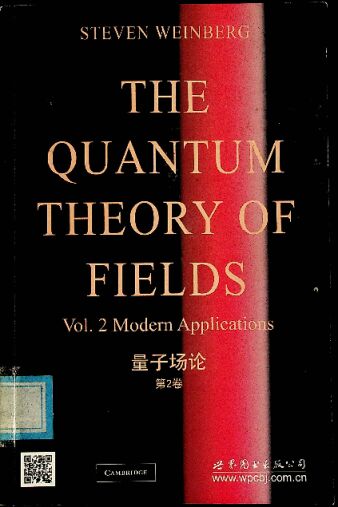
书名:The quantum theory of fields. Volume II, Modern applications = 第2卷
出版时间:2014
出版社:世界图书出版公司北京公司,
分类号:物理学
版次:[Reprinted ed.].
前言
This volume describes the advances in the quantum theory of fields that have led to an understanding of the electroweak and strong interactions of the elementary particles. These interactions have all turned out to be governed by principles of gauge invariance, so we start here in Chapters 15-17 with gauge theories, generalizing the familiar gauge invariance of electrodynamics to non-Abelian Lie groups.
Some of the most dramatic aspects of gauge theories appear at high energy, and are best studied by the methods of the renormalization group. These methods are introduced in Chapter 18, and applied to quantum chromodynamics, the modern non-Abelian gauge theory of strong in-teractions, and also to critical phenomena in condensed matter physics. Chapter 19 deals with general spontaneously broken global symmetries, and their application to the broken approximate SU(2)×SU(2) and S U(3)×S U(3) symmetries of quantum chromodynamics.Both the renor-malization group method and broken symmetries find some of their most interesting applications in the context of operator product expansions, discussed in Chapter 20.
The key to the understanding of the electroweak interactions is the spontaneous breaking of gauge symmetries, which are explored in Chap-ter 21 and applied to superconductivity as well as to the electroweak interactions.Quite apart from spontaneous symmetry breaking is the possibility of symmetry breaking by quantum-mechanical effects known as anomalies. Anomalies and various of their physical implications are presented in Chapter 22. This volume concludes with a discussion in Chapter 23 of extended field configurations, which can arise either as new ingredients in physical states, such as skyrmions, monopoles, or vortex lines, or as non-perturbative quantum corrections to path integrals, where anomalies play a crucial role.
It would not be possible to provide a coherent account of these de-velopments if they were presented in a historical order. I have chosen instead to describe the material of this book in an order that seems to me to work best pedagogically introduce each topic at a point where the motivation as well as the mathematics can be understood with the least possible reference to material in subsequent chapters, even where logic might suggest a somewhat different order. For instance, instead of having one long chapter to introduce non-Abelian gauge theories, this materiaIis split between Chapters 15 and 17, because Chapter 15 provides a motivation for the external field formalism introduced in Chapter 16, and this formalism is necessary for the work of Chapter 17.
In the course of this presentation, the reader will be introduced to various formal devices, including BRST invariance, the quantum effec-tive action, and homotopy theory. The Batalin—Vilkovisky formalism is presented as an optional side track. It is introduced in Chapter 15 as a compact way of formulating gauge theories, whether based on open or closed symmetry algebras, and then used in Chapter 17 to study the cancellation of infinities in 'non-renormalizable' gauge theories, including general relativity, and in Chapter 22 to show that certain gauge theo-ries are anomaly-free to all orders of perturbation theory. The effective field theory approach is extensively used in this volume, especially in applications to theories with broken symmetry, including the theory of superconductivity. I have struggled throughout for the greatest possible clarity of presentation, taking time to show detailed calculations where I thought it might help the reader, and dropping topics that could not be clearly explained in the space available.
The guiding aim of both Volumes I and II of this book is to explain to the reader why quantum field theory takes the form it does, and why in this form it does such a good job of describing the real world. Volume I outlined the foundations of the quantum theory of fields, emphasizing the reasons why nature is described at accessible energies by effective quantum field theories, and in particular by gauge theories. (A list of chapters of Volume I is given at the end of the table of contents of this volume.) The present volume takes quantum field theory and gauge invariance as its starting points, and concentrates on their implications.
This volume should be accessible to readers who have some familiarity with the fundamentals of quantum field theory. It is not assumed that the reader is familiar with Volume I (though it wouldn't hurt). Aspects of group theory and topology are explained where they are introduced.
Some of the formal methods described in this volume (such as BRST invariance and the renormalization group) have important applications in speculative theories that involve supersymmetry or superstrings. I am enthusiastic about the future prospects of these theories, but I have not included them in this book, because it seems to me that they require a whole book to themselves. (Perhaps supersymmetry and supergravity will be the subjects of a Volume III.)
查看更多
目录
PREFACE TO VOLUME II xvii
NOTATION xx
15 NON-ABELIAN GAUGE THEORIES1
15.1 Gauge Invariance Gauge transformations ❑ Structure constants ❑ Jacobi identity ❑ Adjoint repre-sentation ❑ Yang—Mills theory ❑ Covariant derivatives ❑ Field strength tensor ❑ Finite gauge transformations ❑ Analogy with general relativity 2
15.2 Gauge Theory Lagrangians and Simple Lie Groups Gauge field Lagrangian ❑ Metric ❑ Antisymmetric structure constants ❑ Simple, semisimple, and U(1) Lie algebras ❑ Structure of gauge algebra ❑ Compact algebras ❑ Coupling constants 7
15.3 Field Equations and Conservation Laws Conserved currents ❑ Covariantly conserved currents ❑ Inhomogeneous field equations ❑ Homogeneous field equations ❑ Analogy with energy-momentum tensor ❑ Symmetry generators 12
15.4 Quantization Primary and secondary first-class constraints ❑ Axial gauge ❑ Gribov ambiguity ❑ Canonical variables ❑ Hamiltonian ❑ Reintroduction of Aοα ❑ Covariant action ❑ Gauge invariance of the measure 14
15.5 The De Witt—Faddeev—Popov Method Generalization of axial gauge results ❑ Independence of gauge fixing functionals ❑ Generalized Feynman gauge ❑ Form of vertices
15.6 Ghosts Determinant as path integral ❑ Ghost and antighost fields ❑ Feynman rules for ghosts ❑ Modified action ❑ Power counting and renormalizability 19
15.7 BRST Symmetry Auxiliary field k ❑ BRST transformation ❑ Nilpotence ❑ Invariance of new action ❑ BRST-cohomology ❑ Independence of gauge fixing ❑ Application to electrodynamics ❑ BRST-quantization ❑ Geometric interpretation 27
15.8 Generalizations of BRST Symmetry' De Witt notation ❑ General Faddeev—Popov—De Witt theorem ❑ BRST transfor-mations ❑ New action ❑ Slavnov operator ❑ Field-dependent structure constants ❑ Generalized Jacobi identity ❑ Invariance of new action ❑ Independence of gauge fixing ❑ Beyond quadratic ghost actions ❑ BRST quantization ❑ BRST cohomology ❑ Anti-BRST symmetry 3615.9 The Batalin—Vilkovisky Formalism' Open gauge algebras ❑ Antifields ❑ Master equation ❑ Minimal fields and trivial pairs ❑ BRST-transformations with antifields ❑ Antibrackets ❑ Anticanonical transformations ❑ Gauge fixing ❑ Quantum master equation 42
Appendix A A Theorem Regarding Lie Algebras 50Appendix B The Cartan Catalog 54
Problems 58
References 59
16 EXTERNAL FIELD METHODS 63
16.1 The Quantum Effective Action Currents ❑ Generating functional for all graphs ❑ Generating functional for connected graphs ❑ Legendre transformation ❑ Generating functional for one-particle-irreducible graphs ❑ Quantum-corrected field equations ❑ Summing tree graphs 63
16.2 Calculation of the Effective Potential Effective potential for constant fields ❑ One loop calculation ❑ Divergences ❑ Renormalization ❑ Fermion loops 68
16.3 Energy Interpretation Adiabatic perturbation ❑ Effective potential as minimum energy ❑ Convexity ❑ Instability between local minima ❑ Linear interpolation 72
16.4 Symmetries of the Effective Action Symmetry and renormalization ❑ Slavnov—Taylor identities ❑ Linearly realized symmetries ❑ Fermionic fields and currents 75
Problems 78
References 78
17 RENORMALIZATION OF GAUGE THEORIES 80
17.1 The Zinn-Justin Equation Slavnov—Taylor identities for BRST symmetry ❑ External fields Kn(x) ❑ An-tibrackets 80
17.2 Renormalization: Direct Analysis Recursive argument ❑ BRST-symmetry condition on infinities ❑ Linearity in K„(x) ❑ New BRST symmetry ❑ Cancellation of infinities ❑ Renormalization constants ❑ Nonlinear gauge conditions 82
17.3 Renormalization: General Gauge Theories' Are ‘non-renormalizable' gauge theories renormalizable? ❑ Structural constraints ❑ Anticanonical change of variables ❑ Recursive argument ❑ Cohomology theorems 91
17.4 Background Field Gauge New gauge fixing functions ❑ True and formal gauge invariance ❑ Renormaliza-tion constants 95
17.5 A One-Loop Calculation in Background Field Gauge One-loop effective action ❑ Determinants ❑ Algebraic calculation for constant background fields ❑ Renormalization of gauge fields and couplings ❑ Interpre-tation of infinities 100
Problems 109
References 110
18 RENORMALIZATION GROUP METHODS 111
18.1 Where do the Large Logarithms Come From? Singularities at zero mass ❑ 'Infrared safe' amplitudes and rates ❑ Jets ❑ Zero mass singularities from renormalization ❑ Renormalized operators 112
18.2 The Sliding Scale Gell-Mann—Low renormalization ❑ Renormalization group equation ❑ One-loop calculations ❑ Application to φ4 theory ❑ Field renormalization factors ❑ Application to quantum electrodynamics ❑ Effective fine structure constant ❑ Field-dependent renormalized couplings ❑ Vacuum instability 119
18.3 Varieties of Asymptotic Behavior Singularities at finite energy ❑ Continued growth ❑ Fixed point at finite coupling ❑ Asymptotic freedom ❑ Lattice quantization ❑ Triviality ❑ Universal coefficients in the beta function 130
18.4 Multiple Couplings and Mass Effects Behavior near a fixed point ❑ Invariant eigenvalues ❑ Nonrenormalizable theories ❑ Finite dimensional critical surfaces ❑ Mass renormalization at zero mass ❑ Renormalization group equations for masses 139
18.5 Critical Phenomena' Low wave numbers ❑ Relevant, irrelevant, and marginal couplings ❑ Phase transitions and critical surfaces ❑ Critical temperature ❑ Behavior of correlation length ❑ Critical exponent ❑ 4 — E dimensions ❑ Wilson—Fisher fixed point ❑ Comparison with experiment ❑ Universality classes 145
18.6 Minimal Subtraction 148 Definition of renormalized coupling ❑ Calculation of beta function ❑ Applica-tion to electrodynamics ❑ Modified minimal subtraction ❑ Non-renormalizable interactions
18.7 Quantum Chromodynamics Quark colors and flavors ❑ Calculation of beta function ❑ Asymptotic freedom ❑ Quark and gluon trapping ❑ Jets ❑ e+—e— annihilation into hadrons ❑ Accidental symmetries ❑ Non-renormalizable corrections ❑ Behavior of gauge coupling ❑ Experimental results for g5 and A 152
18.8 Improved Perturbation Theory' Leading logarithms ❑ Coefficients of logarithms 157
Problems 158
References 159
19 SPONTANEOUSLY BROKEN GLOBAL SYMMETRIES 163
19.1 Degenerate Vacua Degenerate minima of effective potential ❑ Broken symmetry or symmetric super-positions? ❑ Large systems ❑ Factorization at large distances ❑ Diagonalization of vacuum expectation values ❑ Cluster decomposition 163
19.2 Goldstone Bosons Broken global symmetries imply massless bosons ❑ Proof using effective potential ❑ Proof using current algebra ❑ F factors and vacuum expectation values ❑ Interactions of soft Goldstone bosons 167
19.3 Spontaneously Broken Approximate Symmetries Pseitdo-Goldstone bosons ❑ Tadpoles ❑ Vacuum alignment ❑ Mass matrix ❑ Positivity 177
19.4 Pions as Goldstone Bosons SU(2) × SU(2) chiral symmetry of quantum chromodynamics ❑ Breakdown to isospin ❑ Vector and axial-vector weak currents ❑ Pion decay amplitude ❑ Axial form factors of nucleon ❑ Goldberger-Treiman relation ❑ Vacuum alignment ❑ Quark and pion masses ❑ Soft pion interactions ❑ Historical note 182
19.5 Effective Field Theories: Pions and Nucleons Current algebra for two soft pions ❑ Current algebra justification for effective Lagrangian ❑ a-model ❑ Transformation to derivative coupling ❑ Nonlinear realization of SU(2)×SU(2) ❑ Effective Lagrangian for soft pions ❑ Direct justification of effective Lagrangian ❑ General effective Lagrangian for pions ❑ Power counting ❑ Pion—pion scattering for massless pions ❑ Identification of F-factor ❑ Pion mass terms in effective Lagrangian ❑ Pion—pion scattering for real pions ❑ Pion—pion scattering lengths ❑ Pion—nucleon effective Lagrangian ❑ Covariant derivatives ❑ gA≠ 1 ❑ Power counting with nucleons ❑ Pion—nucleon scattering lengths ❑ a-terms ❑ Isospin violation ❑ Adler—Weisberger sum rule 192
19.6 Effective Field Theories: General Broken Symmetries Transformation to derivative coupling ❑ Goldstone bosons and right cosets ❑ Symmetric spaces ❑ Cartan decomposition ❑ Nonlinear transformation rules ❑ Uniqueness ❑ Covariant derivatives ❑ Symmetry breaking terms ❑ Application to quark mass terms ❑ Power counting ❑ Order parameters 211
19.7 Effective Field Theories: SU(3)×SU(3) SU(3) multiplets and matrices ❑ Goldstone bosons of broken SU(3)×SU(3) ❑ Quark mass terms ❑ Pseudoscalar meson masses ❑ Electromagnetic corrections ❑ Quark mass ratios ❑ Higher terms in Lagrangian ❑ Nucleon mass shifts 225
19.8 Anomalous Terms in Effective Field Theories' Wess—Zumino—Witten term ❑ Five-dimensional form ❑ Integer coupling ❑ Uniqueness and de Rham cohomology 234
19.9 Unbroken Symmetries Persistent mass conjecture ❑ Vafa—Witten proof ❑ Small non-degenerate quark masses 238
19.10 The U(1) Problem Chiral U(1) symmetry ❑ Implications for pseudoscalar masses 243
Problems 246
References 247
20 OPERATOR PRODUCT EXPANSIONS 252
20.1 The Expansion: Description 253
20.2 Momentum Flow'255
20.3 Reoormakz:ation Group Equations for Coefficient Functions Derivation and solution ❑ Behavior for fixed points ❑ Behavior for asymptotic freedom 263
20.4 Symmetry Propertiesof Coefficient Functions265
20.5 Spectral Function Sum Rules 266
20.6 Deep Inelastic Scattering 272
20.7 Renormalons 283
Appendix Momentum Flow:The General Casee 288Problems 292
References 293
21 SPONTANEOUSLY BROKEN GAUGE SYMMETRIES 295
21.1Unitarity Gauge 295
21.2 Renormalizable 4-Gauges Gauge fixing function ❑ Gauge-fixed Lagrangian ❑ Propagators 300
21.3 The Electroweak Theory Lepton-number preserving symmetries ❑ SU(2)×U(1) ❑ W±, Z0, and photons ❑ Mixing angle ❑ Lepton-vector boson couplings ❑ W± and Z0 masses ❑ Muon decay ❑ Effective fine structure constant ❑ Discovery of neutral currents ❑ Quark currents ❑ Cabibbo angle ❑ c quark ❑ Third generation ❑ Kobayashi—Maskawa matrix ❑ Discovery of W± and Z0 ❑ Precise experimental tests ❑ Accidental symmetries ❑ Nonrenormalizable corrections ❑ Lepton nonconservation and neutrino masses ❑ Baryon nonconservation and proton decay 305
21.4 Dynamically Broken Local Symmetries' Fictitious gauge fields ❑ Construction of Lagrangian ❑ Power counting ❑ Gen-eral mass formula ❑ Example: SU(2)×SU(2) ❑ Custodial SU(2) x SU(2) ❑ Technicolor 318
21.5 Electroweak—Strong Unification Simple gauge groups ❑ Relations among gauge couplings ❑ Renormalization group flow ❑ Mixing angle and unification mass ❑ Baryon and lepton noncon-servation 327
21.6 Superconductivity' U(1) broken to Z2 ❑ Goldstone mode ❑ Effective Lagrangian ❑ Conservation of charge ❑ Meissner effect ❑ Penetration depth ❑ Critical field ❑ Flux quan-tization ❑ Zero resistance ❑ ac Josephson effect ❑ Landau—Ginzburg theory ❑ Correlation length ❑ Vortex lines ❑ U(1) restoration ❑ Stability ❑ Type I and II superconductors ❑ Critical fields for vortices ❑ Behavior near vortex center ❑ Effective theory for electrons near Fermi surface ❑ Power counting ❑ Introduc-tion of pair field ❑ Effective action ❑ Gap equation ❑ Renormalization group equations ❑ Conditions for superconductivity 332
Appendix General Unitarity Gauge 352 Problems 353 References 354
22 ANOMALIES 359
22.1 The π0 Decay Problem Rate for π0→2y ❑ Naive estimate ❑ Suppression by chiral symmetry ❑ Comparison with experiment 359
22.2 Transformation of the Measure: The Abelian Anomaly 362 Chiral and non-chiral transformations ❑ Anomaly function ❑ Chern—Pontryagin density ❑ Nonconservation of current ❑ Conservation of gauge-non-invariant current ❑ Calculation of π0→2y ❑ Euclidean calculation ❑ Atiyah—Singer index theorem 362
22.3 Direct Calculation of Anomalies: The General Case Fermion non-conserving currents ❑ Triangle graph calculation ❑ Shift vectors ❑ Syminetric anomaly ❑ Bardeen form ❑ Adler—Bardeen theorem ❑ Massive fermions ❑ Another approach ❑ Global anomalies 370
22.4 Anomaly-Free Gauge Theories Gauge anomalies must vanish ❑ Real and pseudoreal representations ❑ Safe groups ❑ Anomaly cancellation in standard model ❑ Gravitational anomalies ❑ Hypercharge assignments ❑ Another U(1)? 383
22.5 Massless Bound States'Composite quarks and leptons? ❑ Unbroken chiral symmetries ❑ 't Hooft anomaly matching conditions ❑ Anomaly matching for unbroken chiral SU(n)× SU(n) with SU(N) gauge group ❑ The case N = 3 ❑ ❑ Chiral SU(3)×SU(3) must be broken ❑ 't Hooft decoupling condition ❑ Persistent mass condition 389
22.6 Consistency Conditions Wess—Zumino conditions ❑ BRST cohomology ❑ Derivation of symmetric anomaly ❑ Descent equations ❑ Solution of equations ❑ Schwinger terms ❑ Anomalies in Zinn-Justin equation ❑ Antibracket cohomology ❑ Algebraic proof of anomaly absence for safe groups 396
22.7 Anomalies and Goldstone Bosons Anomaly matching ❑ Solution of anomalous Slavnov—Taylor identities ❑ Unique-ness ❑ Anomalous Goldstone boson interactions ❑ The case SU(3)×SU(3) ❑ Derivation of Wess—Zumino—Witten interaction ❑ Evaluation of integer coeffi-cient ❑ Generalization 408
Problems 416
References 417
23 EXTENDED FIELD CONFIGURATIONS 421
23.1 The Uses of Topology Topological classifications ❑ Homotopy ❑ Skyrmions ❑ Derrick's theorem ❑ Domain boundaries ❑ Bogomol'nyi inequality ❑ Cosmological problems ❑ In-stantons ❑ Monopoles and vortex lines ❑ Symmetry restoration 422
23.2 Homotopy Groups Multiplication rule for π1(M) ❑ Associativity ❑ Inverses ❑ Iti(St) ❑ Topological conservation laws ❑ Multiplication rule for nk(d1) ❑ Winding number 430
23.3 Monopoles SU(2)/U(1) model ❑ Winding number ❑ Electromagnetic field 0 Magnetic monopole moment ❑ Kronecker index ❑ 't Hooft—Polyakov monopole ❑ Another Bogomol'nyi inequality ❑ BPS monopole ❑ Dirac gauge ❑ Charge quantization 0 G/(H'× U(1)) monopoles ❑ Cosmological problems ❑ Monopole—particle interactions ❑ G/H monopoles with G not simply connected ❑ Irrelevance of field content 436
23.4 The Cartan—Maurer Integral Invariant Definition of the invariant ❑ Independence of coordinate system ❑ Topological invariance ❑ Additivity O Integral invariant for S1→ U(1) ❑ Bott's theorem 0 Integral invariant for S3 → S U(2) 445
23.5 Instantons Evaluation of Cartan—Maurer invariant ❑ Chern—Pontryagin density 0 One more Bogomol'nyi inequality ❑ v = 1 solution ❑ General winding number 0 Solution of U(1) problem ❑ Baryon and lepton non-conservation by electroweak instantons ❑ Minkowskian approach ❑ Barrier penetration 0 Thermal fluctuations 45023.6 The Theta Angle Cluster decomposition ❑ Superposition of winding numbers ❑ P and CP non-conservation ❑ Complex fermion masses ❑ Suppression of P and CP non-conservation by small quark masses ❑ Neutron electric dipole moment ❑ Peccei—Quinn symmetry ❑ Axions ❑ Axion mass ❑ Axion interactions 455
23.7 Quantum Fluctuations around Extended Field Configurations Fluctuations in general ❑ Collective parameters ❑ Determinental factor ❑ Cou-pling constant dependence ❑ Counting collective parameters 462
23.8 Vacuum Decay False and true vacua ❑ Bounce solutions 0 Four dimensional rotational invari-ance ❑ Sign of action ❑ Decay rate per volume ❑ Thin wall approximation 464
Appendix A Euclidean Path Integrals 468 Appendix B A List of Homotopy Groups 472
Problems 473
References 474
AUTHOR INDEX 478
SUBJECT INDEX 484
查看更多
馆藏单位
中科院文献情报中心