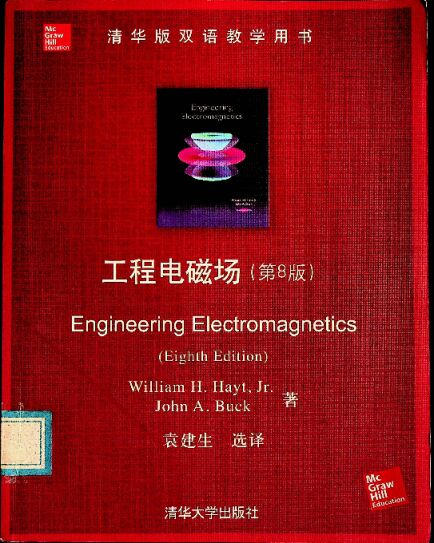
书名:Engineering electromagnetics
责任者:William H. Hayt | Jr. | John A. Buck著 ; 袁建生选译. | Yuan, Jiansheng,
分类号:物理学
版次:8th ed. [Reprinted ed.].
前言
It has been 52 years since the first edition of this book was published, then under thesole authorship of William H. Hayt, Jr. As I was five years old at that time, this wouldhave meant little to me. But everything changed 15 years later when I used the secondedition in a basic electromagnetics course as a college junior. I remember my senseof foreboding at the start of the course, being aware of friends' horror stories. On firstopening the book, however, I was pleasantly surprised by the friendly writing styleand by the measured approach to the subject, which — at least for me — made it avery readable book, out of which I was able to learn with little help from my professor.I referred to it often while in graduate school, taught from the fourth and fifth editionsas a faculty member, and then became coauthor for the sixth and seventh editions onthe retirement (and subsequent untimely death) of Bill Hayt. The memories of mytime as a beginner are clear, and I have tried to maintain the accessible style that Ifound so welcome then.
Over the 50-year span, the subject matter has not changed, but emphases have. Inthe universities, the trend continues toward reducing electrical engineering core courseallocations to electromagnetics. I have made efforts to streamline the presentation in this new edition to enable the student to get to Maxwell's equations sooner, and I have added more advanced material. Many of the earlier chapters are now slightly shorterthan their counterparts in the seventh edition. This has been done by economizing onthe wording, short ening many sections, or by removing some entirely. In some cases,deleted topics have been converted to stand-alone articles and moved to the website,from which they can be downloaded. Major changes include the following: (1) Thematerial on dielectrics, formerly in Chapter 6, has been moved to the end of Chapter 5.(2) The chapter on Poisson's and Laplace's equations has been eliminated, retainingonly the one-dimensional treatment, which has been moved to the end of Chapter 6.The two-dimensional Laplace equation discussion and that of numerical methods havebeen moved to the website for the book. (3) The treatment on rectangular waveguides(Chapter 13) has been expanded, presenting the methodology of two-dimensionalboundary value problems in that context. (4) The coverage of radiation and antennashas been greatly expanded and now forms the entire Chapter 14.
Some 130 new problems have been added throughout. For some of these, I choseparticularly good "classic" problems from the earliest editions. I have also adopteda new system in which the approximate level of difficulty is indicated beside eachproblem on a three-level scale. The lowest level is considered a fairly straightforwardproblem, requiring little work assuming the material is understood; a level 2 problemis conceptually more difficult, and/or may require more work to solve; a level 3 prob-lem is considered either difficult conceptually, or may require extra effort (includingpossibly the help of a computer) to solve.
As in the previous edition, the transmission lines chapter (10) is stand-alone,and can be read or covered in any part of a course, including the beginning. Init, transmission lines are treated entirely within the context of circuit theory; wavephenomena are introduced and used exclusively in the form of voltages and cur-rents. Inductance and capacitance concepts are treated as known parameters, andso there is no reliance on any other chapter. Field concepts and parameter com-putation in transmission lines appear in the early part of the waveguides chapter(13), where they play additional roles of helping to introduce waveguiding con-cepts. The chapters on electromagnetic waves, I I and 12, retain their independenceof transmission line theory in that one can progress from Chapter 9 directly toChapter 11. By doing this, wave phenomena are introduced from first principlesbut within the context of the uniform plane wave. Chapter 1 1 refers to Chapter 10 inplaces where the latter may give additional perspective, along with a little more detail.Nevertheless, all necessary material to learn plane waves without previously studyingtransmission line waves is found in Chapter 11, should the student or instructor wishto proceed in that order.
The new chapter on antennas covers radiation concepts, building on the retardedpotential discussion in Chapter 9. The discussion focuses on the dipole antenna,individually and in simple arrays. The last section covers elementary transmit-receivesystems, again using the dipole as a vehicle.
The book is designed optimally for a two-semester course. As is evident, staticsconcepts are emphasized and occur first in the presentation, but again Chapter 10(transmission lines) can be read first. In a single course that emphasizes dynamics,the transmission lines chapter can be covered initially as mentioned or at any point inthe course. One way to cover the statics material more rapidly is by deemphasizing materials properties (assuming these are covered in other courses) and some of theadvanced topics. This involves omitting Chapter 1 (assigned to be read as a review),and omitting Sections 2.5, 2.6, 4.7, 4.8, 5.5-5.7, 6.3, 6.4, 6.7, 7.6, 7.7, 8.5, 8.6, 8.8,8.9, and 9.5.
A supplement to this edition is web-based material consisting of the afore-mentioned articles on special topics in addition to animated demonstrations and interactive programs developed by Natalya Nikolova of McMaster University and Vikram Jandhyala of the University of Washington. Their excellent contributionsare geared to the text, and icons appear in the margins whenever an exercise thatpertains to the narrative exists. In addition, quizzes are provided to aid in further study.
The theme of the text is the same as it has been since the first edition of 1958.An inductive approach is used that is consistent with the historical development. Init, the experimental laws are presented as individual concepts that are later unifiedin Maxwell's equations. After the first chapter on vector analysis, additional math-ematical tools are introduced in the text on an as-needed basis. Throughout everyedition, as well as this one, the primary goal has been to enable students to learnindependently. Numerous examples, drill problems (usually haying multiple parts),end-of-chapter problems, and material on the web site, are provided to facilitate this.
查看更多
目录
About the Authors 1
Chapter 1 Vector Analysis 2
1.1 Scalars and Vectors 2
1.2 Vector Algebra 3
1.3 The Rectangular Coordinate System 4
1.4 Vector Components and Unit Vectors 6
1.5 The Vector Field 9
1.6 The Dot Product 10
1.7 The Cross Product 12
1.8 Other Coordinate Systems: Circular 14
1.9 Cylindrical Coordinates 19
References 23
Chapter 1 Problems 23
Chapter 2 Coulomb's Law and Electric Field Intensity 28
2.1 The Experimental Law of Coulomb 28
2.2 Electric Field Intensity 31
2.3 Field Arising from a Continuous Volume Charge Distribution 35
2.4 Field of a Line Charge 37
2.5 Field of a Sheet of Charge 41
2.6 Streamlines and Sketches of Fields 43
References 46
Chapter 2 Problems 46
Chapter 3 Electric Flux Density, Gauss's Law,and Divergence 51
3.1 Electric Flux Density 51
3.2 Gauss's Law 55
3.3 Application of Gauss's Law: Some Symmetrical Charge Distributions 59
3.4 Application of Gauss's Law: Differential Volume Element 64
3.5 Divergence and Maxwell's First Equation 67
3.6 The Vector Operator V and the Divergence Theorem 70
References 73
Chapter 3 Problems 74
Chapter 4 Energy and Potential 79
4.1 Energy Expended in Moving a Point Charge in an Electric Field 80
4.2 The Line Integral 81
4.3 Definition of Potential Difference and Potential 86
4.4 The Potential Field of a Point Charge 88
4.5 The Potential Field of a System of Charges: Conservative Property 90
4.6 Potential Gradient 94
4.7 The Electric Dipole 99
4.8 Energy Density in the Electrostatic Field 104
References 108
Chapter 4 Problems 109
Chapter 5 Conductors and Dielectrics 114
5.1 Current and Current Density 115
5.2 Continuity of Current 1 16
5.3 Metallic Conductors 119
5.4 Conductor Properties and Boundary Conditions 124
5.5 The Method of Images 129
5.6 Semiconductors 131
5.7 The Nature of Dielectric Materials 132
5.8 Boundary Conditions for Perfect Dielectric Materials 138
References 142
Chapter 5 Problems 143
Chapter 6 Capacitance 149
6.1 Capacitance Defined 149
6.2 Parallel-Plate Capacitor 151
6.3 Several Capacitance Examples 153
6.4 Capacitance of a Two-Wire Line 156
6.5 Using Field Sketches to Estimate Capacitance in Two-Dimensional Problems 160
6.6 Poisson’s and Laplace’s Equations 166
6.7 Examples of the Solution of Laplace’s Equation 168
6.8 Example of the Solution of Poisson’s Equation: the p-n Junction Capacitance 175
References 178
Chapter 6 Problems 179
Chapter 7 The Steady Magnetic Field 187
7.1 Buiot-Savart Law 187
7.2 Ampére’s Circuital Law 195
7.3 Curl 202 7.3 HeRE 202
7.4 Stokes’ Theorem 209
7.5 Magnetic Flux and Magnetic Flux Density 214
7.6 The Scalar and Vector Magnetic Potentials 217
7.7 Derivation of the Steady-Magnetic-Field Laws 224
References 230
Chapter 7 Problems 230
Chapter 8 Magnetic Forces, Materials, and Inductance
8.1 Force on a Moving Charge 238
8.2 Force ona Differential Current Element 240
8.3 Force between Differential Current Elements 244
8.4 Force and Torque on a Closed Circuit 246
8.5 The Nature of Magnetic Materials 252
8.6 Magnetization and Permeability 255
8.7 Magnetic Boundary Conditions 260
8.8 The Magnetic Circuit 263
8.9 Potential Energy and Forces on Magnetic Materials 269
8.10 Inductance and Mutual Inductance 271
References 278
Chapter 8 Problems 278
Chapter 9 Time-Varying Fields and Maxwell’s Equations 286
9.1 Faraday’s Law 286
9.2 Displacement Current 293
9.3. Maxwell’s Equations in Point Form 297
9.4 Maxwell’s Equations in Integral Form 299
9.5 The Retarded Potentials 301
References 305
Chapter 9 Problems 305
Chapter 10 Transmission Lines 311
10.1 Physical Description of Transmission Line Propagation 312
10.2 The Transmission Line Equations 314
10.3 Lossless Propagation 316
10.4 Lossless Propagation of Sinusoidal Voltages 319
10.5 Complex Analysis of Sinusoidal Waves 321
10.6 Transmission Line Equations and Their It Solutions in Phasor Form 323
10.7 Low-Loss Propagation 325
10.8 Power Transmission and The Use of Decibels in Loss Characterization 327
10.9 Wave Reflection at Discontinuities 330
10.10 Voltage Standing Wave Ratio 333
10.11 Transmission Lines of Finite Length 337
10.12 Some Transmission Line Examples 340
10.13 Graphical Methods: The Smith Chart 344
10.14 Transient Analysis 355
References 368
Chapter 10 Problems 368
Chapter 11 The Uniform Plane Wave 378
11.1 Wave Propagation in Free Space 378
11.2 Wave Propagation in Dielectrics 386
11.3 Poynting’s Theorem and Wave Power 395
11.4 Propagation in Good Conductors Skin Effect 398
11.5 Wave Polarization 405
References 412
Chapter 11 Problems 412
Chapter 12 Plane Wave Reflection and Dispersion 418
12.1. Reflection of Uniform Plane Waves at Normal Incidence 418
12.2 Standing Wave Ratio 425
12.3 Wave Reflection from Multiple Interfaces 429
12.4 Plane Wave Propagation in General Directions 437
12.5 Plane Wave Reflection at Oblique Incidence Angles 440
12.6 Total Reflection and Total Transmission of Obliquely Incident Waves 446
12.7 Wave Propagation in Dispersive Media 449
12.8 Pulse Broadening in Dispersive Media 455
References 459
Chapter 12 Problems 460
Chapter 13 Gulded Waves 466
13.1 Transmission Line Fields and Primary Constants 466
13.2 Basic Waveguide Operation 476
13.3. Plane Wave Analysis of the Parallel-Plate Waveguide 480
13.4 Parallel-Plate Guide Analysis Using the Wave Equation 489
13.5 Rectangular Waveguides 492
13.6 Planar Dielectric Waveguides 503
13.7 Optical Fiber 510
References 519
Chapter 13 Problems 520
Chapter 14 Electromagnetic Radiation and Antennas 525
14.1 Basic Radiation Principles: The Hertzian Dipole 525
14.2 Antenna Specifications 532
14.3 Magnetic Dipole 537
14.4 Thin Wire Antennas 539
14.5 Arrays of Two Elements 547
14.6 Uniform Linear Arrays 551
14.7 Antennas as Receivers 555
References 562
Chapter 14 Problems 562
Appendix A Vector Analysis 567
A.1 General Curvilinear Coordinates 567
A.2 Divergence, Gradient, and Curl in General Curvilinear Coordinates 568
A.3 Vector Identities 570
Appendix B Units 571
Appendix C Material Constants 576
Appendix D The Uniqueness Theorem 579
Appendix E Origins of the Complex Permittivity 581
Appendix F Answers to Odd-Numbered Problems 588
查看更多
作者简介
A native of Los Angeles, California, John A. Buck received his M.S. and Ph.D. degrees in Electrical Engineering from the University of California at Berkeley in 1977 and 1982, and his B.S. in Engineering from UCLA in 1975. In 1982, he joined the faculty of the School of Electrical and Computer Engineering at Georgia Tech, where he has remained for the past 28 years. His research areas and publications have centered within the fields of ultrafast switching, nonlinear optics, and optical fiber communications. He is the author of the graduate text Fundamentals of Optical Fibers (Wiley Interscience), which is now in its second edition. Awards include three institute teaching awards and the IEEE Third Millenium Medal. When not glued to his computer or confined to the lab, Dr. Buck enjoys music, hiking, and photography.
查看更多
馆藏单位
中科院文献情报中心