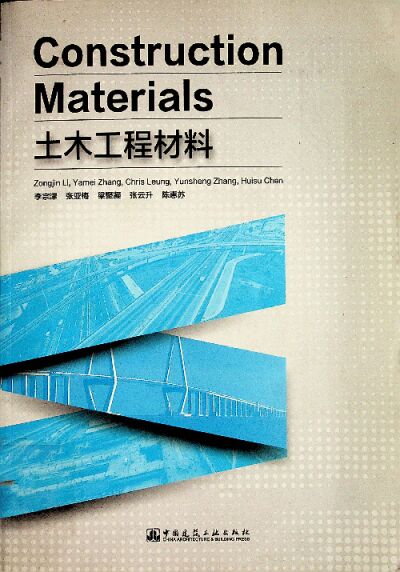
书名:Construction materials
责任者:Zongjin Li... [et al.] = 土木工程材料/李宗津... [等].
出版时间:2014
出版社:China Architecture & Building Press,
前言
Construction materials are the most widely used materials in the world. They are used to construct different infrastructure and private buildings,for both structural and non- structural applications. Understanding the composition,processing methods,mechanical properties and general performance of construction materials are essential for civil gineering students to meet the need in professional careers. Due to the rapid development in construction materials, the content of conventional text book in construction materials field needs to be updated. The motivation to write this book is try to fill in the vacancy by introducing new types of materials,new processing methodologies,new testing methods for property assessment, and innovative developments in technology. The unique features of this book include the introduction of basic mechanical behavior of the materials,emphasized fundamental exploration of materials composition and microstructure,and state of art of construction material development and innovations. This book provides more comprehensive knowledge on construction materials technology including the systematic introduction of fibrous composite materials and functional cement-based materials.The book is divided into ten chapters. Chapter l gives a brief introduction of construction materials,including its historic development,structural materials definition, materials physical and chemical properties,and new development trend of the construction materials. Chapter 2 provides the knowledge of mechanical behavior of construction materials,covering elastic,plastic,creep,fracture and fatigue. Chapter 3 discusses the properties of aggregates,focusing on grading and moisture content.Chapter 4 focuses on the binding materials such as non-hydraulic and hydraulic cement. Emphases are on the Portland cement. Chapter 5 covers the contents of concrete, the most important construction material. The chapter discusses the properties of concrete in both fresh and hardened stage.New testing method of noncontact resistivity measurement is introduced. Chapter6 provides updated knowledge on steel,including corrosion protection and stee recycling. Chapter 7 introduces the basic knowledge of fibrous composites from their composition,mechanics to the application. It is new content for construction materials Chapter 8 covers the essential knowledge of wood on its properties and applications.In chapter 9,the pavement materials have been introduced with the emphases on the asphalt concrete. Finally,chapter 10 discusses the non-structural materials,in which the functional materials are new in a book of construction materials.The book is designed and written primarily to meet the teaching needs for undergraduate students in civil engineering and materials engineering.However,it can serve as a reference or a guide for professional civil engineers in their practice. invaluable assistance from many people,which are deeply appreciated.The authors would like to express their special thanks to Dr.Yu Zhu,MissY u Cheng and for their help inediting the book draft.Mr.Mike Pomfret is acknowledged for his professional page proof reading Friendly Contemporary Concrete(2009CB 623200) is greatly acknowledged.In the process of writing this book,the authors received enthusiastic help and The support from China Basic Research Grant,Basic Research on Environmentally Zong jin Li,Yame i Zhang,Chris Leung,Yun sheng Zhang,Hui su Chen
查看更多
目录
Chapter 1 Introduction 1
1.1Htoric development 1
1.2Structural materials and structural design 2
1.3 Physical properties 3
1.3.1Density,apparent density and packing density of matter 4
1.3.1.1Density 4
1.3.1.2 Apparent density 4
1.3.1.3 Packing density 4
1.3.2 Porosity and void percentage 5
1.3.2.1 Porosity 5
1.3.2.2 Void percentage 6
1.3.3 Physical properties relevant to water 6
1.3.3.1 Hydrophilicity and hydrophobility 6
1.3.3.2 Water adsorption 7
1.3.3.3 Hygroscopicity 7
1.3.3.4 Water resistance(coefficient of softening) 7
1.3.3.5 Water impermeability 7
1.3.3.6 Frost resistance 8
1.3.4 Physical properties relevant to thermal effects 8
1.3.4.1 Thermal conductivity 8
1.3.4.2 Thermal capacity and specific heat capacity 8
1.3.4.3 Thermal expansion 9
1.3.4.4 Fire resistance and refractoriness 9
1.4 Chemical properties 10
1.4.1 Reactivity 10
1.4.2Activation energy 10
1.5 Principles in the selection of materials11
1.6 Innovations and development trends in construction materials 12
1.6.1 Functional materials 12
1.6.1.1 Cement-based piezoelectric materials 12
1.6.1.2 Thin-walled low frequency sound shielding material 15
1.6.1.3 Controllable heat insulation building products with phase changing materials(PCM) 15
1.6.1.4 Electromagnetic wave shielding and absorbing materials 17
1.6.2Sustainability: Eco-friendly material development 20 1.6.2.1 Recycle and reuse of industry waste 20
1.6.2.2 New binders-energy efficient materials with less CO2 23
1.6.3Multiple disciplinary integrated materials 24
1.6.3.1 Nanotechnology in construction 24
1.6.3.2Dynamic shading window system(DSWS) 26
1.6.3.3 Self-compacting concrete(SCC) 27
Discussion topics 28
References 28
Chapter2 Mechanical behavior of materials 32
2.l Material behavior and structural performance 32
2.2 Elastic behavior 34
2.2.1 Introduction 34
2.2.2 Physical basis of elastic behavior 34
2.2.3 Young's Modulus: definition,typical values and significance to structural design 35
2.2.4 Modulus of composite materials and application to reinforced concrete member 36
2.3Plastic behavior 38
2.3.1Phenomenon of plastic yielding 38
2.3.3Physical basis of plastic behavior 40
2.3.3 Modeling of plastic behavior 41
2.3.4 llustration of plastic behavior with a parallel system 42 C2\2.4 Time dependent behavior—Creep 44
2.4.1 Phenomenon of time dependent behavior 44
2.4.2 Implications to structural design 44
2.4.3 Physical basis of time dependent behavior 45
2.4.4 Modeling of creep at low temperature with viscoelastic models 46
2.4.5 Strain response under arbitrary stress history—superposition 49
2.5 Fracture 49
2.5.1 Introduction 49
2.5.2 Fast fracture: physical basis and modeling 50
2.5.3 Ductile to britle failure transition of metal 53
fatigue—phenomenon and empirical expressions 54
2.5.5 Physical basis of fatigue and K-based modeling 57
Discussion topics 58
Problems 59
References 62
Chaper3 Aggregates 63
3.1Introduction 63
3.2 Classification of aggregate 63
3.3 Aggregates produced from industrial waste 66
3.3.1 Blast furnace slag aggregate 67
3.3.2 Aggregates from recycled concrete 67
3.4Properties of aggregates 68
3.4.1Density of aggregate 68
3.4.2 Moisture conditions 69
3.5Grading 70
3.5.1 Definition 70
3.5.2Determination of the grading 71
3.5.3Fineness modulus 72
3.5.4Fineness modulus for blending of aggregates 73
3.6 Shape and surface texture 73
3.7Deleterious substances 74
3.8Soundness 76
Discussion topics 76
Problems 76
References 77
Chapter 4 Binder materials 78
4.1Organic binders 78
4.1.1 Asphalt 78
4.1.1.1 Introduction 78
4.1.1.2 Manufacture78
4.1.1.3Composition of asphalt 80
4.1.1.4Properties of asphalt 81
4.1.1.5Application 82
4.1.2 Polymers 83
4.1.2.1 Introduction 83
4.1.2.2 Composite and manufacture 83
4.1.2.3 Composite properties 84
4.1.2.4 Installation procedures for FRP application 84
4.1.2.5 Applications of FRP 85
4.2Inorganic binders 85
4.2.1 Lime 85
4.2.1.1 Introduction 85
4.2.1.2 Classification 86
4.2.1.3Manufacture 86
4.2.2Gypsum 90
4.2.2.1 Introduction 90
4.2.2.2 Manufacture 91
4.2.2.3 Classification 92
4.2.2.4 Application 92
4.2.3 Water glass 93
4.2.3.1Introduction 93
4.2.3.2 Properties 93
4.2.3.3 Application 93
4.2.4 Portland cement 93
4.2.4.1 Manufacture 94
4.2.4.2 Chemical composition 99
4.2.4.3 Hydration 100
4.2.4.4 Typeof Portland cement 113
4.2.4.5 Properties of Portland cement 116
Discussion topics 120
References 121
Chapter5 Concrete 123
5.1Introduction 123
5.1.1 Historic development 123
5.1.2 The applications of Portland cement concrete 124
5.1.3 Characteristics of concrete l26 5.1.3.1 Advantages of concrete l26
5.1.3.2 Limitations 128
5.1.4 Types of concrete 130
5.1.4.1Classification in accordance with unit weight 130
5.1.4.2 Classification in accordance with compressive strength 130
5.1.4.3 Classification in accordance with additives 131
5.1.5 Factors influencing concrete properties 131
51.5.1 w/c ratio(or w/bor w/p ratio) 131
5.1.5.2 Cement content 132
5.1.5.3 Aggregate 132
5.1.5.4 Admixtures 133
5.1.5.5 Mixing procedures 133
5.1.5.6 Curing 134
5.2 Admixtures used for making concretes 134
5.2.1Definition and classifications 135
5.2.2 Chemical admixtures 136
5.2.2.1 Water reducing admixtures 136
5.2.2.2 Setting control admixtures 137
5.2.3 Air-entraining admixtures 139
5.2.4 Mineral admixtures 142
5.3Three-phase theory for concrete 146
5.3.1 Concept of the third phase—transition zone 146
5.3.2 Structure of the transition zone 148
5.3.3Influence of the transition zone on properties of concrete 148
5.4Fresh concrete 150
5.4.1Definition 150
5.4.2 Workability 150
5.4.3 Measurement of workability 154
5.4.4 Setting of concrete 158
5.4.5 Placing,compacting and curing 159
5.4.5.1 Delivery of concrete 160
5.4.5.2 Placing of concrete 160
5.4.5.3 Compacting and finishing 161
5.4.5.4 Curing 161
5.5 Hardened concrete 163
5.5.1 Strength of hardened concrete 163
5.1.1.1 Control methods for strength test 164
5.5.1.2 Calibration of transducers 165
5.5.1.3 Compressive strength and corresponding tests 166
5.5.1.3.1 Failure mechanism 166
5.5.1.3.2 Specimen preparation for compression test 167
5.5.1.3.3 Factors affecting the measured compressive strength 167
5.5.1.4 Uniaxial tensile strength and corresponding tests 169
5.5.1.4.1 Failure mechanism 170
5.5.1.4.2 Stress concentration factor 170
5.5.1.4.3 Relationship between the compressive strength and tensile strength 170
5.5.1.4.4 Indirect tension test(split cylinder test or Brazilian test) 171
5.5.1.5 Flexural strength and corresponding tests 172
5.5.1.6 Behavior of concrete under multi-axial stresses 173
5.5.1.6.1 Behavior under biaxial stress 173
5.5.1.6.2 Behavior of concrete under triaxial stress 174
5.5.1.7 Fatigue strength of concrete 175
5.5.2 Stress-strain relationship and constitutive equations 177
5.5.2.1 Method to obtain a stresstrain(deformation)curves 177
5.5.2.2 Modulus of elasticity 179
5.5.3 Dimensional stability-shrinkage and creep 181
5.5.3.1 Shrinkage 181
5.5.3.1.1 Plastic shrinkage 181
5.5.3.1.2 Autogenous shrinkage 182
5.5.3.1.3 Drying shrinkage
5.5.3.2 Creep 186
5.5.3.2.1 Phenomenon of creep 186
5.5.3.2.2 Influence of creep on reinforced concrete 187
5.5.3.2.3 Mechanism of creep in concrete 188
5.3.2.4 Importance of applied stress level to creep 189
5.5.3.2.5 ACI equation for predicting creep 189
5.5.3.3 Test method for creep 190
5.5.3.4 Other important factors affecting shrinkage and creep 190
5.5.4 Durability 191
5.5.4.1 Causes of deterioration and main durability problemsl 192
5.5.4.2 Basic factors influencing the durability 193
5.5.4.3Measurement of permeability coefficient 195
5.5.4.4Measurement of diffusivity coefficient 197
5.5.4.5Cracks in concrete 199
5.5.4.6Corrosion of reinforcing steel 200
5.5.4.6.1 Carbonation-induced corrosion 200
5.5.4.6.2Chloride-induced corrosion 202
5.5.4.6.3 Corrosion mechanisms 204
5.5.4.7 Alkali-aggregate reaction 210
5.5.4.8 Deterioration caused by Freeze-thaw 214
5.5.4.9 Degradation caused by sulfate attack 216
5.5.4.10 Durability in marine environment 220
5.5.4.11Deterioration of concrete caused by multi-factors 222
Discussion topics 223
Problems 225
References 226
Chapter6 Steel 231
6.1 Classification 231
6.2 The manufacture and strengthening of steel 232
6.2.1 Cold and hot working 233
6.2.2 Heat treatment 234
6.2.3 Surface treatment 235
6.3 Structure and properties of steel 236
6.3.1Structure of steel 23
6.3.2 Mechanical properties of steel 236
6.3.3 Relationship of steel properties to composition and manufacturing process 239
6.3.4Effect of alloying elements 242
6.3.5Failure of steel under multiaxial stress 243
6.4Steel welding and associated problems 245
6.4.1 Embrittlement due to martensite formation 245
6.4.2 Lamellar tearing 246
Corrosion protection of steel 247
6.5.1Mechanisms of steel corrosion 247
6.5.2 Corrosion protection with paint/coatings 248
6.5.3Cathodic protection 248
6.5.4 Designs to minimize the potential of corrosion 249
6.6 Application and recycling of steel 250
6.6.1Application 250
6.6.2 Recycling 250
Discussion topics 251
Problems 251
References 253
Chapter 7 Fiber reinforced polymer composites 254
7.1Introduction 254
7.2 Advantages of fiber reinforced composite and general applications 254
7.3 Raw materials and processing techniques 256
7.3.1 Polymer matrix 256
7.3.2 Fibers 257
7.3.3 Processing of fiber reinforced polymeric composites 259
7.4 Behavior of aligned continuous fiber composites 260
7.4.1Elastic properties 261
7.4.2 Micromechanical equations for the elastic properties 263
7.4.3 Composite strength 264
7.5Application of fiber reinforced composites in civil engineering 265
7.5.1 Glass fiber reinforced polymer bars for concrete structures 265
7.5.2 Strengthening of concrete structures with carbon fiber reinforced polymer 267
7.5.3 Fiber reinforced polymer components for buildings and bridges 269
Discussion topics 271
Problems 272
References 272
Chapter 8 Wood 273
8.1 Introduction 273
8.2Structure of wood 274
8.3 Properties of wood 276
8.3.1 Physical properties 276
8.3.2 Elastic properties 277
8.3.3 Strength and toughness of wood 278
8.3.4 Time dependency of wood properties 280
8.3.5 Behavior of wood in a fire 281
8.4rading of wood 281
8.5 Wood products 282
8.6Wood degradation and protection 284
Discussion topics 285
References 285
Capter 9 Pavement materials 286
9.1Introduction 286
9.1.1 Pavement types 286
9.1.2Bitumen materials 288
9.1.3Quality control of underlying soil(subgrade) 289
9.2Petroleum asphalt 290
9.2.1 Original asphalt 290
9.2.2 Modified asphalt using polymers 291
9.3Asphalt concrete 293
9.4Testing of asphalt properties 295
9.5Design of asphalt mixture 295
Discussion topics 299
References 299
Chapter 10 Major non-structural materials 300
10.1Partitions 300
10.1.1Brick partitions300
10.1.2 Glass partitions301
10.1.3 Concrete partitions 301
10.1.4 Fibre cement sheet partitions 302
10.1.5 Timber partitions 303
10.2Decoration materials 303
10.2.1 Coatings 303
10.2.2 Paint 304
10.2.3 Tiles 304
10.2.3.1 Roof tiles 305
10.2.3.2 Floor tiles 305
10.2.3.3 Ceiling tiles 306
10.2.4 Glass 306
10.2.4.1 Glass composition 306
10.2.4.2 Color of glass 307
10.3Function materials 307
10.3.1 Waterproofing 307
10.3.2 Fireproofing 308
10.3.3 Soundproofing 309
10.3.4 Building insulation materials 310
10.3.4.1 Spray foam insulation 311
10.3.4.2 Insulating concrete forms ·31
10.3.4.3 Rigid panels 312
10.3.4.4 Batts 313
10.3.4.5 Loose-fill insulation 313
10.3.4.6 Aerogels 314
10.3.4.7 Straw bales 315
10.3.5 Sealants 316
Discussion topics 317
References 317
Construction Materials Laboratory 319
Laboratory Ⅰ:Aggregate 319
LaboratoryⅡ: Cement 323
Laboratory Ⅲ:Fresh concrete 327
Laboratory Ⅳ: Testing methods of mechanical properties of ordinary concrete(GB/T 50081-2002) 329
Laboratory Ⅴ:Two demo tests 331
Laboratory Ⅵ:Hardened concrete tests(28 day properties) 334
Laboratory Ⅶ:Non-contact resistsvity measurement:a demonstration 338
Index 340
查看更多
馆藏单位
中科院文献情报中心