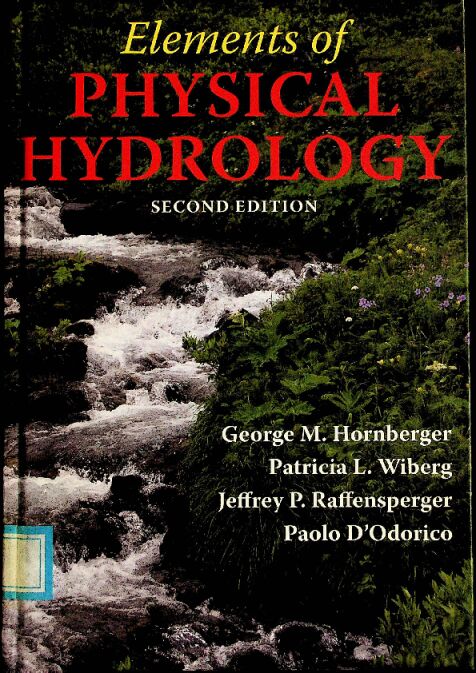
书名:Elements of physical hydrology
责任者:George M. Hornberger ... [et al.].
ISBN\ISSN:9781421413730,1421413736
出版时间:2014
出版社:Johns Hopkins University Press,
前言
The world population is expected to grow to 9 billion by 2050. Food production will have to grow even faster than the population because, as countries develop and achieve a higher standard of living, diets tend to include more animal protein and thus there is a concomitant increased consumption of grain by animals. Agriculture consumes the greatest amount of fresh water of all sectors, so we anticipate increased stress on water resources as a result of increased food production. The growth in population will also result in increases in the use of energy, which entails the use of water as well. Furthermore, these changes will occur amidst large-scale changes in the use of land resources (e.g., increased urbanization) and changes in climate caused by the burning of fossil fuels. It is clear that dealing with water resources issues will be a key activity for regions, nations, and the global village as these changes unfold. Arguably, university students need to acquire knowledge about the hydrological cycle just to be informed citizens of the world in the coming decades.
This book is based on the premise that students of environmental science must learn the quantitative physical basis of hydrology if they are to appreciate the scientific approach to understanding observed phenomena and the basis for achieving solutions to water resources problems. The text is not a catalog of observations nor is it a compendium of applied techniques of engineering hydrology. Rather, it presents a basic coverage of physical principles and how these allow one to grasp the essential elements of hydrological processes. One tenet that we hold is that an understanding of fundamental fluid mechanics is essential to the study of hydrology. Our aim is to provide an integrated coverage of flows of water on and beneath the Earth's surface with the underpinning of a knowledge of basic fluid mechanics.
This book originated from lectures in a course on Physical Hydrology at the University of Virginia that began more than 25 years ago. Following publication of the first edition of our bookin 1998, many colleagues elsewhere told us that they found it useful, but that there were a few topics that were underrepresented. Thus, in addition to updating material throughout the book, in this second edition we includea good bit of new material, including a new chapter on Ecohydrology and a completely new final chapter on water- climate-energy-food interactions.The changes notwithstanding, the book is still designed to accompany an undergraduate course in physical hydrological science. It is aimed at upper-level undergraduates majoring in environmental or Earth sciences. The coverage presupposes a modest background in calculus and physics.
We use several conventions in an attempt to make the book "user friendly." Each chapter has introductory and concluding remarks that seek to place the material presented in the chapter in the context of some contemporary environmental issue. Terms that appear in boldface at their first occurrence are found in the Glossary. Terms that appear in italics deserve emphasis. Supporting material is contained in three appendixes: a review of units and dimensions (Appendix 1); a tabulation of certain properties of water (Appendix 2); and a review of some elementary statistical concepts (Appendix 3).
Over the years we have benefited from ideas and data shared by many colleagues and students. We are grateful to all who have contributed to our education, but will refrain from attempting to produce a comprehensive list. We do want to acknowledge specifically colleagues who either have taught the course at UVA that stimulated the first edition of the book in the past or who are currently in the teaching rotation for the course: John Albertson, Keith Beven, Keith Eshleman, John Fisher, Peter German, Aaron Mills, Matt Reidenbach, and Todd Scanlon. In addition, we especially thank Margot Bjoring for the preparation of the figures for this edition of the book.
查看更多
目录
Preface vii
1 The Science of Hydrology 1
2 Precipitation and Evapotranspiration 20
3 The Basis for Analysis in Physical Hydrology: Principles of Fluid Dynamics 58
4 Open Channel Hydraulics 90
5 Catchment Hydrology: Streams and Floods 118
6 Groundwater Hydraulics 145
7 Groundwater Hydrology 173
8 Water in the Unsaturated Zone 210
9 Ecohydrology: Interactions between Hydrological Processes and the Biota 240
10 Catchment Hydrology: The Hillslope-Stream Continuum 257
11 Water, Climate, Energy, and Food 285
Appendixes 297
1 Units, Dimensions, and Conversions 297
2 Properties of Water 305
3 Basic Statistics in Hydrology307
Answers to Example Problems 313
Glossary 345
References 363
Index 371
查看PDF
查看更多
馆藏单位
中科院文献情报中心