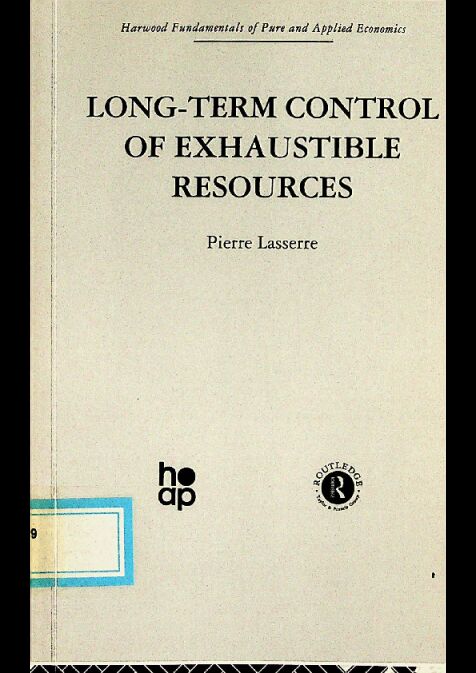
书名:Long-term control of exhaustible resources
出版时间:2013
出版社:Taylor & Francis,
摘要
Natural resources, especially exhaustible and non-renewable ones, have understandably always been a matter of concern to economists, politicians and even philosophers. Over time, this attention has taken various forms and experienced spurs of intense controversy alternating with periods of relative calm.
查看更多
目录
Introduction to the Series vii
INTRODUCTION 1
1.MAJOR THEORETICAL RESULTS 4
1.1 Hotelling rule and the views of Ricardo. 4
1.2 The individual mine. 9
1.3 Economic reserves and exhaustion. 10
1.4 Aggregation. 11
1.5 Exploration. 12
1.6 Sectoral extraction and the behaviour of price. 13
1.7 Multiple deposits, capital, and other complications. 14
1.8 Welfare, competition, and stability. 16
1.9 Other imperfections. 21
1.10 Growth and survival. 22
1.11 Monopoly. 27
1.12 Duopoly and oligopoly. 30
2. EMPIRICAL TESTS AND PRICE STUDIES 37
2.1 Reminder. 37
2.2 Evidence on scarcity rents. 39
2.3 Evidence on the behaviour of rents and prices over time. 40
3. JOINT PRODUCTS AND THE ENVIRONMENT 43
3.1 Introduction. 43
3.2 Joint production from composite reserves. 44
3.3. Optimum pollution stocks and clean-up. 49
3.4 Transnational pollution in general equilibrium. 54
4. TRADE AND MACROECONOMIC ISSUES 56
4.1 Resource models with trade: survival revisited. 56
4.2 Trade models with natural resources: the basic trade theorems. 59
4.3 The Dutch Disease and the Macroeconomy. 69
4.4 Other issues. 79
5. TAXATION 82
5.1 Introduction. 82
5.2 Resource taxation in a simple Hotelling world. 83
5.3 Resource taxation in a simple Ricardian world. 90
5.4 The corporate income tax. 99
5.5 Exploration. 104
5.6 Optimal taxation and tax incidence in general equilibrium. 109
Bibliography 111
Index 120
查看PDF
查看更多
馆藏单位
中科院文献情报中心