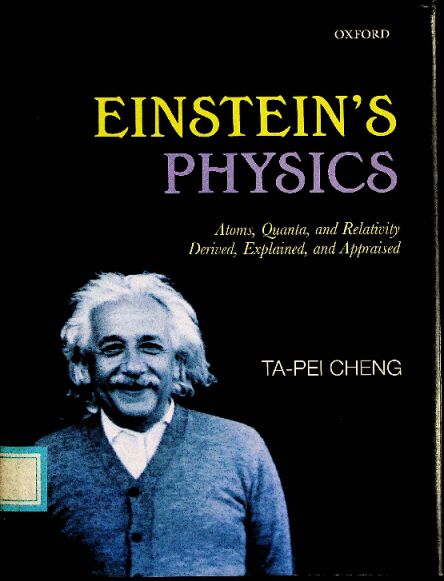
书名:Einstein s physics
ISBN\ISSN:9780199669912,0199669910
出版时间:2013
出版社:Oxford University Press,
前言
Einstein explained in equationsAlbert Einstein's achievement in physics is proverbial. Many regard him as thegreatest physicist since Newton. What did he do in physics that's so important?Whjle there have been many books about Einstein, most of these explainhjs achievement onl y in qualitative terms. This is rather unsatisfactory asthe language of physics is mathematics. One needs to know the equationsin order to understand Einstein's physics: the precise nature of his contribution,its context, and its influence. The most important scientific biographyof Einstein has been the one by Abraham Pais: Subtle is the Lord .. . TheScience and the Life of Albert Einstein: The physics is discussed in depth;however, it is sti ll a narrative account and the equations are not worked outin detail. Thus this biography assumes in effect a high level of physics backgroundthat is perhaps beyond what many readers, even workj ng physicists,possess. Our purpose is to provide an introduction to Einstein's physics ata level accessible to an undergraduate physics student. All physics equationsare worked out from the beginning. Although the book is written withprimarily a physics readership in mind, enough pedagogical support materialis provided that anyone with a solid background in an introductory physicscourse (say, an engineer) can, with some effort, understand a good part of thispresentation.
查看更多
目录
PART I ATOMIC NATURE OF MATTER
1 Molecular size from classical fluids 3
1.1 Two relations of molecular size and the Avogadro number 4
1.2 The relation for the effective viscosity 5
1.2. l The equation of motion for a viscous fluid 5
1.2.2 Viscosity and heat loss in a fluid 6
1.2.3 Volume fraction in terms of molecular dimensions 8
1.3 The relation for the diffusion coefficient 8
1.3. 1 Osmotic force 9
1.3.2 Frictional drag force-the Stokes law 10
1.4 SuppMat: Basics of fluid mechanics 11
1.4.1 The equation of continuity 12
1.4.2 The Euler equation for an ideal fluid 12
1.5 SuppMat: Calculating the effective viscosity 13
1.5.1 The induced velocity field v' 14
1.5.2 The induced pressure field p' 15
1.5.3 Heat dissipation in a fluid with suspended particles 15
1.6 SuppMat: The Stokes formula for the viscous force 18
2 The Brownian motion 20
2.1 Diffusion and Brownian motion 21
2. 1.1 Einstein's statistical derivation of the diffusion equation 22
2. 1.2 The solution of the diffusion equation and the mean-square displacement 23
2.2 Fluctuations of a particle system 24
2.2. 1 Random walk 24
2.2.2 Brownian motion as a random walk 25
2.3 The Einstein- Smoluchowski relation 25
2.3.1 Fluctuation and dissipation 27
2.3.2 Mean-square displacement and molecular dimensions 27
2.4 Perrin's experimental verification 27
PART I1 QUANTUM THEORY
3 Blackbody radiation: From Kirchhoff to Planck 31
3.1 Radiation as a collection of oscillators 32
3.1 .1 Fourier components of radiation obey harmonic oscillator equations 33
3.2 Thermodynamics of blackbody radiation 34
3.2.1 Radiation energy density is a universal function 34
3.2.2 The Stefan-Boltzmann law 35
3.2.3 Wien's displacement law 36
3.2.4 Planck's distribution proposed 38
3.3 Planck's investigation of cavity oscillator entropy 39
3.3.1 Relating the oscillator energy to the radiation density 39
3.3.2 The mean entropy of an oscillator 40
3.4 Planck's statistical analysis leading to energy quantization 41
3.4.1 Calculating the complexion of Planck's distribution 41
3.4.2 Planck's constant and Boltzmann's constant 44
3.4.3 Planck's energy quantization proposal-a summary 45
3.5 SuppMat: Radiation oscillator energy and frequency 45
3.5. l The ratio of the oscillator energy and frequency is an adiabatic invariant 46
3.5.2 The thermodynamic derivation of the relation between radiation pressure and energy density 48
4 Einstein's proposal of light quanta 50
4.1 The equipartition theorem and the Rayleigh-Jeans law 5 1
4.1 .1 Einstein's derivation of the Rayleigh- Jeans law 52
4.1.2 The history of the Rayleigh-Jeans law and "Planck's fortunate failure" 53
4.1.3 An excursion to Rayleigh's calculation of the density of wave states 54
4.2 Radiation entropy and complexion a la Einstein 55
4.2.1 The entropy and complexion of radiation in the Wien limjt 55
4.2.2 The entropy and complexion of an ideal gas 57
4.2.3 Radiation as a gas of light quanta 58
4.2.4 Photons as quanta of radiation 59
4.3 The photoelectric effect 59
4.4 SuppMat: The equipartition theorem 60
5 Quantum theory of specific heat 62
5.1 The quantum postulate: Einstein vs. Planck 62
5.1.1 Einstein's derivation of Planck's distribution 63
5.2 Specific heat and the equipartition theorem 64
5.2. l The study of heat capacity in the pre-quantum era 65
5.2.2 Einstein's quantum insight 66
5.3 The Einstein solid-a quantum prediction 67
5.4 The Debye solid and phonons 69
5.4. l Specific heat of a Debye solid 71
5.4.2 Thermal quanta vs. radiation quanta 72
6 Waves, particles, and quantum jumps 73
6.1 Wave-particle duality 74
6.1.1 Fluctuation theory (Einstein 1904) 75
6. l.2 Energy fluctuation of radiation (Einstein l 909a) 75
6.2 Bohr's atom-another great triumph of the quantum postulate 78
6.2.1 Spectroscopy: Balmer and Rydberg 78
6.2.2 Atomic structure: Thomson and Rutherford 79
6.2.3 Bohr's quantum model and the hydrogen spectrum 79
6.3 Einstein's A and B coefficients 82
6.3 .l Probability introduced in quantum dynamics 82
6.3.2 Stimulated emission and the idea of the laser 84
6.4 Looking ahead to quantum field theory 85
6.4. 1 Oscillators in matrix mechanics 85
6.4.2 Quantum jumps: From emission and absorption of radiation to creation and annihilation of particles 88
6.4.3 Resolving the riddle of wave-particle duality in radiation fluctuation 91
6.5 SuppMat: Fluctuations of a wave system 92
7 Bose-Einstein statistics and condensation 94
7. 1 The photon and the Compton effect 95
7.2 Towards Bose-Einstein statistics 96
7 .2. l Boltzmann statistics 97
7 .2.2 Bo e's counting of photon state 98
7.2.3 Einstein 's elaboration of Bose's counting statistics 100
7 .3 Quantum mechanics and identical particles 102
7 .3.1 Wave mechanics: de Broglie-Einstein-Schrodinger 102
7 .3.2 Identical particles are truly identical in quantum mechanics 103
7.3.3 Spin and statistics 103
7.3.4 The physical implications of symmetrization 104
7.4 Bose- Einstein condensation 105
7.4. 1 Condensate occupancy calculated 105
7.4.2 The condensation temperature 106
7.4.3 Laboratory observation of Bose-Einstein condensation 107
7.5 SuppMat: Radiation pressure due to a gas of photons 108
7.6 SuppMat: Planck's original analy i in view of Bose-Einstein statistics 109
7.7 SuppMat: The role of particle indistinguishability in Bose-Einstein condensation 110
8 Local reality and the Einstein-Bohr debate 112
8. 1 Quantum mechanical basics- superposition and probability 112
8.2 The Copenhagen interpretation 113
8.2. I The Copenhagen vs. the local realist interpretations 113
8.3 EPR paradox: Entanglement and nonlocality 114
8.3.1 The post-EPR era and Bell 's inequality 117
8.3.2 Local reality vs. quantum mechanicsthe experimental outcome 119
8.4 SuppMat: Quantum mechanical calculation of spin correlations 121
8.4.1 Quantum mechanical calculation of spin average values 121
8.4.2 Spin correlation in one direction 122
8.4.3 Spin correlation in two directions 123
PART ill SPECIAL RELATIVITY
9 Prelude to special relativity 127
9.1 Relativity as a coordinate symmetry 128
9.1. l Inertial frames of reference and Newtonian relativity 128
9.2 Maxwell's equations 129
9.2.1 The electromagnetic wave equation 130
9.2.2 Aether as the medium for electromagnetic wave propagation 131
9.3 Experiments and theories prior to special relativity 131
9.3.1 Stellar aberration and Fizeau's experiment 131
9.3.2 Lorentz's corresponding states and local time 133
9.3.3 The Michelson-Morley experiment 136
9.3.4 Length contraction and the Lorentz transformation 137
9.3.5 Poincare and special relativity 138
9.4 Reconstructing Einstein's motivation 139
9.4.1 The magnet and conductor thought experiment 139
9.4.2 From "no absolute time" to the complete theory in five weeks 141
9.4.3 Influence of prior investigators in physics and philosophy 142
9.5 SuppMat: Lorentz transformation a la Lorentz 143
9.5.1 Maxwell's equations are not Galilean covariant 143
9.5.2 Lorentz's local time and noncovariance at O(v2 /c2) 144
9.5.3 Maxwell's equations are Lorentz covariant
10 The new kinematics and E = mc2 146
10.1 The new kinematics 147
10.1.1 Einstein's two postulates 148
10.1.2 The new conception of time and the derivation of the Lorentz transformation 148
10. l.3 Relativity of simultaneity, time dilation, and length contraction 15 I
10.2 The new velocity addition rule 154
10.2.1 The invariant spacetime interval 154
10.2.2 Adding velocities but keeping light speed constant 155
10.3 Maxwell's equations are Lorentz covariant 156
10.3.1 The Lorentz transformation of lectromagnetic fields 156
10.3.2 The Lorentz transformation of radiation energy 158
10.4 The Lorentz force law 158
10.5 The equivalence of inertia and energy 159
10.5. l Work-energy theorem in relativity 159
1 0.5.2 The E = mc2 paper three months later 160
10.6 SuppMat: Relativistic wave motion 162
10.6. 1 The Fresnel formula from the velocity addition rule 162
10.6.2 The Doppler effect and aberration of light 162
10.6.3 Derivation of the radiation energy transformation 163
10. 7 SuppMat: Relativistic momentum and force 164
11 Geometric formulation of relativity 166
11.1 Minkowski spacetime 167
11. 1.1 Rotation in 30 space-a review 168
11.1.2 The Lorentz transformation as a rotation in 40 spacetime 168
11.2 Tensors in a flat spacetime 169
11 .2. 1 Tensor contraction and the metric 169
11 .2.2 Minkowski spacetime is pseudo-Euclidean 171
11 .2.3 Relativistic velocity, momentum, and energy 172
1 l .2.4 The electromagnetic field tensor 173
11 .2.5 The energy-momentum-stress tensor for a field system 174
11 .3 The spacetime diagram 176
11.3.1 Basic features and invariant regions 176
11.3.2 Lorentz transformation in the spacetime diagram 177
11.4 The geometric formulation-a summary 179
PART IV GENERAL RELATIVITY
12 Towards a general theory of relativity 183
12.1 Einstein's motivations for general relativity 184
12.2 The principle of equivalence between inertia and gravitation 184
12.2.1 The inertia mass vs. the gravitational mass 184
12.2.2 "My happiest thought" 186
12.3 Implications of the equivalence principle 187
12.3. 1 Bending of a light ray l87
12.3.2 Gravitational redshift 188
12.3.3 Gravitational time dilation 190
l2.3.4 Gravity-induced index of refraction in free space 19 l
12.3.5 Light ray deflection calculated 192
12.3.6 From the equivalence principle to "gravity as the tructure of spacetime" 193
12.4 Elements of Riemannian geometry l 93
12.4. l Gaussian coordinates and the metric tensor 194
12.4.2 Geodesic equation 195
12.4.3 Flatness theorem 197
12.4.4 Curvature 197
13 Curved spacetime as a gravitational field 200
13.1 The equivalence principle requires a metric description of gravity 20 I
l3. l . l What is a geometric theory? 201
13.1.2 Time dilation as a geometric effect 202
13. l .3 Further arguments for warped spacetime as the gravitational field 203
13.2 General relativity as a field theory of gravitation 204
13.2.1 The geodesic equation as the general relativity equation of motion 205
13.2.2 The Newtonian limit 205
13.3 Tensors in a curved spacetime 207
13.3.1 General coordinate transformations 207
13.3.2 Covariant differentiation 209
13.4 The principle of general covariance 213
13.4.1 The principle of minimal substitution 213
13.4.2 Geodesic equation from the special relativity equation of motion 214
14 The Einstein field equation 216
14. 1 The Newtonian field equation 217
14.2 Seeking the general relativistic field equation 218
14.3 Curvature tensor and tidal forces 219
14.3.1 Tidal forces-a qualitative discussion 219
14.3.2 Newtonian deviation equation and the equation of geodesic deviation 14.3.3 Symmetries and contractions of the curvature tensor 220
14.3.4 The Bianchi identities and the Einstein tensor 222
14.4 The Einstein equation 223
14.4.1 The Newtonian limit for a general source 225
14.4.2 Gravitational waves 225
14.5 The Schwarzschild solution 226
14.5.1 Three classical tests 228
14.5.2 Black holes-the full power and glory of general relativit 231
15 Cosmology 234
15.1 The cosmological principle 235
15.1.1 The Robertson-Walker spacetime 236
15.1.2 The discovery of the expanding universe 238
15.1.3 Big bang cosmology 239
15.2 Time evolution of the universe 240
15.2.1 The R..RW cosmology 240
15.2.2 Mass/energy content of the universe 242
15.3 The cosmological constant 244
15.3. l Einstein and the static universe 244
15.3.2 The Inflationary epoch 247
15.3.3 The dark energy leading to an accelerating universe 249
PART V WALKING IN EINSTEIN'S STEPS
16 Internal symmetry and gauge interactions 255
16.1 Einstein and the symmetry principle 256
16.2 Gauge invariance in classical electromagnetism 257
16.2. l Electromagnetic potentials and gauge transfonnation 258
16.2.2 Hamiltonian of a charged particle in an electromagnetic field 259
16.3 Gauge symmetry in quantum mechanics 261
16.3. l The minimal substitution rnle 261
16.3.2 The gauge transformation of wavefunctions 262
16.3.3 The gauge principle 263
16.4 Electromagnetism as a gauge interaction 266
16.4.1 The 40 spacetime formalism recalled 266
16.4.2 The Maxwell Lagrangian density 268
16.4.3 Maxwell equations from gauge and Lorentz symmetries 269
16.5 Gauge theories: A narrative history 270
16.5.1 Einstein's inspiration, Weyl's program, and Fock's discovery 270
16.5.2 Quantum electrodynamics 271
16.5.3 QCD as a prototype Yang-Mills theory 273
16.5.4 Hidden gauge symmetry and the electroweak interaction 276
16.5.5 The Standard Model and beyond 280
17 The Kaluza-Klein theory and extra dimensions 283
17. 1 Unification of electrodynamics and gravity 284
17.1.1 Einstein and unified field theory 284
17. 1.2 A geometric unification 284
17 .1.3 A rapid review of electromagnetic gauge theory 285
17 .1.4 A rapid review of general relativistic gravitational theory 286
17.2 General relativity in 50 spacetime 287
17 .2. 1 Extra spatial dimension and the Kaluza-Klein metric 287
17 .2.2 "The Kaluza-Klein miracle" 288
17.3 The physics of the Kaluza-Klein spacetime 289
17 .3. 1 Motivating the Kaluza-Klei n metric ansatz 289
17.3 .2 Gauge transformation as a 50 coordinate change 289
17.3.3 Compactified extra dimension 290
17.3.4 Quantum fields in a compactified space 290
17.4 Further theoretical developme nts 292
17.4. l Lessons from Maxwell's equations 292
17.4.2 Einstein and mathematics 293
17 .5 SuppMat: Calculating the 50 tensors 293
17.5.1 The 50 Christoffel symbols 294
17 .5.2 The 50 Ricci tensor components 297
17.5.3 From 50 Ricci tensor to 50 Ricci calar 302
PART VI APPENDICES
A Mathematics supplements 305
A. I Vector calculus 305
A.1.1 The Kronecker delta and Levi-Civita symbols 305
A. I .2 Differential calculu of a vector field 307
A. 1.3 Vector integral calculus 308
A.1.4 Differen tial equations of Maxwell electrodynamics 3 10
A.2 The Gaussian integral 312
A.3 Stirling's approximation 313
A.3.1 The integral representation for n! 313
A.3.2 Derivation of Stirling's formula 314
A.4 Lagrangian multipliers 315
A.4.1 The method 315
A.4.2 Some examples 316
A.5 The Euler-Lagrange equation 317
A.5.1 Mechanics of a single particle 317
A.5.2 Lagrangian density of a field system 318
B Einstein's papers 320
B. l Einstein's journal articles cited in the text 320
B.2 Further reading 323
C Answers to the 21 Einstein questions 325
Glossary of symbols and acronyms 331
l Latin symbols 333
2 Greek symbols 334
3 Acronyms 335
4 Miscellaneous units and symbols 337
Bibliography 337
Index 343
查看PDF
查看更多
馆藏单位
中科院文献情报中心