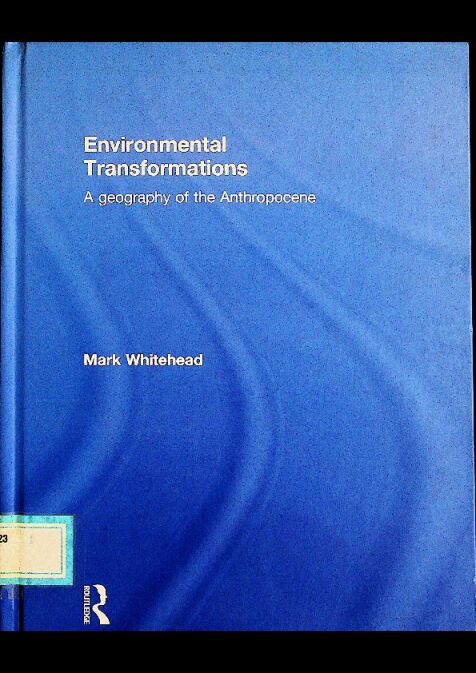
书名:Environmental transformations
ISBN\ISSN:9780415809832,9780415809849
前言
From the depths of the oceans to the highest reaches of the atmosphere, the human impact on the environment is significant and undeniable. These forms of global and local environmental change collectively appear to signal the arrival of a new geological epoch: the Anthropocene. This is a geological era defined not by natural environmental fluctuations or meteorite impacts, but by collective actions of humanity.
Environmental Transformations offers a concise and accessible introduction to the human practices and systems that sustain the Anthropocene. It combines accounts of the carbon cycle, global heat balances, entropy, hydrology, forest ecology and pedology, with theories of demography, war, industrial capitalism, urban development, state theory and behavioural psychology. This book charts the particular role of geography and geographers in studying environmental change and its human drivers. It provides a review of critical theories that can help to uncover the socio-economic and political factors that influence environmental change. It also explores key issues in contemporary environmental studies, such as resource use, water scarcity, climate change, industrial pollution and deforestation. These issues are 'mapped' through a series of geographical case studies to illustrate the particular value of geographical notions of space, place and scale, in uncovering the complex nature of environmental change in different socio-economic, political and cultural contexts. Finally, the book considers the different ways in which nations, communities and individuals around the world are adapting to environmental change in the twenty-first century.
Particular attention is given throughout to the uneven geographical opportunities that different communities have to adapt to environmental change and to the questions of social justice this situation raises. This book encourages students to engage in the scientific uncertainties that surround the study of environmental change, while also discussing both pessimistic and more optimistic views on the ability of humanity to address the environmental challenges of our current era.
查看更多
目录
List of plates ix
List of figures xi
List of tables xii
List of boxes xiii
Acknowledgements xiv
1 Introduction: geography in the Anthropocene 1
1.1 Meme or geological epoch: introducing the Anthropocene 1
1.2 The rough geographies of the Anthropocene 5
1.3 Where do we go from here? 12
Note 14
Key readings 14
Part 1 Environmental transformations 15
2 Resources: oil and water 17
2.1 Introduction: the Simon-Ehrlich wager 17
2.2 Changing patterns of resource use 19
2.3 Doomsters, cornucopians and everything in between 31
2.4 Water resources in the Nile Basin 37
2.5 Conclusions 40
Notes 41
Key readings 41
3 Air: science and the atmosphere 42
3.1 Introduction: Thomas Midgley and the ultraviolet century 42
3.2 A brief history of air pollution: from Mauna Loa to Mumbai 44
3.3 Reflections on the nature of atmospheric science 52
3.4 Corridors of uncertainty: 'fugitive emissions' and the case of Louisiana's cancer alley 60
3.5 Conclusions 63
Notes 63
Key readings 64
4 Soil: the political ecology of soil degradation 65
4.1 Introduction: getting under the planet's skin 65
4.2 Soil and environmental transformations 66
4.3 Interpreting the transformation of soil: a political ecology perspective 73
4.4 A dust bowl for the twenty-first century: soil degradation in China 76
4.5 Conclusions 79
Key readings 80
5 Forests: jungle capitalism and the corporate environment 81
5.1 Introduction: the story of Chut Wutty 81
5.2 Transforming forests: reflections on the long Anthropocene 82
5.3 Globalizing the forest and multinational forest corporations 85
5.4 Jungle capitalism: the case of the United Fruit Company 92
5.5 Big box retail and the global timber supply chain 94
5.6 Conclusions 97
Note 98
Key readings 98
6 Cities: sprawl and the urban planet 99
6.1 Introduction: urbanization and why Darwin was wrong after all 99
6.2 A brief history of urbanization: from Mesopotamia to the mega-region 100
6.3 Theorizing the city: from growth machines to the favela 105
6.4 Urbanization and the environment 109
6.5 Conclusions 116
Notes 119
Key readings 119
Part 2 Living in the Anthropocene 121
7 Governing the environment 123
7.1 Introduction: protecting people from nature or protecting nature from people? 123
7.2 A brief environmental history of the nation state 125
7.3 Thinking about state-environment relations: green arbiters and ecological leviathans 128
7.4 Governing the air: the case of the London fog disaster 134
7.5 Rivers of grass: the US state and the Florida Everglades 137
7.6 Conclusions 141
Key readings 142
8 Greening the brain: understanding and changing human behaviour 143
8.1 Introduction: human psychology in the Anthropocene 143
8.2 Changing patterns of human behaviour and their environmental consequences: Fordism and the Great Acceleration 144
8.3 Understanding human behaviours: religion, science and ideology 150
8.4 Changing human environmental behaviours: beyond homoeconomicus 153
8.5 Policy perspectives on proenvironmental behaviour change 157
8.6 Conclusions 161
Key readings 161
9 Conclusions: misanthropy, adaptation and safe operating spaces 162
Bibliography 164
Index 173
查看更多
馆藏单位
中科院文献情报中心