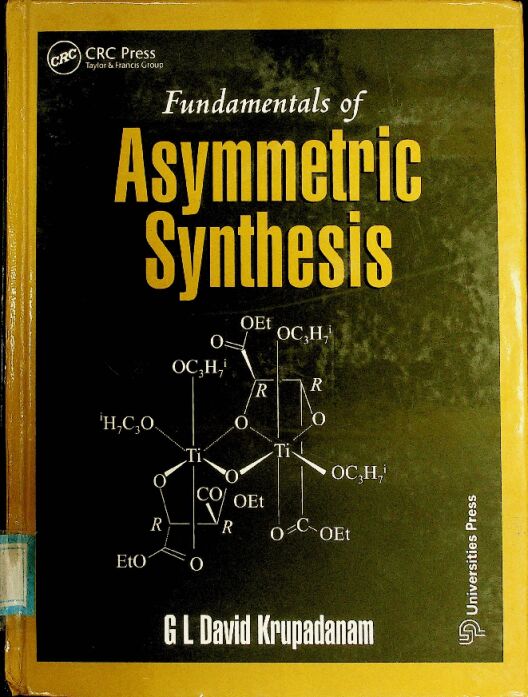
书名:Fundamentals of asymmetric synthesis
责任者:G.L. David Krupadanam.
前言
Asymmetric synthesis is an integral part of synthetic organic chemistry. Some of the reactions in this book were known prior to 1980, while several new ones, particularly catalytic asymmetric reactions, have been discovered in the recent years. The impact of this new class of reactions has been impressively extensive―both on organic and medicinal chemistry. These reactions have been accepted whole-heartedly by synthetic organic chemists in developing shorter routes for complex natural targets as well as in the manufacture of a wide range of drug intermediates.
查看更多
目录
Preface iii
CHAPTER 1 Introduction 1
1.1 Synthesis of chiral molecules in living systems 2
1.2 Need for asymmetric synthesis 5
1.3 Synthesis of stereoisomers as racemic products 11
1.4 Selectivity in synthesis of stereoisomers 17
CHAPTER 2 Terms, definitions and concepts in asymmetric synthesis 24
CHAPTER 3 Achiral and chiral molecules and their properties 44
3.1 Introduction 44
3.2 Properties of enantiomers (E_1and E_2) 48
3.3 Properties of chiral diastereoisomers 67
CHAPTER 4 Prochirality 72
4.1 Introduction: Stereohomotopic and stereoheterotopic atoms/groups and faces 72
4.2 Stereohomotopic atoms/groups and faces 74
4.3 Stereoheterotopic atoms/groups and faces 77
41\4 Prochirality: Nomenclature 93
CHAPTER 5 Enantioselective and diastereoselective synthesis 101
5.1 Structure, symmetry and transition state energy requirements for enantioselectivity 101
5.2 Structure, symmetry and transition state energy requirements for (asymmetric) diastereoselective synthesis 109
CHAPTER 6 Methods for monitoring enantioselective and diastereoselective synthesis 118
6.1 Conventions for expressing enantioselectivity and diastereoselectivity 118
6.2 Determination of % op, % ee, % es in enantioselective reactions 121
6.3 Physical methods in the determination of absolute configuration 138
6.4 Determination of configuration from the established stereochemical pathway of asymmetric reactions 148
CHAPTER 7 Methods for inducing asymmetry 150
7.1 Methods for inducing enantioselectivity 150
7.2 Methods for inducing diastereoselectivity 156
7.3 Classification of asymmetric synthesis 165
CHAPTER 8 Chiral substrate controlled asymmetric reactions: Diastereoselection in acyclic systems 179
8.1 Asymmetric induction 179
8.2 1,2-Asymmetric induction (Cram, Felkin-Anh models) 181
8.3 1,3-Asymmetric induction (Reetz and Cram-Reetz models) 196
8.4 1,4-Asymmetric induction (Prelog's model) 198
CHAPTER 9 Chiral auxiliary controlled asymmetric reactions—asymmetric a-alkylations 202
9.1 Introduction to enolates 202
9.2 Chiral auxiliary controlled a-alkylations of enolates and azaenolates 212
CHAPTER 10 Chiral stoichiometric reagent controlled asymmetric synthesis: Chiral boron reagents 228
10.1 Introduction 228
10.2 Enantioselective hydroboration: Use of chiral boron hydrides 229
10.3 Chiral trialkyl boranes: Alpine borane (IPC.BBN, Midlands reagent) 234
CHAPTER 11 Chiral catalyst mediated asymmetric reactions: Enzymes 238
11.1 Introduction 238
11.2 Enzymes: Chiral biocatalysts 239
11.3 Enantioface Re and Si selective transformations of prochiral ketones, aldehydes and olefins 241
11.4 Enantiotopic and diastereotopic atom/group selective transformations 247
11.5 Enzymatic discrimination of enantiotopic groups of meso compounds: Meso trick 252
11.6 Enzymatic discrimination of diastereotopic atoms and groups 253
11.7 Kinetic resolutions of racemic esters and alcohols with lipases and esterases 254
CHAPTER 12 Chiral organometallic catalysed asymmetric reactions: Sharpless asymmetric epoxidations, dihydroxylations and aminohydroxylations 257
12.1 Introduction 257
12.2 Stoichiometric enantioselective nucleophilic epoxidation 259
12.3 Sharpless asymmetric epoxidation (AE) 260
12.4 Catalytic enantioselective oxidation of sulphides: Kagan's sulphoxidation 280
12.5 Sharpless asymmetric dihydroxylation (AD) 280
12.6 Sharpless asymmetric aminohydroxy lation 293
CHAPTER 13 Chiral organometallic catalysed asymmetric reactions 302
13.1 Jacobsens epoxidation: Catalytic asymmetric epoxidation of unfunctionalised olefins 302
13.2 Knowles catalytic homogeneous asymmetric hydrogenations 309
13.3 Noyoris catalytic homogeneous asymmetric hydrogenations 323
CHAPTER 14 Organocatalysts in asymmetric synthesis—chiral additive mediated reactions 336
14.1 Introduction 336
14.2 Shi epoxidation 336
14.3 (R, R)-tartaric acid catalysed enantioselective reductions 340
14.4 Enantioselective catalytic reduction of ketones by oxazaborolidines 341
14.5 Enantioselective cyclopropanation of allylic alcohols by dioxaboralanes 343
CHAPTER 15 Asymmetric aldol reaction 346
15.1 Introduction 347
15.2 Aldol reactions: Four classes 349
15.3 Mukaiyama aldol reaction 364
CHAPTER 16 Asymmetric Diels-Alder reactions 369
16.1 Introduction 369
16.2 Woodward-Hoffmann suprafacial-suprafacial stereoselectivity: Syn addition 370
16.3 Endo-exo selectivity and the role of Lewis acids 376
16.4 Regioselectivity in Diels-Alder reactions 381
16.5 Enantio- and diastereoselectivity in Diels-Alder reactions (asymmetric Diels-Alder reactions) 381
CHAPTER 17 Stereoselective synthesis and stereospecific synthesis 392
17.1 Stereoselective synthesis 393
17.2 Stereospecific synthesis 402
Annexure 1 Symmetry elements and symmetry operations 413
Annexure 2 Point groups 426
Annexure 3 Molecules with one chiral center 441
Annexure 4 Molecules with two or more chiral centers 448
Index 455
查看PDF
查看更多
馆藏单位
中科院文献情报中心