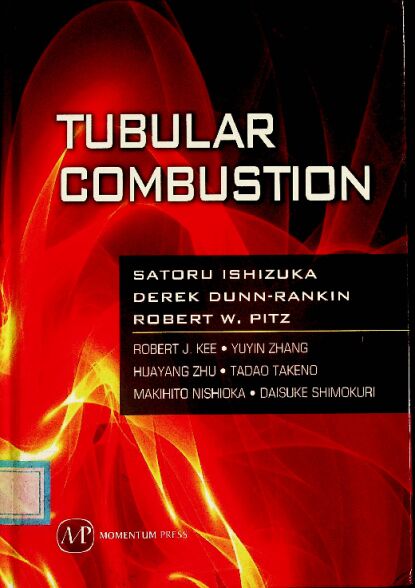
书名:Tubular combustion
责任者:Satoru Ishizuka ... [et al.].
出版时间:2013
出版社:Momentum Press,
摘要
Tubular combustors are cylindrical tubes where flame ignition and propagation occur in a spatially confined, highly controlled environment, in a nearly flat, elongated geometry. This allows for some unique advantages where extremely even heat dispersion is required over a large surface while still maintaining fuel efficiency. Tubular combustors also allow for easy flexibility in type of fuel source, allowing for quick changeover to meet various needs and changing fuel pricing. This new addition to the MP sustainable energy series will provide the most up-to-date research on tubular combustion--some of it only now coming out of private proprietary protection. Plentiful examples of current applications along with a good explanation of background theory will offer readers an invaluable guide on this promising energy technology. Highlights include: * An introduction to the theory of tubular flames * The "how to" of maintaining stability of tubular flames through continuous combustion * Examples of both small-scale and large-scale applications like steel making, chemical processing, flexible-fuel-source heaters, efficient boilers, and other similar uses .
查看更多
目录
PREFACE ix
1 INTRODUCTION
1.1 Background of tubular flame studies
1.1.1 Aerodynamic straining 2
1.1.2 Flame curvature 3
1.1.3 Rotation 5
1.1.4 Tubular flames 7
1.2 Notable tubular flame characteristics 10
1.2.1 Thermal advantage 10
1.2.2 Aerodynamic advantage 12
1.2.3 Lewis number effects 17
1.3 Tubular flame studies 19
1.3.1 Theoretical studies 19
1.3.2 Computational simulations 21
1.3 .3 Experimental studies 21
1.4 Relevant studies 22
1.4.1 Tubular non-premixed, diffusion flame studies 22
1.4.2 Miniature liquid-film combustors 31
1.5 Practical application 32
1.5 .1 Prototype tubular flame burners 32
1.5.2 Rapidly mixed tubular flame combustion 34
References 36
2 THEORY OF T UBULAR FLAMES 41
2.1 Introduction 41
2.2 Theoretical formulation 42
2 .2.1 Model and assumptions 42
2.2.2 Fundamental equations 43
2.3 Similarity solution 45
2.3.1 Introduction 45
2.3 .2 Equations to be solved 45
2.4 Simplified model with one-step kinetics and simple transport properties 46
2.4.1 Fonnulation 46
2.4.2 Nondimensional system 48
2.4.3 Incompressible flow system 50
2.4.4 Flow field 50
2.4.5 Concentration and temperature field 51
2.4.6 Simplification for Le= I 52
2.4.7 Results for simplified model 52
2.4.8 Discussions on results for simplified model 63
2.5 Effects of variable density 65
2.5.1 Model and assumptions 65
2.5.2 Comparison with incompressible solutions 66
2.5.3 Effects of injection velocity 69
2.5.4 Effects of lewis number 72
2.5.5 Discussions on the effects of variable density 73
2.6 Asymptotic analysis 76
2.6.1 Model and assumptions 76
2.6.2 Nondimensional system 76
2.6.3 Asymptotic analysis 77
2.6.4 Approximate solutions 80
2.6.5 Response curves 81
2.6.6 Extinction conditions 82
2.6.7 Numerical example 85
2.6.8 Discussions 88
2.6.9 Some concluding remarks 91
2.7 Numerical study with full kinetics and exact transport properties 92
2.7.1 Introduction 92
2.7.2 Model and equations 93
2.7.3 Reaction mechanism and transport properties 93
2.7.4 Results and discussions 96
2.7.5 Concluding remarks 102
2.8 Final conclusions 102
References 103
3 MATHEMATICAL FORMULATION AND COMPUTATIONAL SIMULATION OF TUBULAR FLAMES 107
3.1 Introduction 107
3.2 Literature overview 109
3.3 Mathematical formulation 111
3.3.1 Similarity form 113
3.3.2 Radial injection 115
3.3.3 Tangential injection 116
3.3.4 Practical considerations 118
3.3 .5 Computational procedure 119
3.4 Model validation 119
3.4.1 Tubular flame with a radial inlet flow 119
3.4.2 Swirling tubular flame with a single inlet slot 119
3.5 Flame structure and pressure diffusion 120
3.5.1 Premixed propane-air flames 121
3.5.2 Premixed methane-air flames 125
3.5.3 Summary of pressure diffusion 130
3.6 Potential technology applications 130
3.7 Summary and conclusions 132
References 133
4 RAMAN SPECTROSCOPIC MEASUREMENTS OF T UBULAR FLAMES 137
4.1 Introduction 137
4.2 Raman scattering technique 137
4.3 Tubular flame burner 146
4.4 Raman scattering measurements in tubular flames 148
4.4.1 Hydrogen-air tubular flames 148
4.4.2 Methane-air tubular flames 153
4.4.3 Propane-air tubular flames 154
4.5 Cellular tubular flames 156
4.5.1 Instabilities in tubular flames 156
4.5 .2 Raman scattering measurements in cellular tubular flames 158
References 162
5 NON-PREMIXED T UBULAR FLAMES 165
5. 1 Introduction 165
5.2 Numerical study of the non-premixed tubular flames 166
5.3 Non-premixed opposed-flow tubular burner 170
5.4 Raman scattering measurements in non-premixed tubular flames 170
5.4.1 Hydrogen I Air non-premixed tubular flames 170
5.4.2 Hydrocarbon-air non-premixed tubular flames 173
5.5 Cellular instabilities in non-premixed tubular flames 179
5.5.1 Cellular instabilities in diffusion flames 180
5.5.2 Cellular formation and extinction in non-premixed tubular flames 180
References 186
6 TUBULAR FLAME CHARACTERISTICS OF MINIATURE LIQUID FILi\l COi\lBUSTORS 189
6.1 Introduction 189
6.2 Brief review of some key features of a tubular flame 190
6.3 Review of the key features of a fuel fi Im combustor flame 190
6.4 Examples of tubular flame behaviors in a fuel film combustor 195
6.4. 1 Original design 195
6.4.2 Secondary air injection 195
6.4.3 Swirler design and tubular flame 200
6.5 Concluding remarks 204
References 205
7 SMALL-SCALE APPLICATIONS 207
7.1. Introduction 207
7.2. Flame quenching in a narrow channel 209
7.2.1 Flame quenching in a nonrotating flow field 209
7.2.2 Advantages using small-scale tubular flame burners 211
7.2.3 Tubular flame in a small-diameter tube 214
7.2.4 Effects of tube size on the tubular flame 217
7.2.5 Critical tube diameter for a rotating flow field 220
7 .3 Development of small power sources using a tubular flame 221
References 224
8 LARGE-SCALE APPLICATIONS 227
8.1 Introduction 227
8.1.1 Classification 228
8.1.2 Flame diameter and length 229
8.1.3 Rapidly mixed tubular flame combustion 234
8.2 Wide flammable range 244
8.2.1 BFG burners 244
8.3 Fuel diversity 249
8.3.1 Gaseous fuels 249
8.3.2 Liquid fuels 25 I
8.3.3 Solid fuels 252
8.4 Compactness 255
8.4.1 Fuel-processing system for polymer electrolyte fuel cell 255
8.4.2 Hollow fastening bolt 256
8.4.3 Superheated steam generator 260
8.5 Geometry 264
8.5.1 Flame stabilization 264
8.5.2 Heating process 266
8.5.3 Stirling engine 270
References 273
INDEX 277
查看PDF
查看更多
作者简介
Satoru Ishizuka is a professor in Institute of Engineering.Division of Energy and Environmental Engineering,at Hiroshima University.He served as the 13th President of the combustion Society of Japan.
查看更多
馆藏单位
中科院文献情报中心