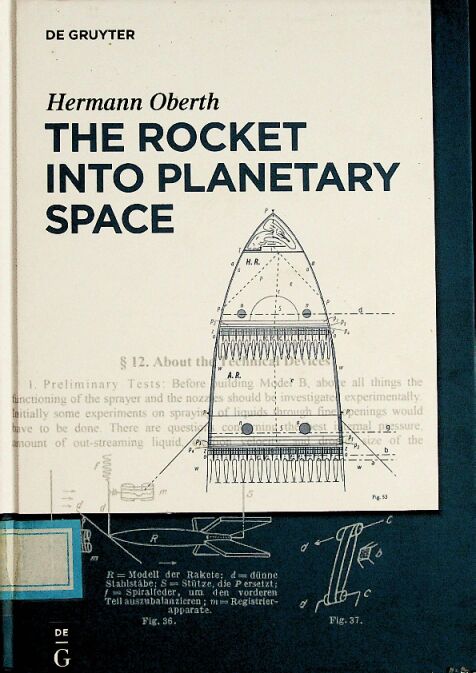
书名:The rocket into planetary space
责任者:Hermann Oberth ; Trevor C. Sorensen … [et al.].
ISBN\ISSN:9783486754636,3486754637
出版时间:2014
出版社:De Gruyter,
前言
For those of us who have spent our careers in one aspect or another of astronautics, and who in many cases have been steeped in the subject since childhood, the release of this new translation of Hermann Oberth's classic work is a truly historic event. To hold it in one's hand (even on an e-reader!) is a profound experience. To read it through, carefully, cannot fail to impress the reader with the magnitude of the debt that we today owe to our pioneers. That debt cannot be paid back, it can only be paid forward, and then only if each new generation comes to understand the magnitude of the contributions to which they are the heirs. With this new translation, the first since a rather hasty and somewhat incomplete work published by NASA in the 1960s, those new generations will have access to this incredible body of work by an old master.
The thing that surprises-stuns, really-even the educated reader is the amazing breadth and scope that Oberth addressed in this truly original work. Once that is grasped, the same reader is surprised again by the success with which Oberth treats his subjects, even as viewed with the benefit of hindsight made possible from nearly a century, now, of technological innovation that Oberth could not possibly have foreseen. Yet despite that, and despite the awkwardness introduced both by the necessities of translation and the changes in idiom and phraseology that have come about during the most volatile century in human history, the issues that Oberth chooses to address and the deftness with which he does so are surprisingly modern in their tone.
Some who pick up this book, who hold it in their hands, may never get beyond this Preface, or will only leaf casually through its pages. If so, that will be a shame, but if such is to be, if that reader is to carry away only one impression from Oberth's work, then he or she should know something about the intellectual span attained by this man, thinking and writing in the early decades of the 20th century.
In a relatively short work, Hermann Oberth laid down the mathematical laws governing rocketry and spaceflight, and he offered practical design considerations based on those laws. He analyzed the design and performance of oxygen-alcohol rockets, of which the V-2 was the first practical example, in addition to that of the hydrogen-fueled rocket, of which the apotheosis remains the Saturn V. He imagined and considered the problem of launching truly large rockets, offering water launch as a prescient alternative and vehicle staging as a method of attaining the required final velocity.
Oberth concerned himself not only with the problems of systems and hardware, but also with the problems of human factors and physiology, offering both analysis and experimental evidence to assess the likely effects of both microgravity and high acceleration on human beings. He proposed the use of tethers and rotating systems to deal with the potentially harmful effects of weightlessness, but he expressed doubt about finding such effects. He introduced risk analysis, he considered the likely failure modes of rockets in the ascent phase and proposed methods to mitigate those risks, and he offered cost estimates for some of the systems and designs that he proposed to be built.
Finally, Oberth devoted considerable effort to considering the practical utility of the satellites and space stations he imagined. He envisioned profit-making commercial applications in addition to public enterprises, including both communications and the collection and distribution of solar power for use on Earth.
One could say with very little exaggeration that we, Oberth's successors, have spent the better part of a century bringing to fruition some of the things imagined by this unique mind. Everyone in astronautics today owes it to himself or herself to become familiar with this pioneering work. Now, with this translation, they can.
This year marks the 90th anniversary of the appearance of one of the seminal publications of human spaceflight-Die Rakete zu den Planetenräumen by Hermann Oberth. In terms of primacy, Oberth's publication is comparable to "A Method of Reaching Extreme Altitudes" by Robert Goddard, an off-print of the Smithsonian Institution, and "Exploration of Space by Reactive Device" by Konstantin Tsiolkovsky, which appeared as an article in the last issue of a Russian science magazine. Goddard, Tsiolkovsky, and Oberth are widely regarded as the "Fathers of Spaceflight." But whereas Goddard was sparse with his words and Tsiolkvosky was largely unknown outside of Russia, Oberth was at the center of European interest and activity related to spaceflight and rockets that can be traced directly to the V-2 and eventually to the Saturn V.
So it has always struck me as odd that, although we mention with reverence this seminal publication, it was never commercially published in English. NASA contracted for a translation in the 1960s, but this translation was restricted to internal uses, and deviated considerably from the original German text.
In my role as chair of the History Committee of the American Astronautical Society (AAS), I seek opportunities for applying the collective interests and abilities of the committee to further public understanding of human spaceflight. The notion of translating Oberth's publication has bounced around for a few years, so I was very receptive when Dr. Trevor Sorensen approached me with a proposal to organize the publication of an English-language translation with the cooperation of the original publishers, R. Oldenbourg.
I was pleased to support the effort to bring this important work to an English- speaking audience. Of particular interest was to read the words (quite literally translated, in many cases) that were used to describe phenomena that could only be imaged at the time of the writing. The patina of time provides a very interesting sheen to this classic work. I hope you enjoy and appreciate the results.
查看更多
目录
Foreword to 2nd Edition 1
List of the Most Important Formula Variables and Abbreviations 5
§ 1. Introduction 7
Part I Principle of Operation and Performance 9
§ 2. Most Favorable Velocity 10
§ 3. Relationships between Time, Mass, Force, Distance, Air Pressure and Most Favorable Velocity 13
§ 4. Propulsion Apparatus and Jet Velocity 24
§ 5. The Free Flight of the Rocket 29
§ 6. Andruck 33
§ 7. Discussion. Results of Our Investigations Thus Far 36
Part II Description of Model B: Discussion of Technical Implementation 48
§ 8. Introductory Remarks 48
§ 9. The Alcohol Rocket 49
General 49
Description of the Alcohol Rocket 51
Instruments of the Alcohol Rocket 54
§ 10. The Hydrogen Rocket 56
General 56
Description of the H.R 57
Instruments of the H.R 58
§ 11. Measurements with Model B 59
§ 12. About the Technical Devices 60
Part III Purpose and Prospects 68
§ 13. Physical Effects of Abnormal Andruck on Humans 68
§ 14. Psychological Effects of Abnormal Andruck Conditions 70
§ 15. Dangers during Ascent 76
§ 16. Equipment of the Rocket 78
§ 17. Outlook 81
Addendum 87
Postscript 95
查看更多
馆藏单位
中科院文献情报中心