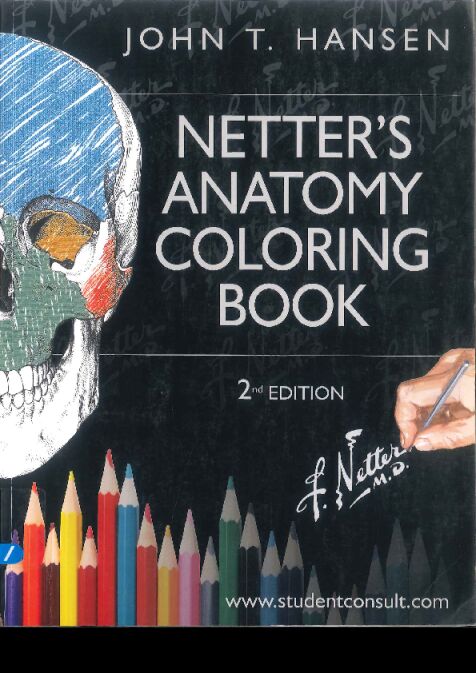
书名:Netter s anatomy coloring book
责任者:John T. Hansen. | Netter, Frank H.
出版时间:2014
出版社:Saunders/Elsevier
前言
Human anatomy is a fascinating and complex subject, and one that is interesting to virtually every one of us. Learning anatomy does not have to be difficult and can actually be enjoyable. Exploring human anatomy in a simple, systematic, and fun way is what the Netter's Anatomy Coloring Book is all about. This coloring book is for students of all ages; curiosity is the only prerequisite!A\The images in Netter's Anatomy Coloring Book are based on the famous beautifully rendered medical illustrations of human anatomy by Frank H. Netter, MD, as compiled in his Atlas of Human Anatomy. This anatomy atlas is the most widely used anatomy atlas in the world and is translated into 16 different languages, and with good reason. The Netter illustrations have withstood the test of time and have illuminated human anatomy for millions of students around the world.A\Why use an anatomy coloring book? The best reason, in my opinion, is because "active learning" always trumps passive learning. Seeing, doing, and learning go hand-in-hand; said another way, "eye to hand to mind to memory." This is how most of us learn best. Textbooks, flash cards, videos, and anatomy atlases all have their place in learning human anatomy, but those elements that engage us the most and allow us to participate in an active learning experience "cement" the material into our memory.A\The Netter's Anatomy Coloring Book approaches human anatomy by body system. Footnotes to the illustrated pages refer to Dr. Netter's Atlas of Human Anatomy and Netter's Clinical Anatomy—the sources of the original full-color, fully labeled illustrations—for your further review and reference. In each coloring book plate, the most important structures are emphasized. The coloring exercises, labels, text, bullet points of essential material, and tables are provided to help you understand why the carefully chosen views of the human body are important both anatomically and functionally. I intentionally did not over-label each image because I want you to focus on the most important aspects of the anatomy; however, this is your coloring book! Feel free to color everything you wish; add your own labels as desired; cover structures to quiz yourself; in short, use each image as creatively as you wish to enhance your learning experience. In most cases, I let you choose the colors you want but would encourage you to color arteries bright red, veins blue, muscles reddish-brown, nerves yellow, and lymph nodes green, as these are common colors used in most color atlases of anatomy. Finally, I think you probably will find that colored pencils work best; but if crayons, colored pens, highlighters, or markers are your preferred medium, by all means use them! Most of all, have fun learning anatomy—after all, it is your anatomy too! John T. HanseN, PhD
查看更多
目录
Chapter 1 Orientation and Introduction
1-1 Terminology
1-2 Body Planes and Terms of Relationship
1-3 Movements
1-4 The Cell
1-5 Epithelial Tissues
1-6 Connective Tissues
1-7 Skeleton
1-8 Joints
1-9 Synovial Joints
1-10 Muscle
1-11 Nervous System
1-12 Skin (Integument)
1-13 Body Cavities
Chapter 2 Skeletal System
2-1 Bone Structure and Classification
2-2 External Features of the Skull
2-3 Internal Features of the Skull
2-4 Mandible and Temporomandibular Joint
2-5 Vertebral Column
2-6 Cervical and Thoracic Vertebrae
2-7 Lumbar, Sacral, and Coccygeal Vertebrae
2-8 Thoracic Cage
2-9 Joints and Ligaments of the Spine
2-10 Pectoral Girdle and Arm
2-11 Shoulder Joint
2-12 Forearm and Elbow Joint
2-13 Wrist and Hand
2-14 Wrist and Finger Joints and Movements
2-15 Pelvic Girdle
2-16 Hip Joint
2-17 Thigh and Leg Bones
2-18 Knee Joint
2-19 Bones of the Ankle and Foot
2-20 Ankle and Foot Joints
Chapter 3 Muscular System
3-1 Muscles of Facial Expression
3-2 Muscles of Mastication
3-3 Extrao-cular Muscles
3-4 Muscles of the Tongue and Palate
3-5 Muscles of the Pharynx and Swallowing
3-6 Intrinsic Muscles of the Larynx and Phonation
3-7 Muscles of the Neck
3-8 Prevertebral Muscles
3-9 Superficial and Intermediate Back Muscles
3-10 Deep (Intrinsic) Back Muscles
3-11 Thoracic Wall Muscles
3-12 Anterior Abdominal Wall Muscles
3-13 Muscles of the Male Inguinal Region
3-14 Muscles of the Posterior Abdominal Wall
3-15 Muscles of the Pelvis
3-16 Muscles of the Perineum
3-17 Posterior Shoulder Muscles
3-18 Anterior Shoulder Muscles
3-19 Arm Muscles
3-20 Pronation and Supination of the Radio-ulna
3-21 Anterior Forearm Muscles
3-22 Posterior Forearm Muscles
3-23 Intrinsic Hand Muscles
3-24 Summary of Upper Limb Muscles
3-25 Gluteal Muscles
3-26 Posterior Thigh Muscles
3-27 Anterior Thigh Muscles
3-28 Medial Thigh Muscles
3-29 Anterior and Lateral Leg Muscles
3-30 Posterior Leg Muscles
3-31 Intrinsic Foot Muscles
3-32 Summary of Lower Limb Muscles
Chapter 4 Nervous System
4-1 Neuronal Structure
4-2 Glial Cells
4-3 Types of Synapses
4-4 Cerebrum
4-5 Cortical Connections
4-6 Midsagittal and Basal Brain Anatomy
4-7 Basal Ganglia
4-8 Limbic System
4-9 Hippocampus
4-10 Thalamus
4-11 Hypothalamus
4-12 Cerebellum
4-13 Spinal Cord I
4-14 Spinal Cord II
4-15 Spinal and Peripheral Nerves
4-16 Dermatomes
4-17 Brain Ventricles
4-18 Subarachnoid Space
4-19 Sympathetic Division of the ANS
4-20 Parasympathetic Division of the ANS
4-21 Enteric Nervous System
4-22 Cranial Nerves
4-23 Visual System I
4-24 Visual System II
4-25 Auditory and Vestibular Systems I
4-26 Auditory and Vestibular Systems II
4-27 Taste and Olfaction
4-28 Cervical Plexus
4-29 Brachial Plexus
4-30 Lumbar Plexus
4-31 Sacral Plexus
Chapter 5 Cardiovascular System
5-1 Composition of Blood
5-2 General Organization
5-3 Heart I
5-4 Heart II
5-5 Heart III
5-6 Heart IV
5-7 Features of Arteries, Capillaries, and Veins
5-8 Head and Neck Arteries
5-9 Head Arteries
5-10 Arteries of the Brain
5-11 Veins of the Head and Neck
5-12 Arteries of the Upper Limb
5-13 Arteries of the Lower Limb
5-14 Thoracic and Abdominal Aorta
5-15 Arteries of the Gastrointestinal Tract
5-16 Arteries of the Pelvis and Perineum
5-17 Veins of the Thorax
5-18 Veins of the Abdominopelvic Cavity
5-19 Portosystemic Anastomoses
5-20 Veins of the Upper Limb
5-21 Veins of the Lower Limb
5-22 Prenatal and Postnatal Circulation
Chapter 6 Lymphatic System
6-1 General Organization of the Lymphatic System
6-2 Innate Immunity
6-3 Adaptive Immunity
6-4 Thymus and Bone Marrow
6-5 Spleen
6-6 Tonsils, BALT, GALT, and MALT
6-7 Clinical Aspects of the Lymphatic System
Chapter 7 Respiratory System
7-1 Overview
7-2 Nasal Cavity and Nasopharynx
7-3 Paranasal Sinuses
7-4 Oropharynx, Laryngopharynx, and Larynx
7-5 Trachea and Lungs
7-6 Respiratory Mechanisms
Chapter 8 Gastrointestinal System
8-1 Overview
8-2 Oral Cavity
8-3 Teeth
8-4 Pharynx and Esophagus
8-5 Peritoneal Cavity and Mesenteries
8-6 Stomach
8-7 Small Intestine
8-8 Large Intestine
8-9 Liver
8-10 Gallbladder and Exocrine Pancreas
Chapters 9 Urinary System
9-1 Overview of the Urinary System
9-2 Kidney
9-3 Nephron
9-4 Renal Tubular Function
9-5 Urinary Bladder and Urethra
Chapter 10 Reproductive System
10-1 Overview of the Female Reproductive System
10-2 Ovaries and Uterine Tubes
10-3 Uterus and Vagina
10-4 Menstrual Cycle
10-5 Female Breast
10-6 Overview of the Male Reproductive System
10-7 Testis and Epididymis
10-8 Male Urethra and Penis
Chapter 11 Endocrine System
C2\11-1 Overview
11-2 Hypothalamus and Pituitary Gland
11-3 Pituitary Gland
11-4 Thyroid and Parathyroid Glands
11-5 Adrenal Glands
11-6 Pancreas
11-7 Puberty
11-8 Digestive System Hormones
查看PDF
查看更多
馆藏单位
中国医科院医学信息研究所