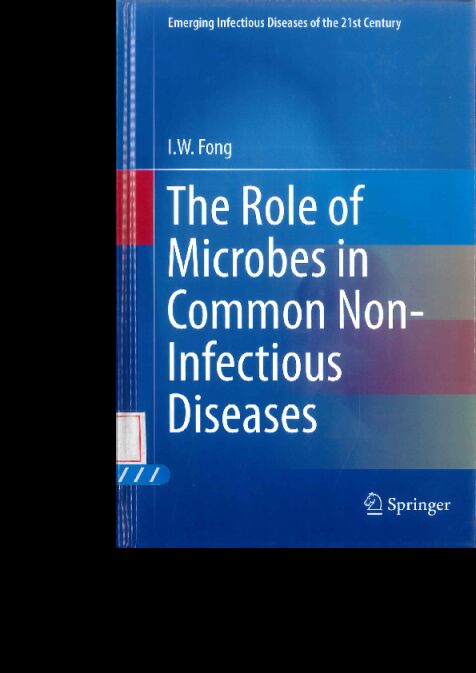
书名:The role of microbes in common non-infectious diseases
责任者:I.W. Fong. | Fong, I. W.
ISBN\ISSN:1493916696,9781493916696
前言
Our understanding of the pathogenesis and etiology of new and venerable diseases has progressed tremendously in the past 30 years, due to improved technology and advances in genomics and molecular science. However, there are several common diseases where the exact causation still eludes investigators, but intensive research over the past decade has provided clues to implicate a microbial role in pathogenesis and causation.
These medical conditions include common nonlife threatening illnesses that affect the daily function and quality of life, such as irritable bowel syndrome and chronic fatigue syndrome. But also microbial pathogenesis has been postulated for more serious disorders such as multiple sclerosis, diabetes mellitus, Crohn's disease, asthma, and rheumatoid arthritis; to potentially fatal and catastrophic conditions such as Alzheimer's disease, colon cancer, and atherosclerosis that leads to heart attacks and strokes.
A brief outline of these clinical conditions and others will be provided, with in-depth review of current understanding of the mechanisms and pathogenesis. The links to microbial pathogenesis will be reviewed from ongoing research, with exploration of theoretical microbial causes and potential for future clinical research and development of novel therapies.
This new volume in the series "Emerging Infectious Diseases of the 21st Century" should provide fodder for investigators and clinicians faced with these conditions, but more importantly to stimulate interest of new investigators and trainees to take a new and novel approach for investigating the mechanisms and causation of these baffling common disorders. Toronto, ON, Canada I.W. Fong
查看更多
目录
1 Irritable Bowel Syndrome and Microbial Pathogenesis 1
1.1 Background 1
1.2 Risk Factors 1
1.3 Pathophysiology 2
1.4 Microbial Link to IBS 3
1.4.1 Epidemiological Association 3
1.4.2 Prevalence of IBS 6
1.4.3 Risk Factors for PI-IBS and IBS 6
1.4.4 Genetic Factors 8
1.5 Mucosal Injury and Inflammation 9
1.5.1 Microbiological Data 12
1.5.1.1 Modulation of Gut Microbiota 13
1.6 Animal Models of IBS 17
1.7 Antibiotic and Probiotic Therapy in IBS 18
1.7.1 Probiotics in IBS 19
1.8 Summary and Conclusion 19
1.9 Future Directions 21
References 21
2 Microbes in Colon Cancer and Inflammatory Bowel Disease 29
2.1 Introduction 29
2.1.1 Risk Factors 29
2.2 Microbes and Colorectal Cancer 32
2.2.1 Animal Models of Colorectal Cancer 32
2.2.2 Mechanisms of Probiotics and Favorable Commensal Bacteria 34
2.2.3 Harmful Effects of Some Commensal Bacteria 35
2.3 Human Studies 36
2.4 Summary of Colorectal Microbial Pathogenesis 38
2.5 Microbes in Inflammatory Bowel Diseases 39
2.5.1 Background 39
2.5.2 Pathobiology of IBD 40
2.5.3 Microbes and Inflammatory Bowel Diseases 41
2.5.4 Dysbiosis of Intestinal Microbiota in IBD 44
2.5.5 Probiotics in IBD 49
2.5.6 Conclusion and Future Directions 50
References 50
3 The Role of Microbes in Obesity 59
3.1 Introduction 59
3.2 Pathophysiology of Obesity 59
3.2.1 Biology of Adipose Tissues 61
3.2.2 Brown Fat and Obesity 61
3.3 Gut Microbiota and Obesity 62
3.4 Oral Microbiota and Obesity 64
3.5 Diet and the Effect on Gut Microbiota 65
3.6 Gut Microbiota and Inflammation 66
3.6.1 Gut Microbiota on Energy Extraction and Balance 67
3.7 Viral Infection Implicated in Obesity 68
3.8 Conclusion 69
3.8.1 Future Directions 69
References 70
4 Microbes in the Pathogenesis of Diabetes Mellitus 75
4.1 Introduction 75
4.2 Pathogenesis of Insulin-Dependent Diabetes Type 1 76
4.3 Microbes in IDDM-1 Pathogenesis 77
4.3.1 Infection as an Etiological Factor in IDDM-1 77
4.3.2 Specific Viruses in IDDM1 78
4.4 The Hygiene Theory of IDDM 79
4.5 Intestinal Microbiota in the Development of IDDM 80
4.6 Other Microbes Implicated in IDDM-1 82
4.7 Type 2 Diabetes and Microbial Pathogenesis 82
4.7.1 Other Microbes Linked to Type 2 Diabetes 84
4.8 Summary 84
4.9 Future Directions 84
References 85
5 Asthma and Microbes: A New Paradigm 89
5.1 Introduction 89
5.2 Pathogenesis of Asthma 89
5.2.1 Pathological Aspects of Asthma 90
5.3 Infection and Asthma 91
5.3.1 Asthma Exacerbations and Infection 91
5.3.2 Viruses in Early Life as a Cause of Asthma 93
5.3.3 Mechanisms of Virus-Related Asthma 95
5.4 The Hygiene Hypothesis of Asthma 96
5.4.1 Microbial Colonization and Asthma 97
5.5 Microbes and Asthma at the Cellular Level 100
5.6 Alternative Hypotheses Linking Microbes and Asthma 101
5.7 Probiotics for Allergic Diseases 102
5.8 Conclusion 103
5.9 Future Directions 104
References 104
6 Chronic Fatigue Syndrome: Searching for a Microbial Etiology 111
6.1 Introduction 111
6.2 Is Chronic Fatigue Syndrome a Psychosocial Disorder? 112
6.3 Pathobiology of Chronic Fatigue Syndrome 113
6.3.1 The Central Sensitizing Theory 115
6.4 Infections and Chronic Fatigue Syndrome 116
6.4.1 Interpretation of Current Data on Microbes in Chronic Fatigue Syndrome 119
6.5 Conclusion 121
6.6 Future Direction 122
References 123
7 Can Microbes Play a Role in the Pathogenesis of Alzheimer Disease? 129
7.1 Alzheimer Disease Background 129
7.1.1 Genetics of Alzheimer Disease 130
7.1.2 Pathogenesis of Alzheimer Disease 130
7.1.3 Risk Factors for Alzheimer Disease 131
7.2 Biomarkers in Alzheimer Disease 132
7.3 Microbes and Alzheimer Disease 134
7.3.1 Potential Microbial Agents 134
7.3.1.1 Viruses 134
7.3.1.2 Bacteria and Alzheimer Disease 135
7.4 Unraveling the Link Between Microbes and Alzheimer Disease 137
7.5 Conclusion 139
7.6 Future Directions 141
References 141
8 Multiple Sclerosis and Microbes 147
8.1 Introduction 147
8.2 Pathobiology of Multiple Sclerosis 147
8.2.1 Pathogenesis of Multiple Sclerosis 148
8.2.2 Hypovitaminosis D in MS 149
8.3 Role of Microbes in Multiple Sclerosis 150
8.3.1 Specific Microbes 151
8.3.2 Epstein-Barr Virus 151
8.3.3 Human Herpesvirus-6 in Multiple Sclerosis 153
8.3.4 Human Retrovirus in Multiple Sclerosis 154
8.4 Conclusion 155
8.5 Future Direction 156
References 156
9 The Role of Infections and Microbes in Atherosclerosis 161
9.1 Introduction 161
9.2 Biology of Atherosclerosis 162
9.3 Risk Factors and Pathogenesis 162
9.4 Possible Mechanisms of Infection and Microbes 163
9.5 Specific Microbes in Atherosclerosis 165
9.5.1 HIV Infection 165
9.5.1.1 Mechanisms in HIV-Associated Atherosclerosis 166
9.5.2 Chlamydia pneumoniae and Atherosclerosis 168
9.5.3 Periodontal Pathogens in Atherosclerosis 169
9.5.4 Burden of Microbes and Gut Microbiota on Atherosclerosis 171
9.6 Conclusion 172
9.7 Future Directions 173
References 173
Index 179
查看PDF
查看更多
馆藏单位
中国医科院医学信息研究所