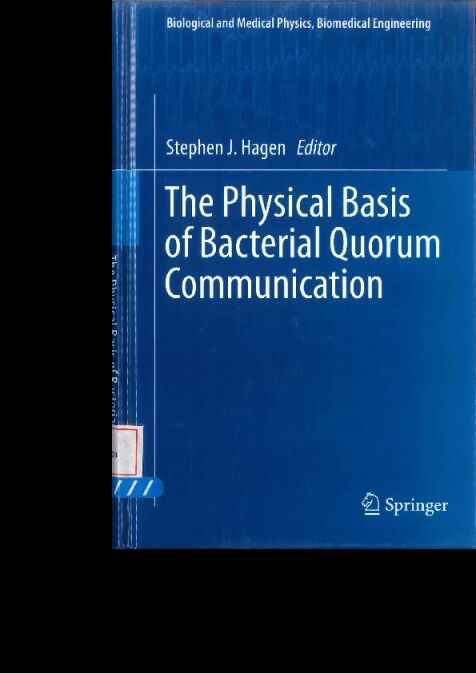
书名:Physical basis of bacterial quorum communication
ISBN\ISSN:9781493914012,1493914014
摘要
Quorum sensing (QS) describes a chemical communication behavior that is nearly universal among bacteria. Individual cells release a diffusible small molecule (an autoinducer) into their environment. A high concentration of this autoinducer serves as a signal of high population density, triggering new patterns of gene expression throughout the population. However QS is often much more complex than this simple census-taking behavior. Many QS bacteria produce and detect multiple autoinducers, which generate quorum signal cross talk with each other and with other bacterial species. QS gene regulatory networks respond to a range of physiological and environmental inputs in addition to autoinducer signals. While a host of individual QS systems have been characterized in great molecular and chemical detail, quorum communication raises many fundamental quantitative problems which are increasingly attracting the attention of physical scientists and mathematicians. Key questions include: What kinds of information can a bacterium gather about its environment through QS? What physical principles ultimately constrain the efficacy of diffusion-based communication? How do QS regulatory networks maximize information throughput while minimizing undesirable noise and cross talk? How does QS function in complex, spatially structured environments such as biofilms? Previous books and reviews have focused on the microbiology and biochemistry of QS. With contributions by leading scientists and mathematicians working in the field of physical biology, this volume examines the interplay of diffusion and signaling, collective and coupled dynamics of gene regulation, and spatiotemporal QS phenomena. Chapters will describe experimental studies of QS in natural and engineered or microfabricated bacterial environments, as well as modeling of QS on length scales spanning from the molecular to macroscopic. The book aims to educate physical scientists and quantitative-oriented biologists on the application of physics-based experiment and analysis, together with appropriate modeling, in the understanding and interpretation of the pervasive phenomenon of microbial quorum communication.
查看更多
目录
1 Introduction 1
2 Modeling of Signal Transduction by the Quorum-Sensing Pathway in the Vibrios 7
3 Stochastic Effects in Quorum Sensing 19
4 Spatial Structure of Microbes in Nature and the Biophysics of Cell-Cell Communication 53
5 Functionality of Autoinducer Systems in Complex Environments 83
6 Localization of Quorum Sensing by Extracellular Polymeric Substances (EPS): Considerations of In Situ Signaling 105
7 Swimming in Information? Physical Limits to Learning by Quorum Sensing 123
8 Interplay Between Sibling Bacterial Colonies 145
9 Mathematical Insights into the Role of Feedback in Quorum-Sensing Architectures 163
10 The Role of Biosurfactants in Bacterial Systems 189
11 Ecology of a Simple Synthetic Biofilm 205
12 Engineering Cell-to-Cell Communication to Explore Fundamental Questions in Ecology and Evolution 227
Index 249
查看PDF
查看更多
馆藏单位
中国医科院医学信息研究所