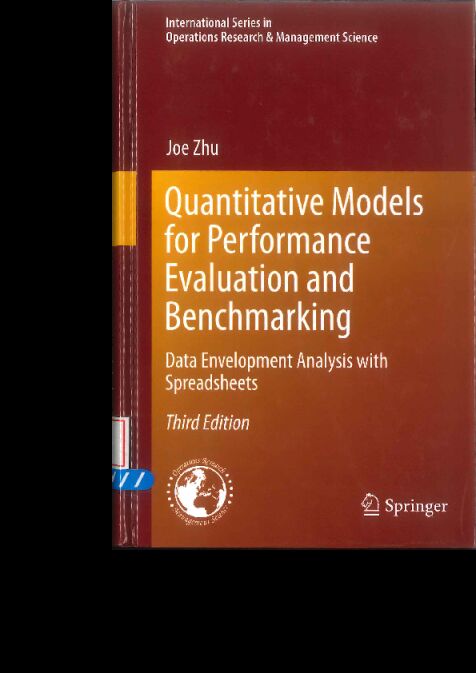
书名:Quantitative models for performance evaluation and benchmarking
摘要
The author is one of the prominent researchers in the field of Data Envelopment Analysis (DEA), a powerful data analysis tool that can be used in performance evaluation and benchmarking. This book is based upon the author’s years of research and teaching experiences. It is difficult to evaluate an organization’s performance when multiple performance metrics are present. The difficulties are further enhanced when the relationships among the performance metrics are complex and involve unknown tradeoffs. This book introduces Data Envelopment Analysis (DEA) as a multiple-measure performance evaluation and benchmarking tool. The focus of performance evaluation and benchmarking is shifted from characterizing performance in terms of single measures to evaluating performance as a multidimensional systems perspective. Conventional and new DEA approaches are presented and discussed using Excel spreadsheets – one of the most effective ways to analyze and evaluate decision alternatives. The user can easily develop and customize new DEA models based upon these spreadsheets. DEA models and approaches are presented to deal with performance evaluation problems in a variety of contexts. For example, a context-dependent DEA measures the relative attractiveness of similar operations/processes/products. Sensitivity analysis techniques can be easily applied, and used to identify critical performance measures. Two-stage network efficiency models can be utilized to study performance of supply chain. DEA benchmarking models extend DEA’s ability in performance evaluation. Various cross efficiency approaches are presented to provide peer evaluation scores. This book also provides an easy-to-use DEA software – DEAFrontier. This DEAFrontier is an Add-In for Microsoft® Excel and provides a custom menu of DEA approaches. This version of DEAFrontier is for use with Excel 97-2013 under Windows and can solve up to 50 DMUs, subject to the capacity of Excel Solver. It is an extremely powerful tool that can assist decision-makers in benchmarking and analyzing complex operational performance issues in manufacturing organizations as well as evaluating processes in banking, retail, franchising, health care, public services and many other industries.
查看更多
目录
1 Data Envelopment Analysis 1
1.1 Performance Evaluation and Tradeoffs 1
1.2 Data Envelopment Analysis 3
1.3 Performance Metrics Classified as Inputs and Outputs 5
1.4 Number of DMUs vs Number of Inputs and Outputs 7
1.5 Measuring and Managing Performance 8
References 9
2 Envelopment DEA Models 11
2.1 Introduction 11
2.2 Variable Returns-to-Scale (VRS) Model 12
2.3 DEA Slacks 17
2.4 Other Envelopment Models 19
2.5 Envelopment Models in Spreadsheets 21
2.5.1 Input-Oriented VRS Envelopment Spreadsheet Model 22
2.5.2 Using Solver 23
2.5.3 Setting the Objective Cell and Changing Variable Cells 24
2.5.4 Adding Constraints and Selecting Solving Method 24
2.5.5 Solving the Model 26
2.5.6 Automating the DEA Calculation 27
2.5.7 Second-Stage Slack Calculation 32
2.5.8 Other Input-Oriented Envelopment Spreadsheet Models 34
2.6 Output-Oriented Envelopment Spreadsheet Models 34
2.7 Using OpenSolver 39
2.8 Solving DEA Using DEAFrontier Software 42
2.8.1 Data Sheet Format 44
2.8.2 Envelopment Models 45
References 48
3 Multiplier DEA Model 49
3.1 Multiplier Models in Spreadsheets 49
3.2 Weight Restrictions in Multiplier Models 54
3.3 Solving Multiplier Models Using DEAFrontier 58
References 60
4 DEA Cross Efficiency 61
4.1 Introduction 61
4.2 Cross Efficiency 62
4.3 Cross Efficiency in Spreadsheets 65
4.4 Game Cross Efficiency 66
4.4.1 Input-oriented Game Cross Efficiency 67
4.4.2 Output-oriented Game Cross Efficiency 73
4.4.3 Output-oriented VRS Game Cross Efficiency 77
4.5 Maximum Log Cross Efficiency 81
4.5.1 Multiplicative DEA Model 81
4.5.2 Maximum Log Cross Efficiency 86
References 92
5 Slack-Based DEA Models 93
5.1 Slack-Based Models 93
5.2 Slack-Based Models in Spreadsheets 95
5.3 Solving Slack-Based DEA Model Using DEAFrontier Software 100
References 101
6 Measure-Specific DEA Models 103
6.1 Measure-Specific Models 103
6.2 Measure-Specific Models in Spreadsheets 105
6.3 Performance Evaluation of Fortune 500 Companies 106
6.3.1 Identification of Best Practice Frontier 107
6.3.2 Measure-Specific Performance 108
6.3.3 Benchmark Share 112
6.4 Solving Measure-Specific Models Using DEAFrontier Software 119 References 119
7 Non-radial DEA Models and DEA with Preference 121
7.1 Non-radial DEA Models 121
7.2 DEA with Preference Structure and Cost/Revenue Efficiency 123
7.3 DEA/Preference Structure Models in Spreadsheets 127
7.4 DEA and Multiple Objective Linear Programming 128
7.4.1 Output-oriented DEA 129
7.4.2 Input-oriented DEA 133
7.4.3 Non-Orientation DEA 134
7.5 Using DEAFrontier Software 135
7.5.1 Non-radial Models 135
7.5.2 Preference-Structure Models 135
7.5.3 Cost Efficiency, Revenue Efficiency and Profit Efficiency 137 References 140
8 Modeling Undesirable Measures 141
8.1 Introduction 141
8.2 Efficiency Invariance 141
8.3 Undesirable Outputs 143
8.4 Undesirable Inputs 145
8.5 Solving DEA Using DEAFrontier Software 148
8.6 Negative Data 148
References 151
9 Context-dependent Data Envelopment Ana lysis 153
9.1 Introduction. 153
9.2 Stratification DEA Method 154
9.3 Input-oriented Context-dependent DEA 158
9.3.1 Attractiveness 158
9.3.2 Progress 164
9.4 Output-oriented Context-dependent DEA 166
9.5 Solving DEA Using DEAFrontier Software 171
References 174
10 Super Efficiency 175
10.1 Super-Efficiency DEAModels 175
10.2 Infeasibility of Super-efficiency DEA Models 177
10.2.1 Output-Oriented VRS Super-Efficiency Model 183
10.2.2 Other Output-oriented Super-efficiency Models 188
10.2.3 Input-Oriented VRS Super-Efficiency Model 188
10.2.4 Other Input-oriented Super-efficiency Models 192
10.3 Models for Dealing with Infeasibility 193
10.4 Zero Data and Infeasibility 197
10.5 Slack-Based Super Efficiency 201
10.6 Solving Super-Efficiency Using DEA Frontier 203
References 205
11 Sensitivity Analysis 207
11.1 DEA Sensitivity Analysis 207
11.2 Stability Region 209
11.2.1 Input Stability Region 209
11.2.2 Output Stability Region 213
11.2.3 Geometrical Presentation of Input Stability Region 215
11.3 Infeasibility and Stability 222
11.4 Simultaneous Data Change 226
11.4.1 Sensitivity Analysis Under CRS 228
11.4.2 Sensitivity Analysis Under VRS 237
11.4.3 Spreadsheet Models for Sensitivity Analysis 239
11.5 Sensitivity Analysis Using DEAFrontier 243
References 244
12 Benchmarking Models 245
12.1 Introduction 245
12.2 Variable-benchmark Model 245
12.3 Fixed-benchmark Model 255
12.4 Fixed-benchmark Model and Efficiency Ratio 259
12.5 Minimum Efficiency Model 263
12.6 Buyer-seller Efficiency Model 267
12.7 Acceptance System Decision 270
12.8 Solving Benchmarking Models Using DEAFrontier 274
12.8.1 Variable-Benchmark Models 274
12.8.2 Fixed-Benchmark Models 275
12.8.3 Minimum Efficiency Models 275
References 276
13 Returns-to-Scale 277
13.1 Introduction 277
13.2 RTS Regions 277
13.3 RTS Estimation 278
13.3.1 VRS and CRS RTS Methods 278
13.3.2 Improved RTS Method 280
13.3.3 Spreadsheets for RTS Estimation 282
13.4 Scale Efficient Targets 286
13.5 Solving DEA Using DEAFrontier Software 288
References 289
14 DEA Models for Two-Stage Network Processes 291
14.1 Introduction 291
14.2 VRS Two-Stage Model 292
14.3 CRS Two-Stage Model: Centralized Model 298
14.4 CRS Two-Stage Model: Equivalence 301
14.5 Frontier Projection 304
14.6 CRS Two-Stage Model: Leader-Follower Model 305
14.7 Solving Two-Stage Network Process Using DEAFrontier 307
References 309
15 Models for Evaluating Supply Chains and Network Structures 311
15.1 Supply Chain Efficiency 311
15.2 Supply Chain Efficiency 312
15.2.1 Supply Chain as an Input-Output System 313
15.2.2 Supply Chain Efficiency Model 316
15.2.3 An example 319
15.3 Cooperative and Non-Cooperative Approaches 324
15.3.1 The Non-Cooperative Model 325
15.3.2 The Cooperative Model 331
15.4 Additive Efficiency Decomposition to Network Structures 334
15.4.1 DEA Model for General Multi-Stage Serial Processes 335
15.4.2 General Multistage Processes 338
15.4.3 An Illustrative Application 340
References 344
16 Congestion 345
16.1 Congestion Measure 345
16.2 Congestion and Slacks 350
16.3 Slack-Based Congestion Measure 353
16.4 Solving Congestion Using DEAFrontier 359
References 360
17 Identifying Critical Measures in DEA 363
17.1 Introduction 363
17.2 Performance Evaluation and DEA 363
17.3 Identifying Critical Output Measures 368
17.4 Identifying Critical Input Measures 369
17.5 Numerical Example and Extension 370
17.6 Application to Fortune E-Companies 372
References 381
18 Interval and Ordinal Data in DEA 383
18.1 Introduction 383
18.2 Imprecise Data 384
18.3 Multiplier IDEA (M1DEA): Standard DEA Model Approach 387
18.3.1 Converting the Bounded Data into a Set of Exact Data 387
18.3.2 Converting the Weak Ordinal Data into a Set of Exact Data 388
18.3.3 Numerical Illustration 389
18.3.4 Converting the Strong Ordinal Data and Ratio Bounded Data into a Set of Exact Data 392
18.4 Treatment of Weight Restrictions 393
18.5 Envelopment IDEA (EIDEA) 395
18.6 Conclusions 397
References 398
19 DEAFrontier Software 399
19.1 Introduction 399
19.2 DEA Bootstrapping 399
19.3 Free Disposal Hull (FDH) 400
19.4 Mamquist Approach 402
19.5 DEAFrontier Models 404
References 407
Licensing and Warranty Agreement 409
Index 411
查看PDF
查看更多
馆藏单位
中国医科院医学信息研究所