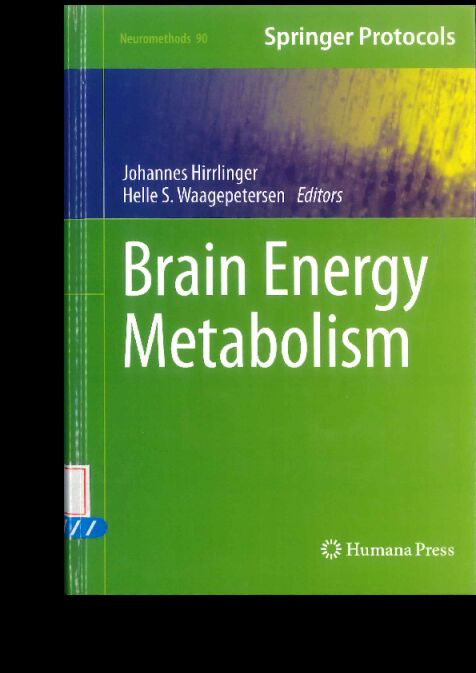
书名:Brain energy metabolism
责任者:Johannes Hirrlinger | Helle S. Waagepetersen.
ISBN\ISSN:1493910582,9781493910588
出版时间:2014
出版社:Heidelberg,Springer
前言
The brain is the major information processing organ of animals and humans. These functions crucially depend on an appropriate supply of energy, and failure of a sufficient supply of energy will very quickly severely disturb brain functions as, e.g., during stroke. While the brain in humans only constitutes 2 % of body weight, it consumes about 20 % of the total oxygen inhaled, illustrating that the brain consumes a major proportion of the energy of an organism. However, while this fact has long been appreciated, it has been (and is still) very difficult to elucidate the pathways and regulation of brain energy metabolism for several reasons: (1) The brain is not a homogenous tissue, and it contains many different types of cells such as neurons, astrocytes, oligodendrocytes, microglial cells, and others. (2) Even within a single major cell type, like neurons, brain energy metabolism is not equal but works differently in different types of neurons. Similarly, also glial cells show a so far underappreciated heterogeneity within a single cell type. (3) Glial cells crucially contribute to brain energy metabolism. These cells elaborate extensive metabolic interactions with neurons and other glial cells thereby making brain energy metabolism very complex. In addition, at least astrocytes contribute crucially to blood flow regulation. (4) The analysis of metabolites of brain energy metabolism with a sufficient spatial and temporal resolution to investigate the contribution of different cell types in vivo is still a major technical challenge. (5) Some key metabolites which are involved in energy metabolism, like glutamate, have additional functions within the brain (glutamate is the major excitatory neurotransmitter), thereby adding additional complexity to the pathways and regulation of brain energy metabolism.
Therefore, this volume aims at presenting different technologies allowing the investigation of brain energy metabolism on different levels of complexity. Model systems will be discussed, starting from the reductionist approach like primary cell cultures which allow for assessing the properties and functions of a single brain cell type with many different types of analysis, however, at the expense of neglecting the interaction between cell types in the brain. On the other end, analysis in animals and humans in vivo will be discussed maintaining the full complexity of the tissue and the organism, but making high demands on the methods of analysis as an appropriate spatial and temporal resolution remains still challenging. Along these lines, this book presents many analytical technologies:
The chapter by McKenna and Hopkins (Chap. 1) focuses on the methods for determining the rates of ~14CO_2 production as a measure of energy production from a given substrate in freshly isolated synaptosomes and mitochondria from brain. The techniques and procedures for the isolation of synaptosomes from rat and/or mouse brain of different ages and for the isolation of mitochondria are described in detail.
The uptake and release of metabolites is of major importance for brain energy homeo-stasis. Therefore, the properties of transport proteins within the plasma membrane, which mediate this exchange of metabolites, are crucial parameters. Holger M. Becker (Chap. 2) presents in his chapter a method to analyze transport activity in a heterologous system, the Xenopus oocyte, showing the example of monocarboxylate transporters (MCTs). MCTs cotransport protons with their substrates resulting in intracellular acidification. Therefore, after injection of the appropriate cDNAs followed by expression of the transporter in the oocyte membrane, transport activity can be monitored using pH-sensitive microelectrodes impaled into the oocyte.
A widely used approach to reduce the complexity of brain metabolism is to use primary cell cultures which are strongly enriched in a single cell type allowing to study metabolic properties of a single type of brain cells. We are presenting three chapters that to some extent describe in detail the procedures for the culturing of primary neurons and astrocytes. The procedures described vary with regard to the origin of the tissue, mouse and rat, and brain area used for the cultures. The chapter by Tulpule et al. (Chap. 3) describes the experimental details for the preparation and the culturing of whole brain rat astrocytes and rat cerebellar granule neurons. Assays including data analysis for measuring glucose consumption, lactate production, content and export of glutathione, and viability of these cell cultures are described. In the chapter by Walls et al. (Chap. 4), details regarding the procedures for preparing primary cultures of neurons and astrocytes and also cocultures of these cell types isolated from either mice cerebral cortex or cerebellum are described. They discuss the various aspects to be considered when designing an incubation experiment with stable isotopes, i.e., ~13C- and ~15N-containing substrates to provide information about cellular metabolism. A detailed outline of the mass spectrometry data analysis procedure and interpretation tools is presented. Amaral et al. (Chap. 5) provide a comprehensive description of how to design ~13C metabolic flux analysis and apply the modeling to data obtained from incubations of mice cerebellar neurons and rat cortical astrocytes in culture with [1-~13C]glucose. The chapter includes details on how to prepare the cultures and the required analytical procedures, ~13C nuclear magnetic resonance (NMR), mass spectroscopy coupled to gas chromatography (GC-MS) for measurement of isotopic enrichment as well as high-pressure liquid chromatography (HPLC) for total amount of amino acids.
A major recent advance in the methodology to analyze metabolism is presented in the chapter by Barros and colleagues (Chap. 6). The use of genetically encoded fluorescent sensors for metabolites is described which allow real-time measurements of several metabolites within single cells using Foerster resonance energy transfer (FRET)-based fluorescence microscopy. Showing the example of a glucose sensor, the procedures used to visualize intracellular glucose concentration are presented. In combination with pharmacological treatments, parameters like the glycolytic flux can also be deduced from these measurements. Finally, mathematical simulations are presented which allow a profound interpretation of the data.
Mitochondria are a central organelle for the energy status of all types of brain cells. The functional state of mitochondria is strongly dependent on its membrane potential. Corona and Duchen (Chap. 7) describe how fluorescent dyes can be used to measure the mitochondrial membrane potential both using fluorescence microscopy and flow cytometry. They describe the advantages and disadvantages of several dyes in relation to different applications allowing the readers to design the best experimental setting for their own questions.
Fernandez-Fernandez and Bolanos (Chap, 8) describe in minutiae all necessary steps to implement RNA interference as a tool to selectively downregulate protein function in a laboratory that is not used to work with gene database information and the required technical skills. They also provide clues on how to transfect hard-to-transfect cells such as primary neuronal cultures.
What is the concentration of a metabolite of interest at a specific place within brain tissue at a specific point of time? Walenta and colleagues (Chap. 9) describe in their chapter the method of Induced Metabolic Bioluminescence Imaging (imBI), which allows these questions to be addressed. By quickly freezing brain tissue and using kryosections, the original distribution of metabolites is maintained within the tissue slice. Using appropriate enzyme mixtures, metabolites such as ATP, glucose, lactate and pyruvate are visualized by emission of light by luciferases. Matching the luminescence with histological images allow to localize these metabolites within the tissue.
Rae and Balcar (Chap. 10) describe how to make and maintain brain tissue slices for metabolic studies and how to use the technique to conduct neurochemical experiments and how to extract metabolic data using NMR spectroscopy. They also describe the use of metabolomics multivariate statistical approaches in neuropharmacology.
Mathiesen et al. (Chap. 11) present the basis for measuring brain activity and metabolism in rats and mice in vivo. They describe animal preparation procedures, the origin of extracellularly recorded electrical signals, and methods for recording cerebral blood flow, tissue partial pressure of oxygen, and cytosolic calcium transients. Protocols in which these measurements are applied in combination are also provided.
Another method for measuring cerebral blood flow both in experimental animals and human patients is presented by St. Lawrence and colleagues (Chap. 12). They provide an in-depth introduction to one approach of near-infrared spectroscopy (NIRS) based on tracer kinetic modelling, which allows for quantifying cerebral hemodynamics.
Mason et al. (Chap. 13) describe fundamentals of ~13C magnetic resonance spectroscopy (MRS). They outline how strengths of specialized techniques to detect ~13C make them suitable to answer particular research questions regarding brain metabolism, and present how these techniques can be applied to study metabolic pathways and compartmentation. They consider the different types of biological sampling, e.g., in vivo, ex vivo, in situ, for ~13C MRS, and provide details on metabolic modeling approaches.
The chapter by Gjedde (Chap. 14) is an overview of the quantitative method of PET imaging with fluorodeoxyglucose in human brain as a measurement of the absolute regional glucose phosphorylation rates. The chapter includes issues of method precision and accuracy applied to high-resolution research tomography. Moreover, a description of mathematical modeling of the dynamic brain records of the uptake of the tracer is provided.
In summary, this volume presents an overview of a number of state-of-the-art model systems and technologies used to investigate brain energy metabolism. In addition, the limitations and pitfalls of these technologies in relation to the different model systems and their level of complexity are also discussed. Therefore, we hope that this volume will provide a guide for researchers interested in brain energy metabolism thereby stimulating more research in this exciting and very important field. Leipzig, Germany Johannes Hirrlinger; Copenhagen, Denmark Helle S. Waagepetersen
查看更多
目录
Series Preface v
Preface vii
Contributors xiii
1 Determination of CO_2 Production in Subcellular Preparations Like Synaptosomes and Isolated Mitochondria Using ~14C-Labeled Substrates and Radioactive CO_2 Measurements 1
Mary C. McKenna and Irene B. Hopkins
2 Transport of Lactate: Characterization of the Transporters Involved in Transport at the Plasma Membrane by Heterologous Protein Expression in Xenopus Oocytes 25
Hotger M. Becker
3 Primary Cultures of Astrocytes and Neurons as Model Systems to Study the Metabolism and Metabolite Export from Brain Cells 45
Ketki Tulpule, Michaela C. Hohnholt, Johannes Hirrlinger, and Ralf Dringen
4 Metabolic Mapping of Astrocytes and Neurons in Culture Using Stable Isotopes and Gas Chromatography-Mass Spectrometry (GC-MS) 73
Anne B. Walls, Lasse K. Bak, Ursula Sonnewald, Arne Schousboe, and Helle S. Waagepetersen
5 Metabolic Flux Analysis Tools to Investigate Brain Metabolism In Vitro 107
Ana I. Amaral, Paula M. Alves, and Ana P. Teixeira
6 Fluorescent Nanosensor Based Flux Analysis: Overview and the Example of Glucose 145
L. Felipe Barros, Felipe Baeza-Lehnert, Roeio Valdebenito, Sebastian Ceballo, and Karin Alegria
7 Mitochondrial Bioenergetics Assessed by Functional Fluorescence Dyes 161
Juan Carlos Corona and Michael R. Duchen
8 RNA Interference as a Tool to Selectively Down-Modulate Protein Function 177
Seila Fernandez-Fernandez and Juan P. Bolanos
9 Localizing and Quantifying Metabolites In Situ with Luminometry: Induced Metabolic Bioluminescence Imaging (imBI) 195
Stefan Walenta, Nadine F. Voelxen, Ulrike G.A. Sattler, and Wolfgang Mueller-Klieser
10 A Chip Off the Old Block: The Brain Slice as a Model for Metabolic Studies of Brain Compartmentation and Neuropharmacology 217
Caroline Rae and Vladimir J. Balcar
11 Integrated Measurements of Electrical Activity, Oxygen Tension, Blood Flow, and Ca~2+-Signaling in Rodents In Vivo 243
Clam Mathiesen, Kirsten Thomsen, and Martin Lauritzen
12 Measuring Cerebral Hemodynamics and Energy Metabolism by Near-Infrared Spectroscopy 265
Keith St. Lawrence, Kyle Verdecchia, Jonathan Elliott, and Mamadou Diop
13 Compartmental Analysis of Metabolism by ~13C Magnetic Resonance Spectroscopy 293
Graeme F. Mason, Lihong Jiang, and Kevin L. Behar
14 Positron Emission Tomography of Brain Glucose Metabolism with [~18F]Fluorodeoxyglucose in Humans 341
Albert Gjedde
Index 365
查看PDF
查看更多
馆藏单位
中国医科院医学信息研究所