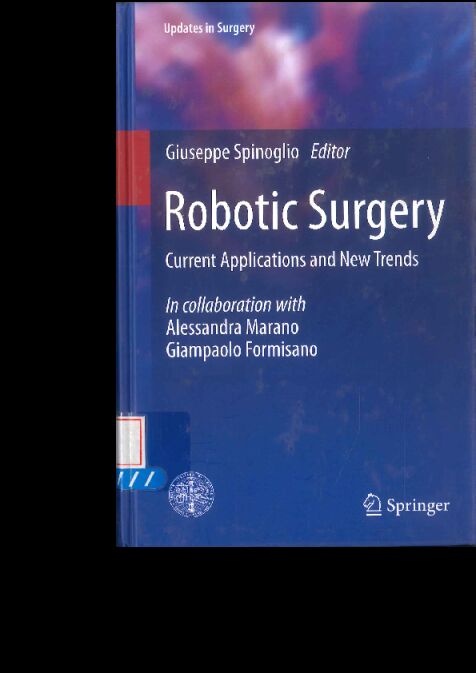
书名:Robotic surgery
责任者:Giuseppe Spinoglio | ; forewords Giorgio De Toma | Francesco Corcione. | Marano, Alessandra. | Formisano, Giampaolo.
ISBN\ISSN:8847057132,9788847057135
前言
Robotics entered the lives of humans more than fifty years ago, with the technology being applied to engine construction.A\In medicine, the use of robotics was established in the early 2000s with the dissemination of the outcomes of the nerve-sparing prostatectomy for cancer. In urology, and later in gynecology, robotics has achieved an immediate and favorable response and subsequent widespread usage. On the other hand, in general surgery its application was limited initially to procedures with a high degree of difficulty that could especially benefit from the advantages of the robotic suturing. Only at the end of the first decade of the 2000s, was robotics continuously applied to colorectal and digestive surgery, especially by Korean and Italian surgeons.A\The da Vinci® System of Intuitive Surgical Inc. is the only robotic platform existing today and has undergone several evolutions from 1998 to present: standard three and four-arm, S™ HD, Si™ HD (including Si™ -e) and the newest Xi™.A\The complex nature of the setup of the first models and the feature of working in fixed and narrow surgical fields has hampered its routine use in general surgery. Indeed, while its users consider the robotic system as a revolutionary innovation, the opponents emphasize costs, time-consuming procedures and the lack of clinical evidence when compared to laparoscopy. Many of the issues related to the robotic setup and its time-spending applications have been overcome by the technical characteristics of the new models and by the standardization of surgical procedures, similar to what happened to surgery after the pioneering phase.A\Regarding robotic benefits, three different types of problems can be identified:1.Robotics has been applied to general surgery for little more than five years and for less time with a standardized technique: randomized clinical trials with adequate follow-up providing sound data are expected to be available in approximately ten years, as occurred with the CLASSIC and COLOR studies for oncological outcomes. 2.About 3,000 da Vinci® systems of different generations are currently installed worldwide and less than 2,000 are applied in general surgery for different procedures: in such conditions, it is difficult to collect a large enough sample to be compared with single laparoscopic procedures. Comparative studies on short-term outcomes have been published to date but they have been performed on small series.3.In robotic surgery, as occurred with other approaches, there is a learning curve. The number of robotic-experienced surgeons is a small percentage of those who have decided to implement it: this specific issue makes it hard to recruit homogeneous centers involved in studies (the same surgeon may be very experienced in laparoscopic techniques but not in robotic ones). Nevertheless, the following main issues need to be underlined: •To date, robotics technology has advantages over other present techniques that are absolutely clear. Its superiority over an action performed manually results mainly in the 3DHD ision, up to 10x magnification, the EndoWrist® instruments with seven degrees of freedom and the intuitive motion. •In every part of the world, surgeons who had the patience and perseverance to overcome the learning curve have not abandoned robotic surgery. •Surgeons who are not convinced of the advantages of robotic surgery are sticking to their opinion, as for the reasons mentioned above, these benefits cannot be demonstrated as yet.A\The purpose of this book is to spread the robotic surgical technique for standardized procedures with the most recent updates. Since Italian surgeons were among the pioneers of this surgery, I had the pleasure of hosting in this volume both experiences of the finest ones and those of surgeons who have spread robotics abroad (i.e. Profs. Enrico Benedetti, Pier Cristoforo Giulianotti and Alessio Pigazzi). I sincerely thank President Giorgio De Toma and all SIC's Board for entrusting me with the lecture at the 116th SIC Congress and the subsequent writing of this book, with a focus on innovation, even when it is still questioned. Finally, I would like to thank my assistants for their sound collaboration, mainly Alessandra Marano and Giampaolo Formisano: without them, this book would never have been completed. Alessandria, September 2014. Giuseppe Spinoglio
查看更多
目录
1 History of Robotic Surgery 1
Part I Neck and Thoracic Surgery
2 Transaxillary Thyroidectomy and Parathyroidectomy 15
3 Zenker Diverticulum Treatment 23
4 Thoracic Surgery 29
Part II Upper Gastrointestinal Surgery
5 Esophagectomy for Cancer 43
6 Anti-reflux Procedures and Cardioesophagomyotomy 51
7 Gastrectomy for Cancer 59
8 Robotic Subtotal Gastrectomy: a Modified Korean Technique 73
Part III Hepatobiliopancreatic Surgery
9 Hepatic Resections 83
10 Biliary Tract Tumors (Resection and Reconstruction) 95
11 Pancreatic Surgery for Cancer 105
Part IV Lower Gastrointestinal Surgery
12 Right Colectomy for Cancer: Three-arm Technique 117
13 Right Colectomy with Complete Mesocolic Excision: Four-arm Technique 125
14 Left Colectomy and Segmental Resections for Cancer 133
15 Hybrid Robotic Technique for Rectal Cancer: Low Anterior Resection and Perineal Resection 147
16 Full-robotic Technique for Rectal Cancer 159
17 Robotic Surgery for Complicated Diverticulitis 171
Part V New Technologies in Robotic Platforn
18 Single-SiteTM Surgery 179
19 ICG Fluorescence: Current and Future Applications 193
Part VI Miscellany
20 Splenectomy and Hemisplenectomy 209
21 Transperitoneai Adrenalectomy 217
22 Robotic-assisted Organ Transplantation 225
查看PDF
查看更多
馆藏单位
中国医科院医学信息研究所