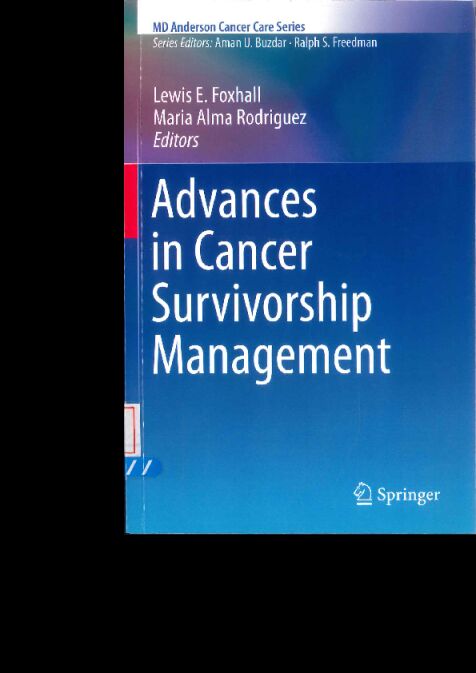
书名:Advances in cancer survivorship management
责任者:Lewis E. Foxhall | Maria Alma Rodriguez
ISBN\ISSN:9781493909865,9781493909858,1493909851
前言
Progress in cancer research, prevention, diagnosis, and treatment during the four decades since the passage of the National Cancer Act of 1971 has been truly remarkable. These advances have made it possible for increasing numbers of people to survive long after a cancer diagnosis. It is estimated that there are now around 12 million cancer survivors in the United States alone and more than 25 million worldwide (Ltekruse et al. 2010; International Agency for Research on Cancer 2008). Although this is cause for celebration, much remains to be done. We are still losing too many lives to this disease, and progress on certain types of cancer has been frustratingly slow. In addition, it is becoming clear that surviving cancer brings with it a whole new set of challenges for these individuals.A\In 2003, the President's Cancer Panel heard testimony from more than 200 cancer survivors and caregivers, who described the difficulties involved in living beyond cancer treatment. At that time, there was little recognition of the challenges faced by cancer survivors in trying to reestablish productive lives. The report of the President's Cancer Panel (2004), "Living Beyond Cancer: Finding a New Balance," attempted to describe the sense of abandonment experienced by people who had completed their treatment but now needed a different type of assistance to restore order to their lives. It was clear that information regarding treatments received, follow-up plans, and potential late effects of treatment were not available to most patients; needs for psychological support and financial and legal counseling were not being met; and recognition that life after cancer was dramatically different from life before cancer was lacking in the medical community. These findings were reiterated and amplified in an Institute of Medicine report in 2006, entitled, "From Cancer Patient to Cancer Survivor; Lost in Transition" (Committee on Cancer Survivorship 2010). Both reports made it clear that the end of cancer treatment did not signify the end of the needs of and challenges for cancer survivors. These findings indicated that it was time for a shift in focus from curing the disease to caring for the patient through and beyond the disease.A\It is very rewarding to see that cancer care is beginning to be viewed as a continuum from prevention to survivorship care, and that cancer survivorship is emerging as an important aspect of the care of cancer patients. This is evident from the creation of the Office of Cancer Survivorship by the National Cancer Institute in 1996 and in the work of the Lance Armstrong Foundation, which in 2005 created the LIVESTRONG Centers of Excellence Survivorship Network, which seeks to offer "information, care, and services to cancer survivors, their family members, and health care providers" (LIVESTRONG 2011). It is also evident from the work presented in this volume, which describes the MD Anderson experience and models for delivering care and services to cancer survivors. As described here, the needs of patients and models of care may differ depending on the age of the patient at the time of treatment, the type of cancer, the treatment received, and the individual circumstances of each person. Nonetheless, there are common elements to address, regardless of these differences, such as the needs for surveillance for disease recurrence, screening for second primary cancers, education regarding potential late effects of treatment, and access to psychosocial counseling. This book provides an excellent guide to addressing these issues and should be of assistance to community oncologists and physicians and their staffs, all of whom must deal with the ever increasing population of cancer survivors. This is extremely important, because the vast majority of cancer patients are treated in the community, not at comprehensive cancer centers, and long-term follow-up of cancer patients is also largely the province of these health care providers. In my view, this book is important because it will help to disseminate models for the care of cancer survivors to the larger medical community outside the academic medical centers and because it represents a major step forward in helping people live productive lives after cancer treatment.
查看更多
目录
1 Introduction 1
Part I Clinical Care Delivery
2 Models of Survivorship Care 7
3 Community Care Integration 27
Part II Surveillance
4 Adult Survivorship of Pediatric Cancers 41
5 Breast Cancer Survivorship Management 57
6 Colorectal Cancer Survivorship Management 71
7 Genitourinary Cancer Survivorship Management 95
8 Gynecologic Cancer Survivorship Management 125
9 Head and Neck Cancer Survivorship Management 145
10 Hematologic Cancer Survivorship Management: Transplantation 167
11 Hematologic Cancer Survivorship Management: Leukemia 187
12 Hematologic Cancer Survivorship Management: Lymphoma 201
13 Melanoma Survivorship Management 219
14 Thyroid Cancer Survivorship Management 241
Part III Cancer Prevention and Screening
15 Tobacco Cessation 257
16 Obesity and Exercise 275
17 Nutrition 287
18 Screening for Second Primary Cancers 299
Part IV Long-Term and Late Effects
19 Cardiovascular Issues 325
20 Cognitive Function 335
21 Endocrinologic Issues 343
22 Fatigue 361
23 Immunologic Issues375
24 Rehabilitation385
25 Sexuality 401
Part V Other Crosscutting Issues
26 Legal Issues 415
27 Communication Between Patients and Health Care Providers 421
28 Integrative Oncology 433
Index 449
查看PDF
查看更多
馆藏单位
中国医科院医学信息研究所