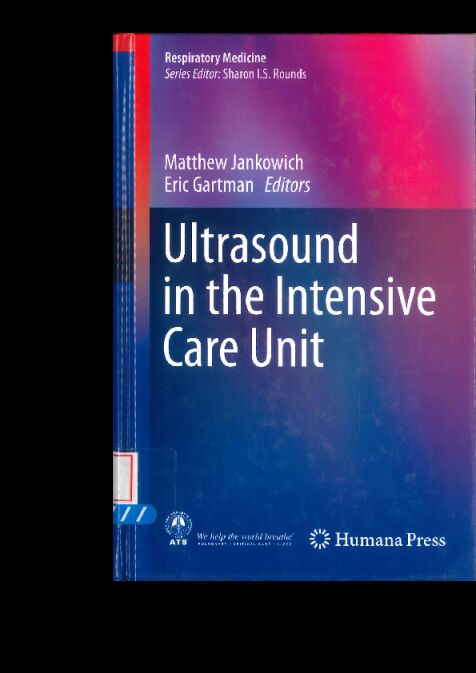
书名:Ultrasound in the intensive car unit
责任者:Matthew Jankowich | Eric Gartman
出版时间:2015
出版社:Humana Press
前言
Physicians have long attempted to gain knowledge of a patient's inner conditions by interpreting sounds, impulses, and vibrations. For many centuries, they have placed an ear to a patient's chest, palpated a pulse, or percussed the body with fingers and assessed the resulting waves. Innovations in technology eventually led to the modern stethoscope, a tool for intensifying certain sounds generated within the body while at the same time damping other frequencies, allowing for better auscultation. A new sound-based tool for examining the body, ultrasound, emerged in the last century, using sophisticated technology to generate high frequency sound waves and receive the reflected waves from within the body and project them onto a display. Ultrasound began to be implemented widely, though not universally, within the field of medicine. Limiting factors included physician knowledge and expertise and the cumbersome nature and expense of early ultrasound machines. However, the technology provided information far beyond what could be gleaned by physical examination or stethoscope, and allowed actual internal imaging of many organs and body parts as well as measurements of blood flow allowing a number of hemo-dynamic inferences.
With advances in miniaturization and decreases in costs, modern ultrasound machines have assumed a size and weight not much beyond that of the traditional stethoscope. This has allowed the bedside clinical application of ultrasound to an expanded number of clinical fields. Perhaps the most rapidly; growing use of ultrasound today is within critical care medicine, where the benefits of ultrasound in guiding difficult bedside procedures such as thoracentesis and central line placement led to a growing familiarity with this technology amongst practitioners. Not surprisingly, critical care physicians, led by a few pioneers, began to apply ultrasound technology to other non-procedural clinical problems in the ICU, such as the emergency diagnosis of pericardial tamponade and pneumothorax. This textbook illustrates the many innovative uses of ultrasound currently taking place in intensive care units; some, like echocardiography, have been adapted from other clinical settings, while others are novel to critical care medicine.
We believe that ultrasound has great potential within the intensive care unit, and that further innovations will take place as more physicians are exposed early in their training to ultrasound technology, leading to a ubiquitous application within critical care. On a cautionary note, the rise and fall of pulmonary artery catheter use within the intensive care unit should be pointed out. Similar to ultrasound, this technology became widely available over the course of a few years, and provided much desired information on the hemodynamics of critically ill patients. It was heralded as an essential tool to guide resuscitation and to assess therapeutic manipulations. However, its application outstripped the evidence base supporting its use, and only over the course of many years did increasing amounts of research indicate that this tool was being misapplied. The reasons for this were multiple, and included errors in the acquisition of the data, the incorrect interpretation of the data, and, likely, that our ability to use the data from these catheters to generate meaningful changes in outcomes was lacking. We hope that this is not the case with critical care ultrasound, and we emphasize in each clinical chapter a structured approach to the application of ultrasound and the current evidence base in the field. In many areas, such as the use of ultrasound to guide volume resuscitation, more supporting data is clearly needed.
As such, this text provides current snapshots of the field—on many more topics than would have existed just a few years ago. We suspect textbooks on this topic in the coming years will detail applications of ultrasound as yet unimagined. We hope this text will inspire further investigation and innovation, will serve as an up-to-date document of the current state of knowledge in this field, and, as important, will expose gaps in knowledge that need to be filled while encouraging responsible clinical implementation of a powerful technology. Providence, RI, USA Matthew Jankowich; Eric Gartman
查看更多
目录
1 Principles of Ultrasound for the Intensivist 1
2 Critical Care Ultrasound Education 19
3 Ultrasound for Vascular Access 35
4 Ultrasound Evaluation of Shock and Volume Status in the Intensive Care Unit 65
5 Critical Care Echocardiography: Acute Left Ventricular and Valvular Dysfunction 77
6 Critical Care Echocardiography: Right Ventricular Dysfunction 123
7 Critical Care Echocardiography: Pericardial Disease, Tamponade, and Other Topics 147
8 Ultrasound and Airway Management 175
9 Lung Ultrasound in Respiratory Failure and Pneumonia 191
10 Pleural Ultrasound 207
11 Diaphragm Ultrasound in the Intensive Care Unit 235
12 Abdominal Ultrasound and Genitourinary Ultrasound in the Intensive Care Unit 249
13 Intensive Care Unit Ultrasound for Venous Thromboembolism 273
14 Ultrasound in Trauma Critical Care 295
15 Ultrasound in the Neurointensive Care Unit 323
16 Ultrasound in the Neonatal Intensive Care Unit 355
Index 379
查看PDF
查看更多
馆藏单位
中国医科院医学信息研究所