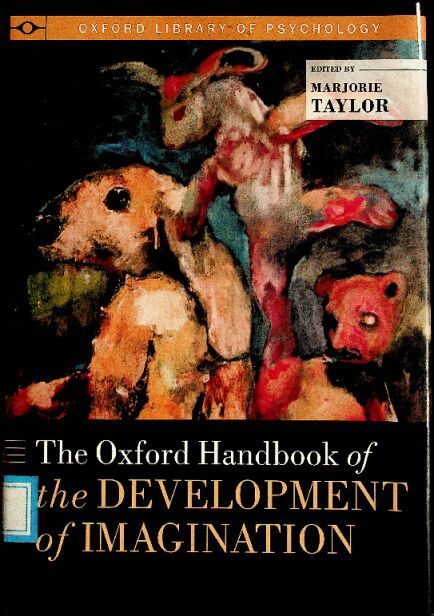
书名:The Oxford handbook of the development of imagination
ISBN\ISSN:9780195395761,019539576X
出版时间:2013
出版社:Oxford University Press
摘要
Children are widely celebrated for their imaginations, but developmental research on this topic has often been fragmented or narrowly focused on fantasy. However, there is growing appreciation for the role that imagination plays in cognitive and emotional development, as well as its link withchildren's understanding of the real world. With their imaginations, children mentally transcend time, place, and/or circumstance to think about what might have been, plan and anticipate the future, create fictional relationships and worlds, and consider alternatives to the actual experiences oftheir lives.The Oxford Handbook of the Development of Imagination provides a comprehensive overview of this broad new perspective by bringing together leading researchers whose findings are moving the study of imagination from the margins of mainstream psychology to a central role in current efforts tounderstand human thought. The topics covered include fantasy-reality distinctions, pretend play, magical thinking, narrative, anthropomorphism, counterfactual reasoning, mental time travel, creativity, paracosms, imaginary companions, imagination in non-human animals, the evolution of imagination,autism, dissociation, and the capacity to derive real life resilience from imaginative experiences. Many of the chapters include discussions of the educational, clinical, and legal implications of the research findings and special attention is given to suggestions for future research.
查看更多
目录
Part One • Introduction
1. Transcending Time, Place, and/or Circumstance: An Introduction 3
2. Historical Overview of Research on Imagination in Children 11
Part Two • Fantasy-Reality Distinctions
3. Fairy Tales, History, and Religion 31
4. Magical Thinking 42
5. Beliefs in Magical Beings and Cultural Myths 61
6. Distinguishing Imagination from Reality 75
7. Children's Source Monitoring of Memories for Imagination 94
8. Suggestibility and Imagination in Early Childhood 113
9. Child Witnesses and Imagination: Lying, Hypothetical Reasoning, and Referential Ambiguity 126
10. Fictional Worlds, the Neuroscience of the Imagination, and Childhood Education 137
Part Three • Pretend Play and Narrative
11. Executive Function, Pretend Play, and Imagination 161
12. The Distinction between Role-Play and Object Substitution in Pretend Play 175
13. How Do Children Represent Pretend Play? 186
14. Culture, Narrative, and Imagination 196
15. Flux and Flow in Children's Narratives 212
16. Pretend Play as Culturally Constructed Activity 224
Part Four • Imagining the Self and Other
17. Imaginary Relationships 251
18. Imagining Other Minds: Anthropomorphism Is Hair-Triggered but Not Hare-Brained 272
19. Imagination and the Self 288
Part Five • Mental Time Travel, Counterfactual Thinking, and Causality
20. Future Thinking in Young Children 305
21. Counterfactuals and Reality 325
22. Causality and Imagination 342
23. What Children Understand About the Flow of Mental Life 359
Part Six • Creativity
24. Imagination and Personal Creativity 379
25. Individual Differences in the Development of Social Creativity 387
26. The Relationship Between Pretend Play and Creativity 403
27. The Creation oflmaginary Worlds 417
28. The Influence of Television, Video Games, and che Internee on Children's Creativity 438
Part Seven • Comparative Issues
29. On the Evolution oflmaginacion and Design 453
30. The Comparative Study oflmagination 468
Part Eight • Clinical Issues
31. Imagination and Dissociation Across the Life Span 489
32. The Development oflmagination in Children with Autism 499
33. The Role of Pretend Play in Child Psychotherapy 516
34. Imagination-Based Interventions with Children 529
35. Telling Srories: Accessing Narrative Imagination for Use in Assessment with Clinical and Typical Populations 539
36. Imagination and Coping with Chronic Illness 550
Part Nine • Conclusion
37. Looking Ahead: Some Thoughts About Future Directions 563
Index 571
查看PDF
查看更多
馆藏单位
中科院文献情报中心