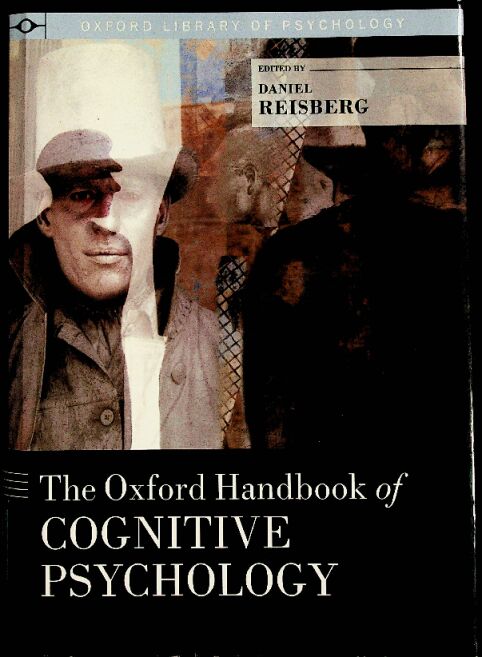
书名:The Oxford handbook of cognitive psychology
ISBN\ISSN:9780195376746,0195376749
出版时间:2013
出版社:Oxford University Press
摘要
Cognitive psychology has matured and flourished in the last half-century, as new theories, research tools, and theoretical frameworks have allowed cognitive psychologists and researchers to explore a broad array of topics. In the same vein, the depth of understanding and the methodological andtheoretical sophistication have also grown in wonderful ways. Given the expanse of the field, an up-to-date and inclusive resource such as this handbook is needed for aspiring generalists who wish to read the book cover to cover, and for the many readers who are simply curious to know the currenthappenings in other cognition laboratories.Guided by this need, this volume's 64 chapters cover all aspects of cognition, spanning perceptual issues, attention, memory, knowledge representation, language, emotional influences, judgment, problem solving, and the study of individual differences in cognition. Additional chapters turn to thecontrol of complex actions and the social, cultural, and developmental context of cognition. The authors include a mix of well-established influential figures and younger colleagues in order to gain an understanding of the field's forward trajectory. The volume also includes a mix of "tutorial"chapters and chapters that powerfully represent a particular research team's point of view.
查看更多
目录
l. Introduction to the H andbook 1
Part One • Gaining Information About the Visual World
2. Perceptual Organization in Vision 9
3. Object Recognition 32
4. Face Recognition 46
5. Eye Movements 69
6. Event Perception 83
Part Two • Attention and Awareness
7. Perception and Attention 97
8. Spatial Attention 117
9. OisordersofAttention 131
l 0. The Nature and Status of Visual Resources 147
11. Auromaticiry 163
12. Unconscious Processes 176
Part Three • Memory
13. Episodic Memory 189
14. Semantic Memory 206
15. Implicit Memory 220
16. The Sources of Memory Errors 232
17. Through the SCAPE Looking Glass: Sources of Performance and Sources of Attribution 243
18. Event-Based Prospective Remembering: An lncegracion of Prospeccive Memory and Cognitive Concrol Theories 267
19. Metamemory 283
20. Memory in Educational Settings 299
Part Four • Knowledge and Mental Representation
21. The Nature of Meneal Concepts 321
22. Culture, Expertise, and Meneal Categories 330
23. Models of Categorization 346
24. The Perceptual Representation of Meneal Categories 358
25. Meneal Images 374
Part Five • Tat and Language
26. Speech Perception 391ys
27. Spoken Word Recognition 412
28. Basic Processes in Reading 442
29. Text Comprehension 462
30. Discourse Comprehension 475
31. Early Word Learning 492
32. Relations Between Language and Thought 504
33. The Evolution of Language 524
Part Six ~ The Role for Emotion
34. Emotion Perception: Putting the Face in Context 539
35. Emotion, Stress, and Memory 557
36. Emotion-Cognition Interactions 57 l
37. An Emotion Regulation Perspective on Belief Change 585
Part Seven • Judgment, Reasoning, and Choice
38. Judgment Under Uncertainry 603
39. Induction 618
40. Reason ing 635
41. ll1e Mental Models Perspective 650
42. Analogical Learning and Reasoning 668
43. Decision Making 682
44. Affective Forecasting and Well-Being 704
Part Eight • Thinking in Specialized Domains
45. Spatial Reasoning 719
46. Causal Reason ing 733
47. Moral Thinking 753
Part Nine • Problem Solving and Creativity
48. Problem Solving 769
49. Insight 779
50. Creativiry 795
Part Ten • How Do We Differ?
51. Contemporary Theories of Intelligence 81 1
52. Genes and Intelligence 823
53. Cognitive Style 842
Part Eleven • Practice and Skilled Performance
54. Planning and Performing Physical Actions 859
55. The Psychology of Practice: Lessons From Spacial Cognition 874
56. Experts and Their Superior Performance 886
Part Twelve • The Social and Cultural Context
57. Self-Knowledge 905
58. Person Perception 918
59. Theory of Mind 943
60. Attitude Change 957
61 . Cultural Differences and Their Mechanisms 970
Part Thirteen • A Developmental Perspective
62. The Development of Cognitive Control From Infancy Through Childhood 989
63. The Development of Attention 1000
64. Cognitive Aging 1014
65. Epilogue: Looking Forward 1036
Index 1047
查看PDF
查看更多
作者简介
Daniel Reisberg is Professor of Psychology at Reed College, in Porcland, Oregon.He has published extensively, wich a focus on how people remember che emotionalevents of their lives, and also on che nature of men cal imagery. In additionco his scholarly writing, he is che author of several successful cexcbooks, includingCognition: &ploring the Science of the Mind, published by W.W. Norron and nowin ics fifth edition. Reisberg has also been increasingly involved wich che applicarionof cognirive psychology co issues wirhin che criminal justice syscem, and hehas provided training sessions for police officers, accorneys, and judges, and somecimesappears in court as an experr witness, with che focus generally on how crimewitnesses (or victims, or perpecrarors) remember and report on a criminal event.Between projects, Reisberg is a devoced wilderness canoe paddler, and escapes whenhe can co rhe far north.
查看更多
馆藏单位
中科院文献情报中心