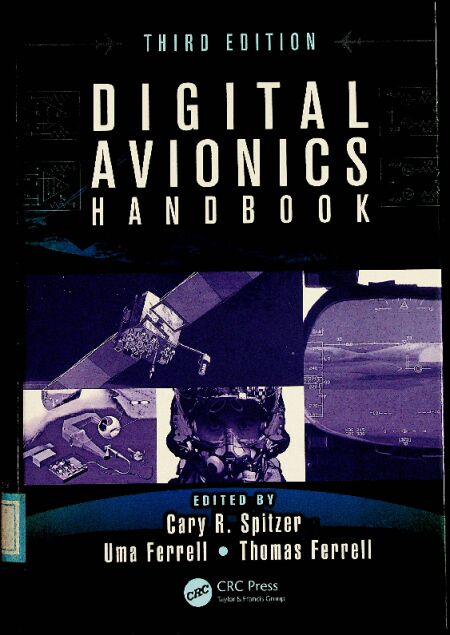
书名:Digital avionics handbook
责任者:Cary R. Spitzer | Uma Ferrell | Thomas Ferrell.
前言
Avionics is the cornerstone of modern aircraft control and operation. Almost every facet of the aircraft is tied to one or more avionics functions. As a result, the complexity and cost of avionics have never been greater. Many technologies that emerged in the last decade will be utilized in the next decade. The global positioning system has enabled satellite-based precise navigation and landing, and communication satellites are now capable of supporting aviation services. Thus, the aviation world is upgrading to satellite-based communications, navigation, and surveillance for a ir traffic management. Both the aircraft operator and the air traffic services provider a re realizing significant benefits. Familiar technologies in this book include data buses, one type of which has been in use for over 20 years; head-mounted displays; and fl y-by-wire flight controls. New bus and display concepts, however, are emerging, for example, a retinal scanning display, which may soon replace these veteran devices. Other emerging technologies include speech interaction with the aircraft and synthetic vision. Speech interaction may soon enter commercial service on business aircraft as another way to perform some noncritical functions. Synthetic vision offers enormous potential for both military and civil aircraft for operations under reduced visibility condit ions or in cases where it is difficult to install sufficient windows in an aircraft. This book offers a comprehensive view of avionics, from the tech nology and elements of a system to examples of modern systems flying on the latest milita ry and civil aircraft. The chapters have been written with the reader in mind by working practitioners in the field. This book was prepa red fo r the working engineer and others seeking information on various aspects of avionics. The topic of avionics cannot be fully explored in a single handbook. Readers are encouraged to make use of the References and Further Reading sect ions to explore topics in more detail. The book has been divided into four sections, each containing a number of related chapters. Section I deals with the evolution of air traffic control to air traffic management and the reason for avionics support in communication, navigation, and surveillance, as well as the supporting safety and certification infrastructure. Section II deals with specific technology and use of different avionics, many of which a re d iscussed in the previous section in a broad sense. Topics include an overview of functions accomplished by avionics, case studies of avionics a rchitectures, and specific instances of avionics. Section III is all about tools, techniques, and methods used to implement avionics func tions. Topics include information on data buses, avionics architectu res, modeling of avionics, and some additional details on navigation algorithms. Section IV provides a long-range look ahead. While the industry is busy implementing NextGen, it is worth considering what a FarGen might look like.
查看更多
目录
Preface xi
Acknowledgments xiii
Editors xv
Contributors xvii
SECTION I Evolution of Avionics: Safety and Certification
1 Evolving Avionics 1-1
2 Communications 2-l
3 Navigation 3 - l
4 Global Positioning System 4-l
5 Fault-Tolerant Avionics 5-l
6 Electromagnetic Environment 6-l
7 Vehicle Health Management Systems i-1
8 Cockpit Voice Recorders and Data Recorders 8-l
9 Certification of Civil Avionics 9 -1
10 System Safety and System Development 10-l
11 Understanding the Role ofRTCA D0-160 in the Avionics Certification Process 11-1
12 RTCA D0-178B/EUROCAE ED-12B 12 -1
13 RTCA D0-178C/EUROCAE ED-12C and the Technical Supplements 13 -1
14 RTCA D0-254/EUROCAE ED-80 14 - l
SECTION II Avionics Functions: Supporting Technology and Case Studies
15 Human Factors Engineering and Flight Deck Design 15 - l
16 Head-Mounted Displays 16 -l
17 Head-Up Display 17-1
18 Display Devices 18 - l
19 Vision Systems 19- l
20 Speech Recognition and Synthesis 20-1
21 Terrain Awareness 21 -1
22 Traffic Alert and Collision Avoidance System II (TCAS II) 22-1
23 Automatic Dependent Surveillance-Broadcast 23 -1
24 Flight Management Systems 24- l
25 Electrical Wiring Interconnect System 25-1
26 Batteries 26-l
27 Genesis 27-1
28 Boeing B-777 Avionics Architecture 28- l
29 Boeing B-777 29- l
30 New Avionics Systems 30-l
31 Airbus Electrical Flight Controls 31-1
SECTION III Avionics Development: Tools, Techniques and Methods
32 Electronic Hardware Reliability 32-1
33 MIL-STD-1553B Digital Time Division Command/Response Multiplex Data Bus 33- l
34 ARINC 429 Digital Information Transfer System 34-l
35 RTCA D0-297/EUROCAE ED-124 Integrat ed Modular Avionics (IMA) Design Guidance and Certi fication Considerations 35-1
36 ARINC Specification 653, Avionics Application Software Standard Interface 36-l
37 Time-Triggered Protocol 37-1
38 Digital Avionics Modeling and Simulation 38- l
39 Model-Based Development with AADL 39-l
40 Mathworks Approach to MBD 40- l
41 Esterel SCA DE Approach to MBD 41-1
42 Model Checking 42- l
43 Formal Methods 43- l
44 Navigation and Tracking 44 - l
SECTION IV Conclusion
45 Next Frontier 45 -1
Index Index- I
查看PDF
查看更多
作者简介
Uma Ferrell and Thomas Ferrell are cofounders of Ferrell and Associates Consulting, Inc. (FAA), a certification and software safety consultancy serving the aerospace industry. They have over 50 years of combined experience in helping industry in accomplishing certification objectives via training, certification project support, and related research. 1l1ey are frequently sought out to help with new and novel technologies and methods where traditional certification approaches break down. In recent years, their consultancy has evolved to include project management support, especially fo r projects in need of recovery plans, to ensure successful engine and airframe certification. Mr. and Mrs. Ferrell have collaborated together in numerous industry efforts as well as jointly authored papers and tutorials for a number of industry conferences, most notably the Digital Avionics Systems Conference (DASC) and the International System Safety Conference (!SSC). They authored the FAA's Service History Handbook (DOT/FAA/AR-01/116), an alternative method for D0-178B compliance. Their other research efforts have included work on the use of wireless systems onboard aircraft (accomplished through AVSI) and a comprehensive review of existing airworthiness standards for use in commercial space conducted for the FAA. Mr. and Mrs. Ferrell have authored and presented numerous courses covering various av iation engineering topics, including D0-178C, D0-178B, D0-254, D0-200A, D0-201A, FAA aircraft certification, system and software safety, engineering ethics, technology transfer, and software verification for aviation systems.
查看更多
馆藏单位
中科院文献情报中心