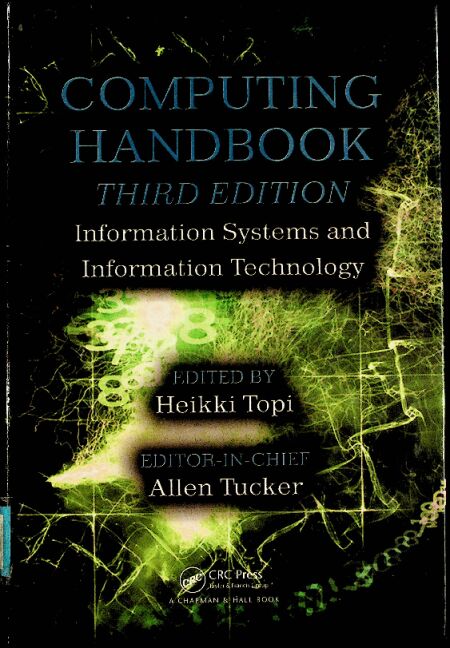
书名:Computing handbook
责任者:Heikki Topi | Allen Tucker.
分类号:自动化技术、计算机技术
版次:3rd ed.
摘要
We are delighted to introduce this new volume of the Computing Handbook Set on information systems(IS) and in formation technology (IT). Both of these disciplines focus on computing in a context (such as an o rga nization) that uses computing resources to achieve its goals and to transform how it reaches these goals. The older and more established discipline IS has existed since the 1960s. Its focus from the beginning has been organizational computing in a business context, with a specific emphasis on how changes in business processes and information management transform the way business is conducted.IT emerged as an independent academic discipline during the last decade, primarily through its contribution to undergraduate education. IT also focuses on the organizational context, but it primarily addresses questions related to the technology infrastructure.
This handbook set has numerous elements that discuss the nature and identity of the IS a nd IT disciplines(such as the Preface to Volume I, and see Chapters 1 th rough 5 in this volume). We will not attempt to replicate that conversation here; it is, however, safe to say that neither discipline has even internally converged into a fully unified understanding of its own identity. Throughout its almost 50 year history, the IS discipline has continuously debated its identity (see Chapter 1 in this volume). The same process has now begun for IT. We hope that this volume will contribute to the disciplinary processes that seek for clarity regarding the identities of both IS and IT.
When referring to organizational units and capabilities, the terms " information systems" and "information technology" are,in practice, used interchangeably. Even the research literature is often incapable of separating them in a consistent way. We would have liked to follow a consistent approach where IT refers prima rily to the technology infrast ructure and IS to the application of the technology in an organizational context, but doing so would have imposed overly restrictive costraints, given the current practice in the field . Therefore, we ask for your patience particularly in the context of management of IS capabilities- the use of these terms is not always systematic between (or even with in) the chapters.Sometimes, we resort to the IS/IT moniker when we want to specifica lly acknowledge a consistent practice of using both terms interchangeably.
This volume of the Computing Handbook Set has nine parts, which collectively demonstrate the richness and breadth of the IS and IT disciplines and their close linkages to the practice of using, managing,and developing IT-based solutions to advance the goals of their environments. As the entire handbook set, this volume is targeted to both academics and practitioners. On the one hand, the chapters provide academic readers with introductions to the cur rent status and futuredirections of academic research in the topic areas of the chapters. On the other hand, the chapters give advanced practitioners in-depth perspectives on the contributions of academic research to the practice of IS and IT development,use,and management. In this preface, we will first explain the background for the structure of the volume and then provide brief introductions to the core content of each of the parts of the volume. We conclude the preface by acknowledging and thanking the people who have been instrumental in making this effort possible.
查看更多
目录
PART I Disciplinary Foundations and Global Impact
l Evolving Discipline of Information Systems 1-1
2 Discipline of Information Technology: History and Development 2-1
3 Information Systems as a Practical Discipline 3-l
4 Information Technology: Principles , Methods, and Theory 4-1
5 Sociotechnical Approaches to the Study of Information Systems 5-1
6 IT and Global Development 6-1
7 Using ICT for Development, Societal Transformation, and Beyond:Closing the Digital Divide in Developing Countries: Case of Egypt 7-1
PART II Technical Foundations of Data and Database Management
8 Data Models 8-l
9 Tuning Database Design for High Performance 9-1
10 Access Methods 10-l
11 Query Optimization 11-1
12 Concurrency Control and Recovery 12-l
13 Distributed and Parallel Database Systems 13-1
14 Multimedia Databases: Description, Analysis, Modeling, and Retrieval 14-1
PART III Data, Information, and Knowledge Management
15 Building Conceptual Modeling on the Foundation of Ontology 15-1
16 Data and Information Quality Research: Its Evolution and Future 16-1
17 Knowledge Management 17-1
18 Digital Libraries 18-1
19 Knowledge Discovery and Data Mining 19-1
20 Big Data 20-l
21 Governance of Organizational Data and Information 21-1
PART IV Analysis, Design, and Development of Organizational Systems
22 Design Science Research 22-1
23 Identifying Opportunities for IT-Enabled Organizational Change 23-1
24 Deconstructi ng Enterprise Systems: Emerging Trends in the Next Generation of ES Applications 24-1
25 Enterprise Architecture 25-1
26 Business Process Management and Business Process Analysis 26-1
27 lnform ation Requirements Determination 27-1
28 From Waterfall to Agile: A Review of Approaches to Systems Analysis and Design 28-1
29 Human-Centered System Development 29-1
30 Developing and Managing Complex, Evolving Information Infrastructures 30-1
31 Impact of Culture on Information Systems Design and Use: A Focus on E-Busines 31-1
PART V Human-Computer Interaction and User Experience
32 Usabi lity Engineering 32-l
33 Task Analysis and t he Design of Functionality 33-l
34 Designing Multimedia Applications for User Experience 34-1
35 Applying Internatio nal Usability Standards 35-1
36 Designing Highly Usable Web Applications 36-1
37 Transforming HCI: The Art, Science, and Business of User Experience Design 37- l
PART VI Using Information Systems and Technology to Support Individual and Group Tasks
38 Individual-Level Technology Adoption Research: An Assessment of the Strengths,Weaknesses, Threats, and Opportunities for Further Research Contributions 38-1
39 Computer Self-Efficacy 39-1
40 Developing Individual Computing Capabilities 40-l
41 Role of Trust in the Design and Use of Information Technology and Information Systems 41 -1
42 Impacts of Information Systems on Decision-Making 42-l
43 Computer-Supported Cooperative Work 43-1
44 Information Technology for Enhancing Team Problem Solving and Decision Malting 44-1
45 Organizational Adoption of New Communication Technologies 45-1
46 Social Media Use within the Workplace 46-l
PART VII Managing and Securing the IT Infrastructure and Systems
47 Virtualization of Storage and Systems 47-1
48 Cloud Computing 48-l
49 Enterprise Mobility 49-1
50 Sustainable IT 50-1
51 Business Continuity 51-1
52 Technical Foundations of Information Systems Security 52-1
53 Database Security and Privacy 53-l
54 Behavioral Information Security Management 54-l
55 Privacy, Accuracy, and Accessibility of Digital Business 55-1
56 Digital Forensics 56-l
PART VIII Managing Organizational Information Systems and Technology Capabilities
57 Organizing and Configuring the IT Function 57-1
58 Topics of Conversation: The New Agenda for the CI0 58-l
59 Information Technology Management Frameworks: An Overview and Resea rch Directions 59-l
60 Sourcing Information Technology Services 60-l
61 IS/IT Project Management: The Quest for Flexibility and Agility 61-1
62 IS/IT Human Resource Development and Retention 62-1
63 Performance Evaluation/Assessment for IS Professionals 63-1
64 Financial Information Systems Audit Practice: Implications of International Auditing and Accounting Standards 64-l
PART IX Information Systems and the Domain of Business Intertwined
65 Strategic Alignment Maturity 65-l
66 Process of Informa tion Systems Strategizing: Review and Synthesis 66-1
67 Information Technology and Organizational Struc ture 67-1
68 Open Innovation: A New Paradigm in Innovation Management 68-1
69 Inter-Organizational Information Systems 69-L
70 Future of Information Systems Success: Opportunities and Challenges70-L
71 Business Value of IS Investments 71-1
72 Information Technology and Firm Value: Productivity Paradox,Information Technology and Firm Value: Productivity Paradox,
Profitability Paradox, and New Frontiers 72-1
Index Index-1
查看更多
馆藏单位
中科院文献情报中心