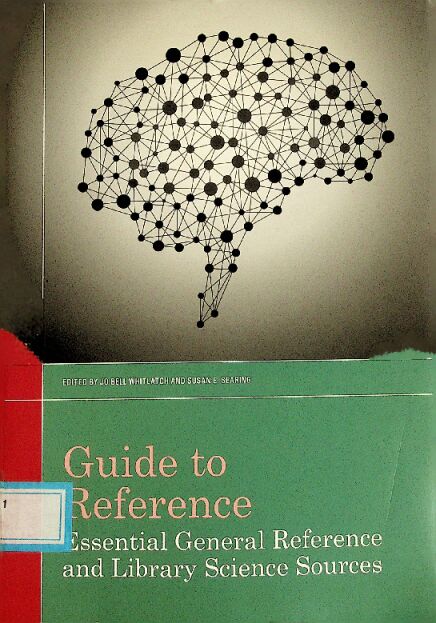
书名:Guide to reference
责任者:Jo Bell Whitlatch and Susan E. Searing | Searing, Susan E.
出版时间:2014
出版社:ALA Editions, An imprint of the American Library Association
摘要
Ideal for public, school, and academic libraries looking to freshen up their reference collection, as well as for LIS students and instructors conducting research, this resource collects the cream of the crop sources of general reference and library science information. Encompassing internet resources, digital image collections, and print resources, it includes the full section on LIS Resources from the Guide to Reference database, which was voted #1 Best Professional Resource Database by Library Journal readers. Organized by topic and thoroughly indexed, this guide makes it a snap to find the right sources. It offers an appealing introduction to reference work and resources for LIS students and also serves as an affordable course book to complement online Guide to Reference access.
查看更多
前言
The American Library Association has long been a source for authoritative bibliographies of the reference literature for practicing librarians, library educators, and reference service trainers. ALA's Guide to Reference Books was printed in eleven editions over nearly a century, and was succeeded in 2009 by the online Guide to Reference (www.guidetoreference.org). The Guide to Reference segments, drawn from the online Guide, continue that tradition with expertly compiled, annotated bibliographies of reference works and serve as snapshots of the evolving content of the Guide.
Although intended for use largely in North American libraries serving institutions of higher education, the segments will also be valuable to public and school librarians, independent researchers, publishers and book deal-ers, as well as librarians outside North America, for tasks such as identify-ing sources that will answer questions, directing researchers, creating local instructional materials, educating and training US students and reference staff, and inventorying and developing reference collections. These guides provide a usably comprehensive, rather than exhaustive, repertory of sources as the foundation for reference and information services in today's higher education settings. They include works that can most usefully satisfy the vast majority of demands made on a reference service, while not altogether exclud-ing "exotic" or little-known works that will meet only the unusual need.
In addition to providing classified annotated bibliographies, topical sections include editors' guides that orient readers to each subject, its scope and concerns, and the types of sources commonly consulted. The editors' guides will be useful to the generalist librarian and to the LIS stu-dent as background to the bibliographies or as intellectual frameworks for addressing reference questions.
The reader will find entries for works that are, for the most part, broadly focused; works on individual persons or with a narrow geographical or chronological focus are generally not included. Selection criteria favored titles published in the last twenty years; the reader may consult earlier printed bibliographies and indexes, such as the numer-ous print editions of the Guide to Reference Books, for many earlier and still important works. As libraries shift their print reference works to the general stacks or to remote locations, the online Guide and its older print editions may help to identify reference works that are no longer close at hand.
Sources in the Guide include websites, search engines, and full-text databases as well as the traditional array of encyclopedic, bibliographic, and compendious works. Online sources have replaced their printed ver-sions for most librarians under most circumstances. A source only appears in one format; its annotation will identify the format options and describe the relationships between online and print versions. New reference works or editions are not automatically included in the Guide. Selection criteria favor sources that have stood some test of time and utility, as well as sources that are free but authoritative or sources that require purchase or licensing but are held at enough libraries to be reasonably available to read-ers of the Guide. The General Reference Works sections do not include the vast majority of discipline-specific sources that are covered in the History and Area Studies; Humanities; Science, Technology, and Medicine; or Social and Behavioral Sciences divisions; please consult the discipline spe-cific volumes or the online Guide for specialized discipline sources.
The reader is encouraged to peruse the annotations of entries in the same subcategory as known items. An annotation may contain extensive cross references to related sources that are not described separately as well as comparisons to related sources, indications of appropriate audiences for the source, and other details that provide significant added value. In an attempt to balance inclusion and exhaustion, a source may be included in several but not necessarily all relevant subcategories.
This segment on Essential General Reference and Library Science Sources includes sources for each patron and librarian in every type of library. The first subsection on Essential General Reference Works draws from more than 5600 General Reference Works currently annotated in the online Guide and is intended to provide a basic set of the most useful general reference sources for librarians assisting patrons with their queries or, for patrons pursuing queries on their own. The subsection on Library Science includes the majority of works about library science that are cur-rently represented in the online Guide.
We on the Guide to Reference team hope you find the segments help-ful, and we welcome your comments at guidetoreference@ala.org. To get the full benefit of the comprehensive compilation in a wide range of sub-ject areas as well as updates to each segment, we also encourage you to subscribe to the online Guide, where you have access to updated entries, annotations, user comments, and special features such as personal notes and lists. We regularly seek new editors, especially those who believe they can improve existing sections or develop new ones. Please check the web-site at www.guidetoreference.org for details on subscribing or volunteering to participate in the continuing development of the Guide to Reference.
查看更多
目录
FOREWORD IX
CONTRIBUTORS XIII
ESSENTIAL GENERAL REFERENCE 1
Introduction: Essential General Reference Sources Jo Bell Whitlatch 3
1 Bibliography Rosanne M. Cordell and Barry Trott 7
2 Biography Fred Burchsted 20
3 Core Geography Steven W Sowards 31
4 Dissertations Cynthia Thomes 44
5 Encyclopedias Barbara M. Bibel 46
6 Genealogy Mary K. Mannix 50
7 Government Publications Christopher C. Brown 54
8 Language Dictionaries Melissa S. Van Vuuren 63
9 Newspapers Patrick Reakes 76
10 Online General Reference Libraries Lili Luo 79
11 Other General Reference Works Donald Altschiller 81
12 Periodicals Jennifer Duncan 91
13 The Web as Reference Tool Lili Luo 105
LIBRARY AND INFORMATION SCIENCES 107
Introduction: Library and Information Science Sources Susan E. Searing 109
14 General Works 113
Bibliography 113
Biography 115
Blogs and News 117
Dictionaries and Thesauruses 118
Directories of Institutions and People 121
Encyclopedias 128
Factbooks and Compendiums 130
Guides to the Literature 130
Indexes; Abstract Journals; Databases 131
Library History 133
Periodicals 136
Professional Associations 141
Quotations 145
Research Methods 145
Standards 146
Statistics 147
User Guides to Library Research 150
Yearbooks and Current Surveys 151
15 Professional Practice 153
Administration, Management, and Planning - General Works 153
Archives and Special Collections 154
Assessment and Evaluation 157
Budgeting and Fundraising 159
Cataloging and Classification 161
Collection Development and Acquisitions 171
Digitization, Digital Libraries, and Information Technologies 174
Education and Continuing Professional Development 177
Human Resources 178
Indexing and Abstracting 180
Information Literacy Instruction 181
Knowledge Management 184
Library Facilities 184
Marketing, Advocacy, and Public Relations 186
Policies, Procedures, and Legal Issues 187
Preservation and Conservation 189
Readers' Advisory 191
Reference and Information Retrieval 192
Resource Sharing 197
Services to Special and Diverse Populations 198
Type of Library 201
Youth Services 204
INDEX 209
查看PDF
查看更多
馆藏单位
中科院文献情报中心