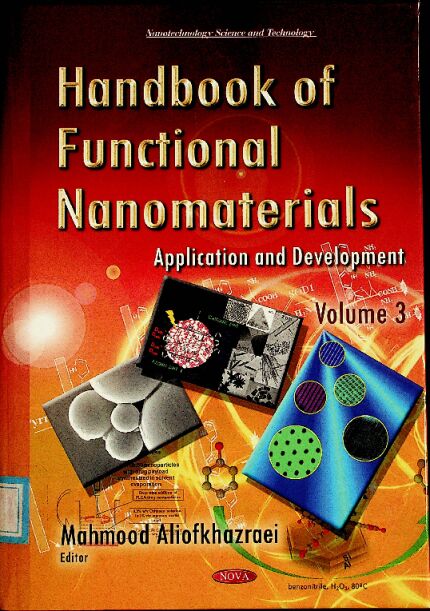
书名:Handbook of functional nanomaterials. Volume 3, Application and development
责任者:Mahmood Aliofkhazraei
出版时间:2014
出版社:Nova Science Publishers
摘要
This is the third volume of the Handbook of Functional Nanomaterials (4 volume set).Functional nanomaterials appear in our daily lives. These materials mainly include nanocomposites, nanopowders, nanoparticles and nanocoatings. Nanotechnology enables the creation of structures that do not exist in nature, those which cannot be produced by conventional chemistry. Some advantages of this technology are the synthesis of stronger,more adjustable materials as well as lower costs. Nanotechnology is scientific and research development at the atomic, molecular, or macromolecular levels in a dimension range of 1 to 100 nm; the fabrication and application of the structures, equipment, and systems which in volve unique characteristics and new applications because of their small or medium dimensions; and the potential for (materials and processes) the control and management of atomic scales. Therefore, nanotechnology involves industrial research and development at atomic, molecular, and macromolecular levels. This research aims to create and exploit the structures and systems which in volve unique applications due to their small dimensions. The main difference between nanotechnology and other technologies is found within the dimensions and properties of the materials and structures applied to this technology. As a matter of fact, the main difference between these two types of technologies is the presence of base elements, which are indeed the same nanoscale elements with different properties in their nanoscale and larger states. Due to the developed properties of the very fine powders including surface chemistry, compressive properties, optical characteristics, and synthetic reactions, as well as an increasing demand for fine powders in industries, a very fine fragmentation is appl ied in many materials such as: minerals, ceramics, dyes, chemicals,microorganisms, pharmaceuticals and paper manufacturing.
This volume mainly discusses the application and development of functional nanomaterials. Some of the functional nanom terials that were discussed in this volume are titania nanostructures, hybrid nanomaterials based on nanoclays, multifunctional nanomedicine, nanocomposites using polypyrrole, metallic nanoparticle , quantum dots,fullerenes and capped nanotubes, graphene, nanocomposite coatings, functionaLized carbon nanotube, nanopowders. There are 21 chapters in this volume; each one includes examples of these interesting materials, supported with appropriate figures fo r better clarification.
Titanium dioxide has been used a the white pigment s ince the ancient times.95% of its current usage in industry involves paints, cosmetics, plastics, paper, and food. However, in near future the economic impact of titanium dioxide seems to be controlled by energy related applications mostly. Therefore, Chapter I projects a br ief outlook on the added value provided by the titanium dioxide structures in new and emerging technologies of the energy sector. The applications focused are: solar fuels, solar cells, fuel cells, Li ion batteries and solid state lighting. In those applications, Ti02 standouts with its chemical and thermal stability, morphology variety, position of conduction and valance band energy levels, optical properties and cost.
Several naturally-<>ccurring enzymes, like cytochromes P450, selectively oxidize different substrates under mild conditions, using molecular oxygen as oxidant. Such a feat i desirable for any industrial process. The synthesis of new catalysts that mimic the action of these enzymes has been targeted in the area of catalysis. Synthetic metalloporphyrins,particularly ironporphyrins, have been successfully used as biomimetic catalysts in numerouoxidation reactions in homogeneous media. However, their high cost and difficult recovery from the reaction medium make their large-scale utilization unviable.
Catalyst heterogeneization is an alternative approach to overcome the typical problems of homogeneous catalysis, as heterogeneous catalysts can be reused, reducing costs.Furthermore, enzyme site isolation can be mimicked, improving the reaction selectivity. In Chapter 2, new matrices must be designed for immobilization of metalloporphyrins, to atify current demands such as the use of clean oxidants like hydrogen peroxide. Despite the many literature studies on heterogeneizedmetalloporphyrin catalysts, few works have reported on their efficiency and selectivity in the presence of this oxidant.
In recent years, an increasing interest has been observed in the synthesis of multifunctional organic-inorganic hybrid materials that meet the requirements of Green Chemistry, i.e., materials that combine maximum usability with environmental compatibility,and that open a new way for the preparation of heterogeneous catalysts. In this context, we describe in this chapter the catalytic activity of ironporphyrins supported on functionaJized clays in the oxidation of cyclohexanone, as a part of our ongoing search for novel systems that perform green oxidation reactions using bioinspired catalysts.
Neglected Tropical Diseases (NTDs) are WHO notified infective conditions that encompass a high risk of propagation and very low R&D developments. As explained in Chapter 3, NTDs like Ieishmaniasis, trypanosomiasis, and dengue are prevalent in the developing countries but are currently over spreading in the developed world. Most available medicines in these areas associate low specificity, low patient compliance and are inherently toxic. Early solutions entail through put screening of known chemical enti ties and pharmacokinetic developments for known compounds like that in case of amphotericin B.Nanomedicines like liposomes, polymeric nanoparticles and micelles are some of the recent successes in chemotherapy of NTDs. Functionalized vesicle vaccine carriers are recently developed for clinical trials. While vector control is a powerful remedy at the pre-in fection stages, biophannaceutical developments and targetability of nanoparticles are seen as a new strategy in postinfection disease management.
Nanocomposites based on the integration of conducting polymer, polypyrrole (PPy) with other nanostructured-materials viz. carbon nanotubes (CNT) and gold nanoparticles (GNP) to construct a suitable host matrix for the functionalization of enzymes hold a great promise for the development of biosensors for the measurement of oxidative stress. Themitochondrial respiratory chain is an important source for the production of cellular reactive oxygen species(ROS) and reactive nitrogen species (RNS), causing a poptosis by the release of cytochromec(cyt c) from mitochondria. Therefore, the quantification of various biomarkers of oxidative stress could be of great importance in the clinical diagnosis and therapeutic research. Chapter 4 presents the bio-functionalization of nanocomposites with enzymes for electrochemical biosensing of oxidative stress biomarkers viz. superoxide, nitricoxide,nitrite,nitrate, cysteine, and cyt c. The synergistic effect of the nanocomposites enhanced the direct electron transfer and catalytic activity of enzymes by roviding a well ordered, stable and large surface for the functionalization without affecting their biological activity.
Nanostructured materials have attracted great attention in recent time because of their innovative characteristics and potential applications in the fields of catalysis, drug deli very,sensors and pollution abatement measures. Stabilized metal nanoparticles (size< I O nm) with very active surface atoms, high selectivity and recyclability have lead to a new generation of'Nanocatalysts' for sustainable green chemistry for industrial applications like fine and bulk chemicals, pharmaceuticals, fuel cell, petroleum refineries, environmental catalysis and many other fields. Chapter 5 summarize the techniques for preparations, characterizations, and catalytic acti vities of different metals nanoparticles for organic transformations.
Nanotechnology has already become a burgeoning, multidisciplinary scientific field that applies engineering and manu facturing principles at the nanoscale. It proides the tools and methods to characterize and manipulate nanomaterials, further elucidate nanosca.le phenomena, and equip researchers and developers with the ability to fabricate novel materials and tructures. Nanomaterials have unique phy icoche mical properties due to the large su1·face area to mass ratio, which can be di fferent from bulk materials of the same composition. These properties can be used to overcome some of the limitations found in traditional research areas. Drug delivery syste m is major area which has been deeply influenced by nanotechnology.
Drug delivery has also aided the development and implementation of nanometer-sized components. Most importantly, nanotechnology has opened new therapeutic opportunities for drugs which cannot be used effectively in traditional drug formulations due to poor bioavailability or less instability. Nanoparticles have advantages in enhancing dissolution,providing stability during circulation and enhancing transport. The importance of biodegradable nanopa.ricles is related to the enhanced bioavailability through uptake,followed by degradation and disappearance of the vehicle from the body. In Chapter 6, focus will be placed on the applications of such nanopa.rticles in drug deli very. Different fabrications and formulations of nanoparticles for drug delivery will be introduced. The applications of drug-loaded nanoparticles via different drug delivery routes and utilization of nanopa.rticles in different therapeutic areas will be further discussed.
As explained in Chapter 7, organic/inorganic hybrid materials which show particular promise for a variety of optical, electrochemical and electronic applications a.re composites of supramolecular organic moieties and inorganic semiconducting nanoparticles and quantum dots. The nanoscale template refer to the use of a prefabricated, nano tructured matrix,which can influence the arrangement of the building block . The ynthetic peptide matrixutilize a prefabricated structure to collect multiple, discrete nano-objects ito a larger, welldefined,ordered architecture. The resulting nanocomposites can exploit the complementary properties of the organic template and inorganic components. The e nanocompo ites have applications in light-e mitting materials, photovoltaics, nonlinear optics, sen or , torage and biological imaging.
The fullerenes are cage molecules with a large number of carbon atom . A table C60 cluster was discovered in 1985 as a cage structure by Kroto and his team. lt is we ll -known that such molecules made up entirely of II carbon atoms having 12 pentagonal and (n/2 - 1O)hexagonal faces, where 11:it 22 is a natural number equal or greater than 20. The goal of Chapter 8 is to investigate the geometry and topology of these advance materials.
The catenating property of carbon makes it unique to forming various architectures (e.g.diamond, fullerenes, carbon nanotubes, graphene, etc.) at nanolevel. Graphene, a 2D material,has received increasing attention since the first historical isolation of single-layer graphenefrom the crystalline graphite in 2004 owing to its unique physicochemical properties and ease of functionalization. Suitable methods have been discovered to synthesize graphene and its composites with metal/oxide nanoparticles for use in electrochemical devices to improve their efficiencies. Chapter 9 with a brief description of methods of synthesis of graphene and its structural characterization presents a detailed review of the work carried out on application of graphene to improve the performance of electrochemical devices, namely fuel cells, supercapacitors and batteries.
Despite the rapid progress in the development of new pharmaceutical product , modern medicine has not been able to keep pace with the infectious diseases that have reached high mortality rates in recent years. Since infectious agents such as bacteria, viruses,and paraites have developed resistance to current drugs, successful treatment of these agents remainsinsufficient. Furthermore, exposed drugs may lose their efficacy while circulati ng in the human body, depending on how the drugs were administered. In the other words, such drugs generally cannot reach the site of infection, resulting in uncontrolled treatment of the illness or condition. Because of the development of resistance and the ineffectiveness of these drugs,high dosages are commonly administered, which leads to various side effects.
Recently, researchers have primarily focused on drug delivery systems in order to enhance the efficacy of these drugs and to prevent their negative side effects. It has been asserted that delivery of drugs with nanoparticles provides an opportunity for transporting a sufficient amount of drug molecules to the site of infection owing to the unique propertie of nanoparticles. Nano-sized delivery systems offer several advantages, such as small particle size, narrow size distribution, surface features for target-specific localization, protection of drug molecules to enhance stability, and the opportunity to develop nanocarriers that respond to physiological stimuli.
In Chapter 10, we aimed to demonstrate the applications of drug del ivery through different nanoparticulate systems for bacterial, viral, and parasitic infections such a H.pylori, Herpes Simplex Virus (HSV), Human Immunodeficiency Virus (HIV), Malaria,and Leishmania infections, conditions that threaten millions of people around the world.Analysis of the literature indicated that nanoparticulate drug delivery systems have so far revealed promising results for the treatment of various infectious diseases. There fore it is expected that nanoparticulate drug delivery systems might be one of the most important methods for the treatment of infectious diseases in conjunction with the increased interest surrounding the subject.
In Chapter 11, we review recent work about time dependent quantum transport through a quantum dot in Kondo regime. This represents a major step towards designing next generation transistors that are expected to replace current MOSFET's in a few years. We first discuss the effects of the density of states of gold contacts on the instantaneous conductance of an asymmetrically coupled quantum dot that is abruptly moved into Kondo regime via a gate voltage. Next, we investigate the effect of strong electron-phonon coupling on the dot on the instantaneous conductance. Finally, we discuss thermoelectric effects using linear response Onsager relations for a quantum dot that is either abruptly moved into Kondo regime or driven sinusoidally via a gate voltage. We explain encountered peculiarities in transport based on the behaviour of the density of states of the dot and the evolution of the Kondo resonance.
J.n composites, two or more materials are combined in order to employ their individual virtues while minimizing their deficiencies. In general, these hybrid systems exhibit new chemico-physical characteristics that originate from the cooperative effect of the distinctive properties of the materials used. In its own particular way, the engineering of composite carbon-based materials through decoration with metal NanoParticles (NPs) has proved to be key for the improvement of the intrins ic properties of graphene and Carbon NanoTubes(CNTs). A plethora of methods have been employed for the controlled deposi tion and immobilization of metal NPs onto the CNT surface. To this end, both physical and chemical approaches have been recently developed; each offering its own strengths and weaknesses,which can then be tailored for specific applications. In Chapter 12, we start with an overview of the main methods used for the synthesis of these hybrid systems, with emphasis on the most meaningful examples described in the literature. Metal NP-CNT composites are highly suitable for a number of practical applications ranging from catalysis to optoelectron.ics to chemical and bio-sensing. The Chapter reports the main efforts carried out to date to integratemetal NP-CNT compo ites in high-performance nano-devices.The use of modified CNTs often proved more effective than that of pristine ones; however in some cases decoration with metal NPs leads to no improvement. This Chapter sets out to describe the mechanisms, which improve decorated CNTs or pristine CNTs according to the case involved. We conclude by considering metal filled-CNTs, a special class of metal modified-CNTs. The different approaches to filling CNTs with metal NPs are discussed; we then focus on their u e as magnetic probes and m.icrowave absorbing materials.
Chapter 13 examines the critical aspects related to the electrodeposition conditions of nanocomposite films, from aqueous solutions. The use of these films in different tribological applications strongly depends on their compositional, morphological and structural characteristic . Similarly these factors are directly related to the preparation method and deposition condition such as: current density, ubstrate, pH, ions concentration, size and quantity of nano-particles, and electrolyte agitation. Thus, the correct chem.ical and physical characterization is of critical importance to assess the volume of nano-particle dispersion in the metallic matrix as well as to evaluate their routine manufacturing quality and performance. The use of elemental analysis techniques such as: XRD and WDS spectrometry and x-ray mapping provides some unique analytical advantages for the fast analysis of nanocomposite coatings to determ.ine nano-particle concentration, homogeneity and coating thickness.
While the unique properties of nanopru1 icles are employed in an uncountable number of applications their use at high temperatures is limited by the ir thermal stability. Encapsulation of the nanoparticles with a protective layer can reduce particle sintering but, at the same time, renders the surface inaccessible for reactive species as for instance desired in heterogeneous catalysis. Therefore, Chapter 14 aims at the introduction of a one-step fl ame process to produce high temperature stable titania nanoparticles with a ilica coating. It was found that grain growth and phase transformation from active anatase into inactive rutile phase was inhibitedup to 1050°C. The heat treatment was necessary to obtain a permeable coating,as proven by the decomposition of organic compounds. In fact, for each application temperature an optimum layer thickness exists for maximum photocatalytic activity. It was shown that high temperature stable and self-cleaning-coatings can be achieved by s pray coating of silica wafers. The concept of high temperature tabi lization by hermetic coating could be refined for pure interparticle contact passivation and extended to other material systems such as metal nanoparticle catalysts.
Due to the large surface area, high conductivity, rigid structure and ordered strnctural arrangements, carbon nanotube (CNT) is considered as a potential carbon material for chemically modified electrode preparations and further to various electrochemical applications.CNT behaves as a good-matrix in preparing "redox active site bearing organic compounds"functionalized CNTs (organic redox mediator@CNT), and the integrated systems show promising application to electrocatalytic oxidation/reduction reactions and sensing. Reported Literature also reveals that CNT is the best adsorbent for the adsorption of the aromatic compounds. Organic redox mediators such as catechol, dopamine, hydroquinone,anthraquinone, phenanthrolinedione, methyl viologen and organic dyes like thionine, methylene blue, o-toluidine blue, tetracyanoquinodimethane and polyphenols including flavonoids contributed excellent electrocatalytic activities when those mediators are functionaLized on CNT as chemically modified electrodes.The organic redox mediator@CNT modified electrode led to effective and selective sensing of various biomolecules like nicotinamide adenine dinucleotide, ascorbic acid, dopamine, cysteine, H202, and hydrazine. In Chapter 15 we have discussed different approaches involved in the organic functionalization of CNTs, which includes oxygenation of the graphitic carbons, covalent immobilization and pi-pi interaction based preparation approaches. This review also gives information about the mechanism behind the functionalization of redox mediators on the CNT surface.
A simple approach to the synthesis of Ag, Au, and Pt nanoparticles by a photochemical reaction at room temperature was demonstrated in Chapter 16. Metal precursors, sodium citrate as a capping agent, and water were used for the synthesis of metal nanoparticles. By controlling of UV exposure time, the particle size distribution of metal colloidal solution can be possibly tuned. For the growth of Ag nanostructure such as Ag nanorods I nanowires,citrate-capped Pt nanoparticle seeds played a crucial role as a catalyst. Sodium citrate plays a key role for a photochemical reaction to synthesize metal nanoparticles. From the results of UV-vis. spectra, photographs, and particles size distribution of the metal colloidal solu tions,we can deduce the size control of metal nanoparticles by controlling of UV exposure time.
As explained in Chapter 17, nanopowder is a nanostructured material that conforms to the definition of being a powder. A complex nanopowder is a nanopowder where each individual particle is composed of two or more different cations in their chemical formula. ln terms of diameter, fine particles cover a range between I 00 and 2500 nanometers, while ultrafine particles are sized between I and l00 nanometers.
Nanopowders are finding their way into a variety of uses from processing of drngs to electronics because of its ability to provide chemical, physical, therapeutical and cosmetic benefits. Drug delivery has been impacted in several ways due to the advances in nanopowder technology. Because of the nano size range they can be easily delivered through solutions,oral or injected, aerosol or inhaler. As smaller particles provide better absorption by the body,less amount of drug is needed, because of a combination of these, side effects are lessened.Targeted drug delivery could also be achieved by encapsulation of the nanopowder with specific polymers. Nanopowders were found to be successful in medical applications like Japaroscopy and angioscopy. The most common methods of nanopowder production involves the principle of supercritical fluid technology i.e; rapid depressurization of saturated solutions. This causes the saturate to precipitate out of the solution in the form of nanopowder. The widely used methods include Rapid Expansion of Supercritical Fluids,Particle from Gas Saturated Solution, Depressurization of Expanded Liquid Organic Solution.Newer techniques like Fl ame spray pyrolys is, a one step process, have also been developed.The morphology of nanopowders must be evaluated in terms of size, size distribu tion and its 3D structure. Surface coating coverage and surface reactivity are the important parameters for coated nanopowders. Crystallinity studies help in distinguishing amorphous from crystall ine forms. Agglomeration which is the major disadvantage of these nanostructures can be avoided by addition of stabilizers or polymers. They can be admjnistered into the body in the form of nanosuspensions, matrix tablets, pellets etc.
The use of drug nanocrystals is a uni versal formul ation approach to increase the therape utic performance of poorly water soluble drugs. Conclusion of all these studies is that,amorphous nanoparticles show better solubility and bioavailability as compared to crystall1ne particles. The best reason to promote its development is that, these nanodelivey systems can be applied to all routes of adrrunistration, mainly oral and parental. Since drug nanocrystals could enhance the intracellular uptake of macromolecules they can also act as carriers for delivery of biomo lecules. Jn spite of its merits, there are still many issues to be resolved,nanotoxicology being fi rst of them. Further developments in field of nanopowders will make it an ideal drug delivery system to meet the present day requirements.
ln the past years, self assembling has been employed to transform two-dimensional (2D)layers into compact three-dimensional (30 ) archit ctures by roll-up of strained nanomembranes. This method has shown to be suitable for the development of versatiJe on chip devices of custorru zed size and geometry synergetically combirung magnetic, electronic,optical and fluidic functions. Various rolled-up magnetic nanomembranes have been fabricated consisting of either magnetic layers with in-plane easy axis of magnetization, i.e.Permalloy, Fe3Si, Co, Co/Cu or coiled-up initiall y out-of-plane magnetized Co/Pt multilayers revealing magnetic patterns not existing in nature. More recently, such rolled-up magnetic architectures were applied as compact magneto-electronic devices, in the study of spin-wave interference and in GMR devices, e.g. for the in-flow detection of magnetic objects. In Chapter 18, we will highlight the most important results of rolled-up magnetic nanomembranes obtained during the last years.
The motivation behind this study originates from the wide volume of research and development in the area of cherrulum1nescence (CL) detection methods in general and nanomaterial s (NMs) e nhanced cherruluminescence detection systems in particular in recent years. This document summarizes: a) the mecharism of direct and indirect cherruluminescence methods; b) the use of different types of nanomaterials in enhanced cherruluminescence detection methods, illustrated by different reaction mechanisms. In Chapter 19, we mainly focus on gold, silver, platinum, magnetic, bimetallic and semiconductor nanomate rials. Furthermore, we review their analytical applicat1ons on the basis of range and sensitivity, and draw some useful conclusion about the most ensitive approach in analytical applications. We also discuss some critical challenges in this field and possible solutions to overcome the challenges.
Currently, high-risk cancers are treated with a combination of chemotherapy, surgery and radiation. Conventional radiation and chemotherapy treatment of malignant cells however cannot avoid collateral damage to healthy tissues. In the past decade, selectively t rgeting functional nanomaterials to tumor cells have been tudied in anticancer treatment to lessen the adverse side effects of current therapie . Chapter 20 will provide highlights of functional nanomateria]s such as nanogolds, carbon nanotubes and magnetic nanoparticles employed as thermal nanoscalpels for the ablation of cancer cells.
Titanium dioxide (Ti02) is the most intensely investigated photocatalyst and until today the only one that has already been commercialized and that is involved in many applications such as self-cleaning materials, dye-sensitized solar cells, as well as water and air purification. Consequently, an exponential growth of research activities concerning the nanoscience and nanotechnology of Ti02 has been observed during the last decades. These raising research activities have recently lead to the synthesis of nanosized Ti02 nanoparticles and nanostructures with different shapes, morphologies and phase compositions. Chapter 21 focuses mainly on the synthesis of these nanomaterials. The thermodynamic stabiJjty, the transition between different Ti02 polymorphs and the surface properties of these polymorphs are presented with the aim to utilize this information for a better understanding of the mechanism of the formation of Ti02 nanomaterials. The photocatalytic applkations of these Ti02 nanomaterials are also discussed.
查看更多
目录
Chapter 1 Titanium Dioxide Nanostructures in New and Emerging Energy 1
Chapter 2 Hybrid Materials Based on Nanoclays as Green Catalysts for Oxidation Reactions 69
Chapter 3 Nanomedicines in Neglected Tropical Diseases 89
Chapter 4 Nanocomposites Using Polypyrrole and Nanotubes/Nanoparticles-Enhanced Biosensors for Oxidative Stress Biomarkers 109
Chapter 5 Metal Nanoparticles for Catalytic Applications 135
Chapter 6 Nanoparticles for Applications in Drug Delivery 159
Chapter 7 Structural and Photoelectrochemical Properties of Quantum Dots Embedded Peptide Matrix Nanocomposites 197
Chapter 8 Fullerenes and Capped Nanotubes: Applications and Geometry 225
Chapter 9 Application of Graphene in Electrochemical Devices 239
Chapter 10 Nanoparticulate Drug Delivery Systems and Infectious Diseases 263
Chapter 11 Time Dependent Quantum Transport through Kondo-Correlated Quantum Dots 293
Chapter 12 Metal Nanoparticle/Carbon Nanotube Composites:Methods and Applications 317
Chapter 13 Electrodeposited Nanocomposite Coatings: Principles and Applications 337
Chapter 14 High-Temperature Stable Nanoparticles Demonstrated on Self-Cleaning Titania Coatings 357
Chapter 15 Organic Redox Mediators Functionalized CNT Chemically-Modified Electrodes for Electrochemical Applications 377
Chapter 16 Fabrication of Metal Nanoparticles and Nanorods/Nanowires by a Photochemical Reaction 393
Chapter 17 Nanopowders: An Overview 419
Chapter 18 Rolled-Up Magnetic Nanomembranes for Sensor Applications 453
Chapter 19 Chemiluminescence Detection Systems Using Nanomaterials 473
Chapter 20 Functional Nanomaterials for Thermoablation Therapy 501
Chapter 21 Titanium Dioxide Nanoparticles and Nanostructures for Photocatalytic Applications 525
Index 533
查看PDF
查看更多
馆藏单位
中科院文献情报中心