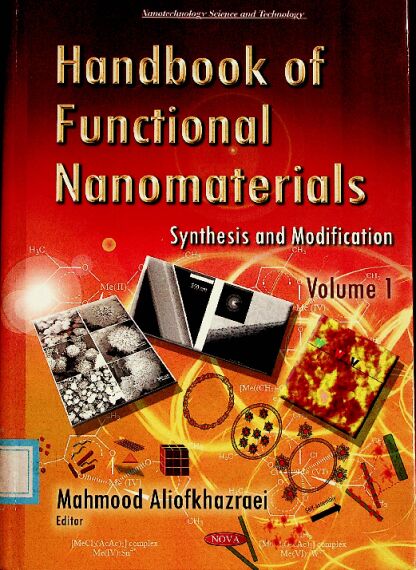
书名:Handbook of functional nanomaterials. Volume 1, Synthesis and modification
责任者:Mahmood Aliofkhazraei
ISBN\ISSN:9781629483641,1629483648
出版时间:2014
出版社:Nova Science Publishers
摘要
This is the first volume of the handbook of functional nanomaterials (4 volume set).Functional nanomaterials appear in our daily lives. These materials mainly include nanocomposites,nanopowders, nanoparticles and nanocoatings. Nanotechnology enables the creation of structures that do not exist in nature, those which cannot be produced by conventional chemistry. Some advantages of this technology are the synthesis of stronger,more adjustable materials as well as lower costs. Nanotechnology is scientific and research development at the atomic, molecular, or macromolecular levels in a dimension range of I to 100 nm; the fabrication and application of the structures, equipment, and systems which involve unique characteristics and new applications because of their small or medium dimensions; and the potential for (materials and processes) the control and management of atomic scales. Therefore, nanotechnology involves industrial research and development at atomic, molecular, and macromolecular levels. This research aims to create and exploit the structures and systems which involve unique applications due to their small dimensions. The main difference between nanotechnology and other technologies is found within the dimensions and properties of the materials and structures applied to this technology. As a matter of fact, the main difference between these two types of technologies is the presence of base elements, which are indeed the same nanoscale elements with different properties in their nanoscale and larger states.Due to the developed properties of the very fine powders including surface chemistry, compressive properties, optical characteristics, and synthetic reactions, as well as an increasing demand for fine powders in industries, a very fine fragmentation is applied in many materials such as: minerals, ceramics, dyes, chemicals,microorganisms, pharmaceuticals and paper manufacturing. This volume mainly discusses the synthesis and modification of functional nanomaterials. Some of the functional nanomaterials discussed in this volume are zinc oxide nanoparticles, iron oxide, cadmium chalcogenide nanoparticles, chitosan-based nanocomposites, mesoporous materials, gallium nitride nanowires, titania nanoparticles, plasmonic nanofilms, polyaniline nanocomposites and nano silver. There are 19 chapters in this volume; each one includes examples of these interesting materials, supported by appropriate figures for better clarification.
Chapter 1 - This chapter is an introduction to the role of functional nanomaterials in our life. Nanotechnology allows ceation of structures which do not exist in the nature and the conventional chemistry is not able to produce them. It also involves industrial researches and developments in atomic, molecular, and macromolecular levels. Functional nanomaterials will open their way in our life day after day. These materials mainly include nanocomposites,nanopowders and nanoparticles and nanocoatings. Some initial examples of these interesting materials have been mentioned in this chapter.
Chapter 2 - Owing to diverse applications in the field of electronics, optoelectronics and sensors, zinc oxide (ZnO) nanoparticles are attracting considerable attention in recent years.A few sol-gel processes for lab scale synthesis of ZnO nanoparticles have been reported so far. Increasing environmental concerns over chemical synthesis routes have culminated in efforts to develop biologically inspired synthesis processes. In case of ZnO nanoparticles the biological processes are yet to be explored. This chapter deals with sol-gel route to prepare zinc oxide nanoparticles using a biological agent (aqueous extract of Azadirachla indica (Neem) leaf) and provides an insight into its possible applications.
Chapter 3 - By manipulating the nanostructures, it is possible to impart new functi onalities to material systems. In this chapter we try to combine the advantages of ID and 30 nanostructures, to achieve superior electron transport along with high surface area. Intrigued by the unique properties of Fe20 3 at nanoscale and its abundance in nature, we demonstrate facile template-free solution based synthesis of hybrid a-Fe20 3 comprising of ID nanorods nucleating radially from 3D core. We carry out studies on dye sensitized solar cell (DSSC) device characterization so as to gain understanding of how surface area and transport properties are affected by variation in morphology.
Chapter 4 - Ultra-small, 1.8-2.3 nm, CdS quantum dots (QDs) stabilized by polyethyleneimine (PEI) in water and guanidine dendrimers in dimethylfonnamide were prepared. CdSPEIQDs have narrow size distribution of around I 0% and photoluminescence emitted in a broad range of 400-600 nm with the quantum yields of I 0-20%. Photo luminescence decay kinetics of CdS-PEI QDs is very non-exponential with an average radiative life time growing from - 15 to - 80 ns with the light quantum energy varying from - 3.2 to - 1.8 eV. Vibrational Raman spectra of CdS-PEI QDs exhibit a main peak at 250-300 cm-• which is a superposition of longitudinal, transvrse and surface-related vibrational modes, broadened due to spatial phonon confinement and structural reconstruction of QDs. Dendrimer-stabilized CdS QDs emit electroluminescence in the range of 450- 700 nm under applied voltage higher than 6 V. Unusually strong temperature dependences of photoluminescence intensity and spectral maximum energy of CdS-PEI QDs in aqueous solutions and PEI films in the range of 280-353 K were found and interpreted in terms of reversible dissociation of a PEI complex with under-coordinated Cd(ll) atoms on the QD surface.
Chapter 5 - Hybrid, semiconductor nanowire - metal nanoparticle assemblies have been investigated extensively in the context of nanotechnology for the development of novel sensors, solar cells, memory, energy storage and catalysis applications. In most cases silicon and metal - oxide semiconductor nanowires have been functionalized with noble metal nanoparticles. The large surface to volume ratio and high aspect ratio of semiconductor nanowires combined with the size dependent physical and chemical properties of noble metal nanoparticles make semiconductor nanowire - metal nanoparticle assemblies very attractive since one may achieve high device performances. Critical issues include control and modification of the surface properties of semiconductor nanowires for anchoring of noble metal nanoparticles but also the realization of ordered assemblies rather than random aggregates. Here we review the state of the art on the synthesis but also on the physical and chemical properties of semiconductor nanowires functionalized with noble metal nanoparticles such as Ag, Au, Pt and Pd with particular emphasis on their application for gas sensors, surface enhanced raman scaterring sensors, resistance switching memories, supercapacitors and batteries but also for their application in photocatalys is and electrocatalysis.
Chapter 6 - Chitosan, the only alkaline polysaccharide in nature, which has cationic polyelectrolytical and chemical reactive activities, has been applied widely in medicine, food,functional materials, cosmetics, environment, agriculture areas and so on. To expand the applications of chitosan, the composites based on chitosan or chitosan derivates have been the topic for many researchers. In recent years, chitosan-based layered silicate nanocompos ites have attracted considerable interest since they combine the structural, physical and chemical properties of both layered silicate and chitosan. They are organic-inorganic hybrid nanocomposites with chitosan intercalated into the interlayers of layered silicate via simple solution intercalation method. Compared with ordinary composites, they excel in structure,property and applications. Intercalation of chitosan into layered s ilicate can identify characteristics of chitosan by layered silicate and construct novel chitosan-based nanocompos ites from molecular level, which opens up the new development directions for chitosan. This chapter introduced the properties and applications of chitosan and layered silicate, and summarized the intercalation method, mechanism and applications of chitosanbased layered silicate nanocomposites.
Chapter 7 - Nanotechnology has been used in dentistry in several forms with the development of nanostructured materials as a usefu l tool. Nanomaterials are attractive to researchers both from practical and theoretical point of view because of their special properties. Many efforts have been made in the last two decades using novel nanotechnology and nanoscience knowledge in order to get nanostructured materials with determined functionality. There has been enormous interest in the evaluation of properties of nanosized materials for a variety of dental applications. The aim of this chapter is to study the methods of making, properties and applications ofnanomaterials used in dentistry.
Chapter 8 - The Siliceous Mesoporous Molecular Sieve Si-MCM-41 was synthesized by the hydrothermal method at 100°C for 2-10 days. Results show that eight days duration is the optimum duration for the synthesis of Si-MCM-41 with highly ordered uniform hexagonal mesopores with Type IV isotherm and HI type hysteresis loop. The Si-MCM-41 was then functionalized with I 0-50wt% of Monoethanolamine (MEA), Tetraethylenpentamine (TEPA) and Polyethylenimine (PEI). All the functionalized samples were characterized by XRD,FTIR, FESEM, HRTEM, N2 adsorption-desorption, TGA and elemental analysis. The physicochemical changes have been observed with a reduction in peak intensity in XRD diffractograms. Functional groups responsible for amine functionalization were observed ln FTIR spectra. Agglomerated.particles were o bserved in FESEM micrographs. Hexagonal pores remained intact as observed in HRTEM images The adsorption-desorption isothenns changed from Type IV to Type III by N2 adsorption-desorption. Each group showed different thermal s tability observed by TGA and elemental analysis confirmed the presence of C and N in functionalized samples. Overall, results showed that Si-MCM-41 was successfully modified with Monoethanolamin, Tetraethylenpentamine and Polyethylenimine.
Chapter 9 - Crystalline wide bandgap semiconductors can be tailored for opto-electronic applications using solar radiation, ranging from photovoltaics up to photocatalysis, covering electrochromic windows and hydrogen production in photoelectrochemical cells. For each application, the main output property/properties might be different but it is strongly influenced by the crysta lline structure and morphology of the components and assembly;when developing semiconductor associates, tandem materials or diode structures, the output properties are also significantly influenced by the interface. In optoelectronic applications, the real band structure of the components and assemblies can be tuned in the nano-range, with deviation from the bulk values, allowing the obtaining of novel or improved properties. The chapter focuses on controlling the optoelectronic properties of wide bandgap semiconductors(comparative analysis for Ti02, W03, Sn02 and ZnO), by investigating the surfactant assisted spray pyrolysis deposition of thin films; the interaction mechanisms of the surfactants with the cation precursors and the influence of various types of surfactant templates on the morphology and crystallinity are investigated. Band energy models are developed and applied to assemblies containing wide bandgap semiconductors, allowing drawing conclusions on the need for fine tuning in semiconductor associates. To prove the concept, selected data from photocatalysis applications are presented.
Chapter 10 - In this work, we give a review of recent analytical results of reference character related to the fluctuation-electromagnetic interactions in the systems particlesurface,surface-surface, and particle-particle. The applications of these results are important in atomic and molecular physics, quantum field theory and nanotechnology.
Chapter 11 - Solar control windows, which shield considerable amount of near-infrared (NfR) light yet transmit visible light, are realized with conductive naoparticles dispersed in binder resins. Those windows using nanoparticles have advantages over conventional technologies in low solar energy gain, transparency to radio-wave frequencies, high stabilities and low cost, while keeping visible transmittance high. Especially nanoparticles of lanthanum hexaboride (LaB6) and Cs-doped tungsten oxide (CWO) have excellent NIR-blocking properties at significantly little amount used. The origin of NIR absorption by dispersed nanoparticles was investigated by measuring dielectric functions and using electron energyloss spectroscopy, and the localized surface plasmon resonance was found as responsible for such a strong absorption. A numerical approach to calculate optical extinctions using Mie theory suggests that the numerous-particle effect and dielectric modification of nanoparticles due to surface oxidation should be taken into account for the observed broad-banded NIR absorption profiles, in addition to the effects of variations of particle shape and diameter.These NfR absorbing nanoparticles are applied to solar control films in automotive and architectural windows, laminated glasses for automotive windshield, plastic glazing for arcade roofs and domes, on-site solar control coatings for existing windows, among others.
Chapter 12 - Vesicles are aqueous capsules dispersed in an aqueous media; their shells consist of supramolecular assemblies of amphiphilic molecules. The possibility to load hydrophobic encapsulants into the shell and hydrophilic encapsulants into the core of vesicles renders them attractive, versatile delivery vehicles. Vesicles must retain encapsulants while being stored; however, once in use, these encapsulants should be controllably released. One possibility to gain control over the timing of release is by functionalizing thermo-responsive vesicles with actuators that locally generate heat such as plasmonic nanoparticles when subjected to light, or magnetic nanoparticles when exposed to alternating magnetic fields. In this book chapter, we discuss possibilities to assemble, characterize and apply different types of nanoparticle functionalized vesicles.
Chapter 13 - The third order nonlinear optical properties of self-assembled films formed from ZnO colloidal spheres are investigated and are compared with those of ZnO thin films deposited by the sol-gel process as well as pulsed laser ablation. ZnO thin films clearly exhibit a negative nonlinear index of refraction at 532 nm and the observed nonlinear refraction. The colloids and films developed by dip coating as well as pulsed laser ablation exhibit induced absorption whereas the self-assembled film exhibits saturable absorption.These different nonlinear characteristics can be mainly attributed to the satu ration of linear absorption of the ZnO defect states and electronic effects when the colloidal solution is transformed into self-assembled films. ZnO colloids and self-assembled films show two emission bands. The presence of pronounced visible fluorescence in the self-assembled film confirms the presece of surface defect sates. We also report our investigations on the intensity, wavelength and size dependence of saturable and induced absorption of ZnO selfassembled films and colloids. Values of the imaginary part of third order susceptibi lity are calculated for particles of size in the range 20-300 nm at different intensity levels ranging from 40 to 325 MW /cm2 within the wavelength range of 450-650 nm. The wavelength dependence of figure of merit, which specifies the magnitude of non linear absorption for unit value of linear absorption, is calculated and this helps in comparing the absorptivenon linearities at various excitation wavelengths. From the saturation property of selfassembled films of ZnO, it can be used to construct an optic diode which passes light only in one direction. In conclusion, a passive a ll-optical diode us ing nanoZnO can be realized.
Chapter 14 - Chemical sensing us ing nanoscale materials and devices is gaining increasing interest in recent years, due to unique properties of low-dimensional structures.Owing to their high surface-to-volume ratio, the one-dimensional semiconducting nanowires act as efficient electrical transducers with high sensitivity to the environment, while the zerodimensional metal oxide nanoclusters can further enhance the device functionality by acting as highly selective receptors. By functionalizing the nanowires with metal/metal-oxide nanoclusters, the nanoclusters not only act as nanocatalysts increasing the sensi tivity of the device and reducing the detection time but also enable us to tailor selectivity of such hybrid sensors by changi_ng the adsorption behavior of the analytes. By incorporating different nanoclusters on the nanowire surface, multi-analyte sensing on a single chip can easily be realized. This chapter focuses on highly sensitive, selective and room temperature operable gallium nitride nanowire chemical/gas sensors functionalized with metal/ metal oxide nanoclusters.PA/Chapter 15 - Trivalent silver nanocomposites stabi lized by polydiguanide ligand are synthesized through the oxidation of monovalent silver using a reverse microemulsion technique. These nanocomposites showed superior antibacterial activity toward Grampositive and Gram-negative bacteria compared to silver sulfadiazine, which has been used as standard bum wound therapeutic agent. The synthesized trivalent silver nanocomposite was monodisperse and it exhibited excellent photostability under ambient conditions. Based on highly antibacterial activity and its moisturizing effect on human skin, these nanoparticles are expected to be used as active therapeutic agents in the host matrices of antibacterial cream or in wound dressings.
Chapter 16 - Titanium dioxide is one of the most widely used metal oxide semiconductors for photoinduced processes because of its comparatively low cost, low toxicity and its ability to resist photocorrosion. Nanopa1ticulate Ti02 has proven as efficient lightharvesting material for potential use in photocata lytic removal of hazardous industrial byproucts, in nanocrystalline solar cells, photovoltaics and sensors. Manipulating shape and size of Ti02 nanoparticles has gained considerable attention primarily in order to control surface chemistry at nanoscale. Although uni fom1 morphologies and well-defined structures have been studied, there is s ti II lack of full understanding of the interconnection between surface, bulk and electronic properties of nano-Ti 0 2. Herein, we will discuss how size, shape and crystallinity of Ti02 nanoparticles affect their electronic properties, and how interplay between these properties affect tailoring of nano-Ti02 in order to create efficient functional systems.
Chapter 17 - Highly uniform silver thin films were realized on glass and various plasticsvia wet chemistry route. These solution deposited silver thin films were used as inexpensive substrates for surface plasmon-coupled fluorescence emission (SPCE) studies. Their use as real time plasmonic optical filters for photon sorting of fluorescence emission from molecular multiplexes under ambient conditions have been demonstrated. These substrates were also used in ethanol sensing. Our research opens doors to a broad spectrum of next generation ratiometric SPCE sensors based on high-resolution spectral determination of nanoenvironments in a multi-species system. SPCE measurements are made possible even in water medium which was not possible till now because of large exit angles.
Chapter 18 - Among conducting polymers, polyaniline (PANI) because of its high electrical conductivity, environmental stability, ease of preparation and relatively low cost,has been studied extensively for various applications. One of the most important applications of PAN! is in protection of metals against corrosion. PAN! has both barrier and electrochemical protection effects. However, to enhance the anticorrosion efficiency of PAN!coatings, various nanoparticles like nanoclays, zeolites, graphene, metals and metal oxides have been used. This chapter deals with introduction of anticorrosive prperty of polyaniline and also application of polyaniline nanocomposites as anticorrosive coating on various metal substrates. Finally this chapter will focus on the mechanism of corrosion protection by these materials.
Chapter 19 - This chapter explains the significance of obtaining an antibacterial property for the textile materials and supports the choice of silver nano particles in attaining it, by citing some of its advantages. After discussing the present understanding prevailing among the researchers about the mechanism of nanosilver in imparting antibacterial property, it outlines various methods of synthesizing and incorporating the nanosilver on the textile materials with varying substrate geometry such as fibers, yams and fabrics of woven, knitted and nonwoven types made up of a variety of fibers. Some of the methods outlined in this chapter include nanosilver synthesis and deposition on the textile materials by Layer-byLayer technique using polyelectrolytes as reducing and stabilizing agent, photo induced reduction, sonochemical application, graft co-polymerization, sol-gel techniques, electro spinning, etc. It cites the wide application of different chemicals as reductants to get nanosilver particles and at the end describes a few methods of green synthesis of nanosilver for application on the textiles. Incorporation of nanosilver on fibers like cotton, wool, silk,poly (L-Lactide), cellulose acetate, and their blends, etc. to obtain antibacterial products for day to day applications and also in the medical field has also been reviewed along with the author's research in this field.
查看更多
目录
Chapter 1 Functional Nanostructured Materials 1
Chapter 2 Studies on Bio-Fabrication of ZnO Nanoparticles with Magnetic Properties 19
Chapter 3 Quasi-3D Architecture for Iron Oxide and its Influence on Solar Cell Performance 37
Chapter 4 Ultra-Small CdS Quantum Dots Capped by Amine Polyelectrolytes 49
Chapter 5 Hybrid Metal Nanoparticle- Semiconductor Nanowire Assemblies:Synthesis, Properties and Applications 71
Chapter 6 Chitosan-Based Layered Silicate Nanocomposites 89
Chapter 7 Nanostructured Materials in Dental Applications 111
Chapter 8 Synthesis and Functionalization of Si-MCM-41 with Amines 125
Chapter 9 Crystalline Wide Bandgap Semiconductors with Optoelectronic Properties 157
Chapter 10 Fluctuation-Electromagnetic Interaction ofNanoparticles:Effects of Uniform Motion, Rotation, and Thermal Disequilibrium 177
Chapter 11 Conductive Nanoparticles Applied for Solar Control Windows 199
Chapter 12 Nanoparticle Actuated Vesicles 221
Chapter 13 Self Assembly in Nanostructured ZnO 245
Chapter 14 Robust Gas/Chemical Sensors Based on Functionalized Gallium Nitride Nanowires 269
Chapter 15 Synthesis of Highly Antibacterial Higher Valence Silver Nanocomposites 291
Chapter 16 Control of Size and Shape of Titania Nanoparticles 305
Chapter 17 Solution-Deposited Plasmonic Nanofilms and their Applications 333
Chapter 18 Polyaniline Nanocomposites As Anticorrosive Materials 349
Chapter 19 Nanosilver for Imparting Antibacterial Properties to the Textile Substrates 365
Index 387
查看PDF
查看更多
馆藏单位
中科院文献情报中心