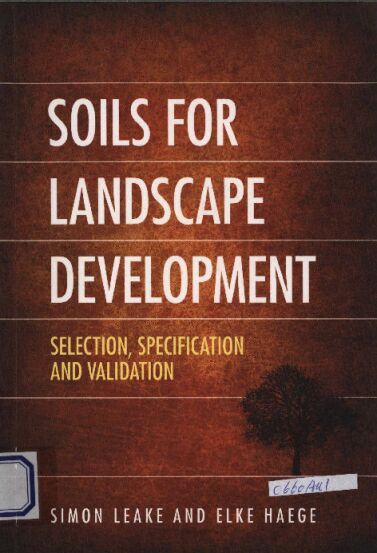
书名:Soils for landscape development
责任者:Simon Leake and Elke Haege. | Haege, Elke,
ISBN\ISSN:9780643109643,0643109641,9780643109650,064310965X
出版时间:2014
出版社:CSIRO Publishing
前言
Soils for Landscape Development: selection,specification and validation is written to instruct and assist designers to specify landscape soils properly using objective and meas¬urable criteria. It provides essential information and a universally applicable method for landscape architects and designers, specification writers, landscape contractors and soil supply companies using a systematic, clear and practical template based on solid and scientifically objective criteria.
This book links the landscape design processes with sound modern soil science prac¬tices to promote better quality project outcomes by ensuring that the basis of the land¬scape, the soil, is suitable for the intended purpose. Many different types of soils are used in landscape developments, from recycled site soils to lightweight podium and planter box mixes using artificial components. Many different proprietary soil products are available. This book attempts to provide an objective set of criteria for ensuring the chosen soil is truly suitable for the intended landscape treatment. The authors emphasise the use of measurable chemical and physical properties, well understood by soil scientists, to inform these decisions, not the use of arbitrary recipes or formulations.
This book seeks to provide landscape practitioners with a set of tools that will enable them to deliver functional and successful landscape soils to their clients and reduce the incidence of failure and the attendant costs and wastes of natural resources. A strong emphasis in all chapters is placed on reducing environmental impacts by reuse of site soil, promoting appropriate minimal soil intervention and using recycled products.
Unique features of the handbook include:
1. The soil approach method, which promotes consideration of existing site resources and outlines steps to take to minimise costs through soil reuse and to use site soil analysis and edaphic considerations to inform and promote sustainable design.
2. A site soil characterisation and investigation specification, which provides a method by which site-won soils should be characterised and then be used to form part of the performance specification. Thus the performance specification process is not confined to the use of purchased imported soils.
3∙ Performance-based technical specifications, where two compulsory specifications are given outlining the performance requirement and the range of physical and chemical properties essential for the performance criteria to be met.
4. An informative section, where a clear description of both the intended use and type of soil mixes that might meet the criteria is given. This informative descriptive element allows for variation and market competition.
5∙ Suggested soil components, which provide examples and guidance to soil supply companies as to the likely proportions in order to meet the specification criteria.
6. Ten main and three specialist landscape soil specifications in a ccopy and paste1 2 * 4 1 2 * 4 5 6 6 template, which is ready for use in landscape soil specification reports. These are numbered so they can be universally referenced. The most typical landscape soil situations have been rationalised to fit into these 13 categories.
7. A set of design drivers to improve the adaptation of landscape to place, and hence success rates, sustainability and provide optimum landscape performance.
8. A ready reference to landscape soils to inform and promote sound reasoning for client understanding and satisfaction.
9. Verification and quality assurance specification steps and guidelines to enable clear, standard, industry-accepted processes over the quality of the product, certifi¬cation requirements, construction process, and correct supply of specified land¬scape soils and mulches.
10. A soil volume ‘estimator’ and outline of eight key factors that are useful in deter-mining soil volume for trees in spaces where soil is limited.
The authors (Simon Leake and Elke Haege) have been advocating the use of objective measurable soil properties to specify soils and ensure they meet the performance criteria required, in preference to the current tformulatioπ-based, method so widely used in land¬scape construction contracts.
Over several years, we have put together a set of the most typical soil specifications that could simply be used by landscape development professionals for the majority of their landscape projects.
Our aim was to provide a clear and defined set of core specifications for the selection, specification and validation of soils for landscape developments that can be directly used for the majority of landscape projects in order to optimise the quality and longevity, and hence sustainability, of landscape design concepts.
Our purpose is to permit proper measurement-based quality assurance during con¬struction to reduce the likelihood of landscape failure due to the purchase of soil that is inappropriate for the intended use and often not necessary. We also provide general guidance to soil selection and installation, with the examples of typical soil specifications. The general aim is to avoid the common plant and installation failures that are unneces¬sarily common in our industry.
We believe it is important to give landscape development professionals sound reasons why soil selection, specification and validation is important, and have therefore provided some case studies and some general background in a practical and understandable, yet scientifically sound, format.
We hope the use of this handbook will help to rationalise the varied array of chemical and physical property values currently provided to soil suppliers and contractors, so that the suppliers of soil will also use these specifications to develop soil products that meet the typical soil examples given. In this way, the process should become more streamlined and the industry self-regulated.
The utilisation of on-site soils in urban, suburban, pastoral or any development situa¬tion is common and the specifications encourage and allow for assessment, preparation, improvement and validation of site soil, as well as imported commercial soil.
The soil specifications are typically used to construct both the topsoil and the subsoil depths necessary for acceptable to optimum plant or tree growth. In the case of trees with limited space, additional advisory specifications are provided to define soil volumes (depth and extent) for tree growth zones to quantify and validate estimations for the area of soil required for adequate supply of nutrients, water, air, physical stability and hence growth and longevity for a tree or group of trees in urban environments.
查看更多
目录
Foreword vii
Preface ix
Acknowledgements xi
1 Introduction 1
1.1 Why are these soil specifications needed? 1
1.2 Lessons from failed project examples to demonstrate why we need this handbook 2
1.3 The function of this handbook 4
1.4 Who will use this handbook? 5
1.5 Key benefits 5
1.6 Structure of this handbook 6
1.7 How to use this handbook to drive your project 6
1.8 Traps for unwary players (the most common landscape soil problems) 7
1.9 Due diligence and responsibilities 10
2 Design development process and the soil approach 11
2.1 Project initiation 11
2.2 Site soil analysis 11
2.3 Landscape balance (prioritising project factors) 13
2.4 Landscape objectives 13
2.5 Influence of soil on design 14
2.6 Soil choice versus design 15
2.7 Specification case study 1: 'Woo-la-ra', Sydney Olympic Park (SOP), NSW, Australia 15
2.8 Specification case study 2: Barangaroo, Sydney City former port, NSW 17
2.9 Specification case study 3: One Central Park, Broadway, Sydney 24
3 Understanding soils for landscape development 31
3.1 Understanding and investigating site soils 31
3.2 Natural soils 31
3.3 Disturbed and urban soils 34
3.4 Soil contamination 34
3.5 Site soil survey 35
3.6 Sampling and analysis 36
3.7 Reporting on soil conditions 37
3.8 The soil selection process 38
3.9 Bringing the soil selection process and design together 38
3.10 Identification of4fit for purpose’ 40
3.11 Amelioration and improvement 40
4 Soil design 43
4.1 The soil approach method 43
4.2 Choosing the profile form for Part I of the soil specifications 45
4.3 Specifying soil depths 48
4.4 Specifying drainage types 48
4.5 Specifying soil volumes 50
4.6 Specifying the soil volumes, profile structures and depths for trees in areas with limited soil 51
4.7 Choosing the Part III product specifications 52
4.8 Mulches 55
4.9 Specifications for mulch 56
4.10 Creating artificial and specialist growing media 58
5 Guidance to using the soil performance specifications 59
5.1 Using the templates 59
5.2 Structure 59
5.3 Scope 60
5.4 Variation 60
5.5 Test methods 61
5.6 How to construct your soil specification 62
6 The performance specifications 65
Part I A Site investigation∕analysis 66
Specification Al: Site soil investigation and characterisation 67
Specification A2: Site subgrade investigation and characterisation 69
Part II B Preparatory soil works 70
Specification BI: Stripping and stockpiling 71
Specification B2: Site subgrade preparation 72
Specification B3: Imported subsoil 73
Specification B4: Soil schedules (profiles, volumes and depths) 75
Schedule of soil horizon depths 76
Tree rooting volumes table 77
Part III C Soils for turf and lawns 78
Specification Cl: Passive amenity turf 79
Specification C2: Active high-traffic turf 81
Specification C3: Sports field turf 83
Part III D Soils for gardens and mass planting 85
Specification DI: Mass planting soil 86
Specification D2: Garden bed planting soil 89
Specification D3: Display bed soil 92
Specification D4: Advanced tree and vault subsoils 95
Part III E On slab media 98
Specification El: On slab soil media ‘A’ horizon 99
Specification E2: On slab soil media tB5 horizon 102
Specification E3: Low-density container and green roof 105
Part III F Specialist soils 108
Specification FI: Structural support soil 109
Specification F2: Raingardens and stormwater filtration soils 112
Specification F3: Wetland soils 115
Part IV G Validation specifications 117
Specification Gl: Quality assurance and control 118
Specification G2: Hold points 121
Specification G3: Compliance certification 122
Bibliography 125
Appendix A: Technical information, sampling and test methods 127
Appendix B: Forms and templates 133
Appendix C: Soil rooting volumes 147
Glossary of industry terms 161
Index 171
查看PDF
查看更多
馆藏单位
中国农科院农业信息研究所