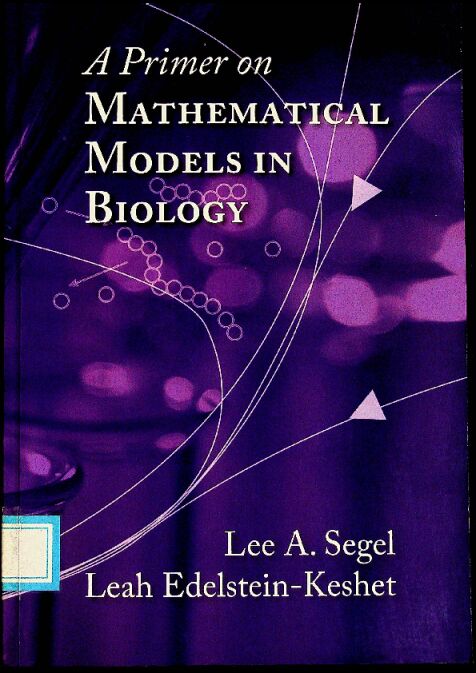
书名:A primer on mathematical models in biology
责任者:Lee A. Segel | Leah Edelstein-Keshet.
出版时间:2013
出版社:Society for Industrial and Applied Mathematics
摘要
This textbook grew out of a course that the highly respected applied mathematician Lee Segel taught at the Weizmann Institute. This book represents the unique perspective on mathematical biology of Segel and his co-author Leah Edelstein-Keshet (author of the popular SIAM book, Mathematical Models in Biology). It introduces differential equations, biological applications, and simulations, with emphasis on molecular events (biochemistry and enzyme kinetics), excitable systems (neural signals), and small protein and genetic circuits. The exposition combines clear and useful mathematical methods with plenty of applications to illustrate the power of such tools, along with many exercises in reasoning, modelling and simulation. The reader will also find suggestions for further study and appendices containing useful background material. These features make the book ideal for students at the advanced undergraduate or graduate level in both biology and mathematics who wish to experience the application of mathematical techniques to the biological sciences.
查看更多
目录
List of Figures ix
List of Tables xv
Acknowledgments xvii
Preface xix
1 Introduction 1
1.1 When to model 2
1.2 What is a model 2
1.3 Formulation of a mathematical model 3
1.4 Solving the model equations 5
1.5 Drawing qualitative conclusions 6
1.6 Choosing parameters 7
1.7 Robustness 7
1.8 Analysis of results 9
1.9 Successes and failures of modeling 9
1.10 Final remarks 11
1.11 Other sources of information on mathematical modeling in biology 12
2 Introduction to biochemical kinetics 13
2.1 Transitions between states at the molecular level 13
2.2 Transitions between states at the population level 16
2.3 The law of mass action 23
2.4 Enzyme kinetics: Saturating and cooperative reactions 24
2.5 Simple models for polymer growth dynamics 27
2.6 Discussion 36
Exercises 37
3 Review of linear differential equations 43
3.1 First-order differential equations 44
3.2 Linear second-order equations 50
3.3 Linear second-order equations with constant coefficients 52
3.4 A system of two linear equations 55
3.5 Summary of solutions to differential equations in this chapter 61
Exercises 61
4 Introduction to nondimensionalization and scaling 67
4.1 Simple examples 67
4.2 Rescaling the dimerization model 72
4.3 Other examples 76
Exercises 79
5 Qualitative behavior of simple differential equation models 83
5.1 Revisiting the simple linear ODEs 83
5.2 Stability of steady states 86
5.3 Qualitative analysis of models with bifurcations 88
Exercises 99
6 Developing a model from the ground up: Case study of the spread of an infection 103
6.1 Deriving a model for the spread of an infection 103
6.2 Dimensional analysis applied to the model 105
6.3 Analysis 107
6.4 Interpretation of the results 111
Exercises 111
7 Phase plane analysis 115
7.1 Phase plane trajectories 115
7.2 NulIclines 117
7.3 Steady states 118
7.4 Stability of steady states 120
7.5 Classification of steady state behavior 122
7.6 Qualitative behavior and phase plane analysis 124
7.7 Limit cycles, attractors, and domains of attraction 132
7.8 Bifurcations continued 135
Exercises 138
8 Quasi steady state and enzyme-mediated biochemical kinetics 145
8.1 Warm-up example: Transitions between three states 145
8.2 Enzyme-substrate complex and the quasi steady state approximation 152
8.3 Conditions for validity of the QSS 158
8.4 Overview and discussion of the QSS 165
8.5 Related applications 167
Exercises 168
9 Multiple subunit enzymes and proteins: Cooperativity 173
9.1 Preliminary model for rapid dimerization 173
9.2 Dimer binding that induces conformational change: Model formulation 176
9.3 Consequences of a QSS assumption 178
9.4 Ligand binding to dimer 179
9.5 Results for binding and their interpretation: Cooperativity 183
9.6 Cooperativity in enzyme action 184
9.7 Monod-Wyman-Changeaux (MWC) cooperativity 185
9.8 Discussion 190
Exercises 190
10 Dynamic behavior of neuronal membranes 195
10.1 Introduction 195
10.2 An informal preview of the Hodgkin-Huxley model 198
10.3 Working towards the Hodgkin-Huxley model 202
10.4 The full Hodgkin-Huxley model 214
10.5 Comparison between theory and experiment 216
10.6 Bifurcations in the Hodgkin-Huxley model 219
10.7 Discussion 222
Exercises 222
11 Excitable systems and the FitzHugh-Nagumo equations 227
11.1 A simple excitable system 227
11.2 Phase plane analysis of the model 229
11.3 Piecing together the qualitative behavior 234
11.4 Simulations of the FitzHugh-Nagumo model 236
11.5 Connection to neuronal excitation 241
11.6 Other systems with excitable behavior 246
Exercises 247
12 Biochemical modules 251
12.1 Simple biochemical circuits with useful functions 251
12.2 Genetic switches 257
12.3 Models for the cell division cycle 262
Exercises 277
13 Discrete networks of genes and cells 283
13.1 Some simple automata networks 284
13.2 Boolean algebra 294
13.3 Lysis-lysogeny in bacteriophage 入 299
13.4 Cell cycle, revisited 304
13.5 Discussion 306
Exercises 308
14 For further study 311
14.1 Nondimensionalizing a functional relationship 311
14.2 Scaled dimensionless variables 312
14.3 Mathematical development of the Michaelis-Menten QSS via scaled variables 316
14.4 Cooperativity in the Monod-Wyman-Changeaux theory for binding 318
14.5 Ultrasensitivity in covalent protein modification 320
14.6 Fraction of open channels, Hodgkin-Huxley Model 324
14.7 Asynchronous Boolean networks (kinetic logic) 327
Exercises 333
15 Extended exercises and projects 337
Exercises 337
A The Taylor approximation and Taylor series 355
Exercises 361
B Complex numbers 363
Exercises 365
C A review of basic theory of electricity 367
C.1 Amps, coulombs, and volts 367
C.2 Ohm's law 370
C.3 Capacitance 371
C.4 Circuits 373
C.5 The Nernst equation 375
Exercises 377
D Proofs of Boolean algebra rules 379
Exercises 381
E Appendix: XPP files for models in this book 385
E.1 Biochemical reactions 385
E.2 Linear differential equations 386
E.3 Simple differential equations and bifurcations 387
E.4 Disease dynamics models 389
E.5 Phase plane analysis 389
E.6 Chemical reactions and the QSS 391
E.7 Neuronal excitation and excitable systems 392
E.8 Biochemical modules 394
E.9 Cell division cycle models 396
E.10 Boolean network models 401
E.11 Odell-Oster model of Exercise 15.7 403
Bibliography 405
Index 417
查看更多
馆藏单位
中科院文献情报中心