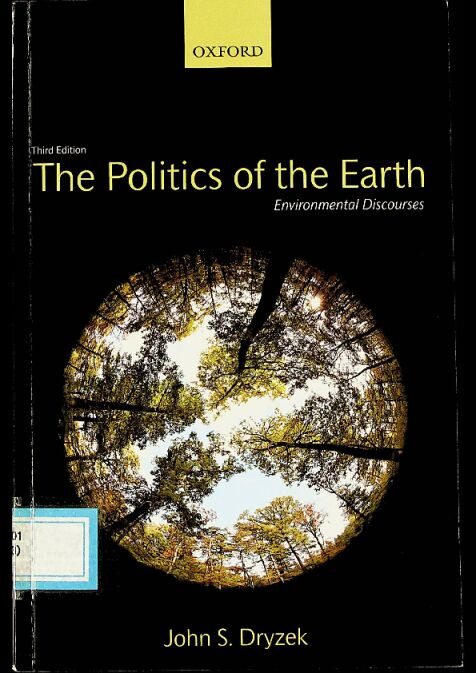
书名:The politics of the Earth
ISBN\ISSN:9780199696000,0199696004
出版时间:2013
出版社:Oxford University Press
前言
A lot has happened in the last five decades of environmental affairs. Environmental crisis arrived in the late 1960s, along with dire warnings about global shortages and ecological collapse. Since then, the Earth's population has almost doubled. There have been spectacular nuclear accidents at Chernobyl and Fukushima, and spectacular nonnuclear accidents at Bhopal in India, Prince William Sound in Alaska, and the Gulf of Mexico. Extreme weather events, as predicted by most models of climate change, have become more common, putting New Orleans under water. Green parties have emerged as a significant electoral force, and joined governing coalitions in several countries. Mainstream environmental groups have developed massive memberships. Populist backlashes against environmentalism have flared. Global environmental issues relating to climate change, biodiversity, and ozone layer depletion have come to the fore. We have had World Summits, Earth Days, environmental presidents, ecological sabotage, civil disobedience, legislation and regulation by the bookful, and movements for environmental justice, sustainable development, deep ecology, antiglobalization, "wise use," and climate change denial.
The idea of this book is to make sense of all these developments. I do so by deploying the notion of environmental discourses. A discourse is a shared way of looking at the world. Its adherents will therefore use a particular kind of language when talking about events, which in turn rests on some common definitions, judgments, assumptions, and contentions. There turns out to be rather little in common between(say) partisans of a discourse believing in the unproblematic nature of uncontrolled economic growth and a radical green discourse seeking renewed harmony among humans and between humans and nature.The history of environmental affairs is largely a matter of the history of the discourses I survey, their rise and fall, their interactions and impacts. All these discourses are still with us, and none has fallen by the wayside (which itself says a lot about the increasing complexity of environmental affairs). I will recount their history, and assess their impact, strengths, and weaknesses as ways of dealing with environmental issues.
I have tried to approach these questions from a position of critical detachment, but at the end of the day I do have some strong positions of my own. I have left an explicit statement of these to the conclusion, under the heading of ecological democracy, though they do put in occasional earlier appearances.
This book began life on September 9, 1994 at 12.45 pm, when Tim Barton of Oxford University Press suggested I write it. Ruth Anderson of Oxford University Press helped guide the second edition, Catherine Page and Martha Bailes this third edition. The world changes. While the basic classification of discourses remains the same as in the second edition, the content of each has undergone significant change.
The deeper life of this project exists in years of environmental discourse with students, scholars, and activists. In Oregon I learned much from Joseph Boland, David Carruthers, Irene Diamond, Dan Goldrich, Jeff Land, Gerry Mackie, Michael McGinnis, Ronald Mitchell, Alan Moore, David Schlosberg, Stuart Shulman, Paul Thiers, and Michael Welsh. In Australia, ecopolitical interlocutors have included Mani Banjade, Mike Bennell, Mark Carden, Peter Christoff, Louise Clery, Weng Dano, Steve Dovers, David Downes, Charlotte Epstein, Robyn Eckersley, Simon Grant, Carolyn Hendriks, Kersty Hobson, Peter Kanowski, Kathryn Kelly, Janette Lindesay, Alex Lo, Nicholas Low, Freya Mathews, Simon Niemeyer, Val Plumwood, Adrianna Semmens, Cassandra Star, Will Steffen, Richard Sylvan, Janna Thompson, Ken Walker, and David Yencken. Elsewhere, correspondents and conversationalists have included Laurie Adkin, Terence Ball, Brendan Barrett John Barry, Walter Baber, Robert Bartlett, Gary Bryner, Margaret Clark, Tim Clark, Andrew Dobson, Frank Fischer, George González, Robert Goodin, Adolf Gundersen, Garrett Hardin, Bronwyn Hayward, Tim Hayward, Hans-Kristian Hernes, Qingzhi Huan, Christian Hunold, Susan Hunter, Michael Jacobs, Sheila Jasanoff, William Lafferty, Oluf Langhelle, Sang-Hun Lee, James Lester, Hemant Ojha, Stig Toft Madsen, Masatsugu Maruyama, Hiro Matsuno, James Meadowcroft, John Meyer, Soon-Hong Moon, Arne Naess, Richard Norgaard, James O'Connor, Catherine Oelofse, Claus Offe, Robert Paehlke, Thomas Princen, Craig Rimmerman, Dianne Scott, Graham Smith, Clive Spash, Paul Wapner, Albert Weale, Douglas Wilson, Edward Woodhouse, Iris Young, and Oran Young. It has been a pleasure to work with members of the Earth System Governance community, especially Karin Bäckstrand, Frank Biermann, Aarti Gupta, and Ruben Zondervan. I have also learned a lot through my membership of the Science Committee of the International Human Dimensions Program on Global Environmental Change. The particular shape taken by this book depends a lot on advice from Douglas Torgerson and Maarten Hajer (Maarten once insisted in jest that every book should end with a chapter in which democracy comes to the rescue). I have worked with David Schlosberg on co-editing editions of the companion reader to this book, Debating the Earth, and benefited a great deal from his insights and advice. More recently, David and I co-edited The Oxford Handbook of Climate Change and Society with Richard Norgaard, I have worked extensively on the global governance of climate change, and especially its discourses, with Hayley Stevenson. Thanks to people such as these, the environmental field is today alive, growing, and the site of some of the most interesting thinking in social science, philosophy, public policy, and practical politics, making a book like this so much easier to write. I would also like to thank readers from around the world who have given me feedback on the previous two editions (even when they didn't get some of the jokes) and suggestions for this one. For research assistance I thank Elaine dos Santos.
In the preface to his classic Risk Society, Ulrich Beck says that he wrote most of it overlooking a picturesque lake, and that readers should imagine a lake in the background. I wrote most of the first edition overlooking a garbage dump that is now a park. The second edition was completed in the pleasant surroundings of a dry sclerophyll forest. I suggested that readers should imagine tall eucalyptus trees and the call of parrots in the background-but watch out for bush fires. This third edition is completed in that same forest, which it turns out had much more to fear from bulldozers than fire. One day they will have to go.
查看更多
目录
LIST OF BOXES AND FIGURES xvii
PART l INTRODUCTION 1
1 Making Sense of Earth's Politics: A Discourse Approach 3
PART II GLOBAL LIMITS AND THEIR DENIAL 25
2 Looming Tragedy: Limits, Boundaries, Survival 27
3 Growth Unlimited: The Promethean Response 52
PART III SOLVING ENVIRONMENTAL PROBLEMS 73
4 Leave it to the Experts: Administrative Rationalism 75
5 Leave it to the People: Democratic Pragmatism 99
6 Leave it to the Market: Economic Rationalism 122
PART IV THE QUEST FOR SUSTAINABILITY 145
7 Greener Growth: Sustainable Development 147
8 Industrial Society and Beyond: Ecological Modernization 165
PART V GREEN RADICALISM 185
9 Changing People: Green Consciousness 187
10 New Society: Green Politics 207
PART VI CONCLUSION 231
11 Ecological Democracy 233
REFERENCES 241
INDEX 263
查看更多
馆藏单位
中科院文献情报中心