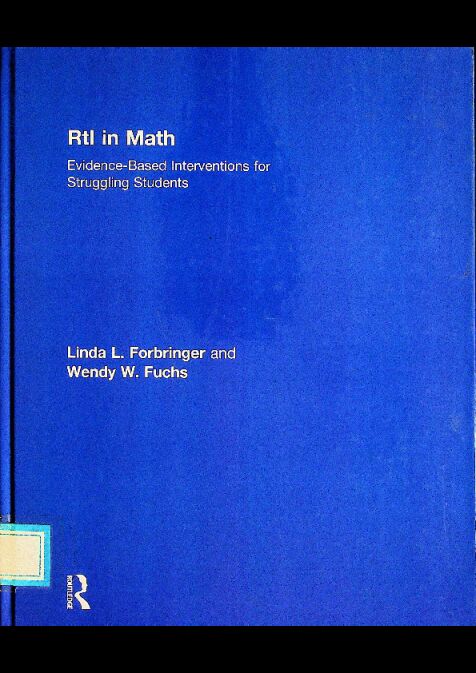
书名:Rti in math
责任者:Linda L. Forbringer and Wendy W. Fuchs. | Fuchs, Wendy W.
ISBN\ISSN:9780415735308,0415735300,9781596672543
出版时间:2014
出版社:Eye on Education
目录
Meet the Authors ix
Introduction xi
1 Overview of Response to Intervention in Mathematics 1
What Is Response to Intervention? 1
Evidence-Based Instruction 2
Data-Based Decision Making 2
Tiered Support 3
Models of Implementation 6
Summary 7
2 Using Assessment to Make Instructional Decisions 8
Step 1: Problem Identification 9
Core Program Evaluation 13
Identifying Struggling Learners 13
Step 2: Problem Analysis 15
Step 3: Intervention Plan Development 19
Step 4: Plan Implementation 22
Step 5: Plan Evaluation 24
Summary 24
3 Overview of Evidence-Based Practices for Teaching Mathematics 25
What Is the Core Curriculum? 25
Description of the Core Curriculum 25
Evidence-Based Practice for the Core Curriculum 27
Emphasize Critical Concepts 27
Teach Critical Foundations to Mastery 27
Balance Conceptual Understanding, Fluency, and Problem Solving 28
Use a Combination of Teacher-Centered and Student-Centered Approaches 28
Follow the CRA Sequence 28
Select High-Quality Programs 30
Interventions to Support Students Who Struggle in Mathematics 30
Teach Critical Content During Interventions 31
Focus on Whole Numbers and Rational Numbers 31
Basic Facts 32
Problem Solving 32
Effective Instructional Methods for Struggling Students 33
Explicit Instruction 33
Manipulatives and Visual Representation 33
Motivation 34
Summary 35
4 Setting the Stage: Increasing Motivation 36
Why Focus on Motivation? 36
Increasing Motivation by Creating Meaningful, Engaging Lessons 37
Using Self-Monitoring and Goal-Setting to Increase Motivation 40
Effective Use of Praise 42
Rewards 45
I = Instruction with Incentive 46
N = Not Negative! 46
C = Criteria 48
E = Easy 48
N = Never Leave a Child with No Reason to Try! 49
T = Time 49
I = Individualized Incentive 50
V = Verbal Feedback 52
E = Evaluate 53
Summary 54
5 Explicit Instruction 55
Instructional Considerations for Struggling Learners 55
The Explicit Instruction Lesson 58
structional Objectives 60
Lesson Introduction 62
Engage 62
Review of Prerequisite Skills and Concepts 62
Presentation of New Content 64
Guided Practice 68
Independent Practice 70
Massed Practice 70
Distributed Practice 74
Lesson Closure 75
How Explicit Instruction Improves Motivation 76
Summary 76
6 Concrete and Visual Representation 78
Research on the Concrete-Representational-Abstract Sequence 79
Virtual Manipulatives 84
Suggestions for Using the CRA Sequence 87
Summary 89
7 Representing Whole Numbers 91
Developing Number Sense 91
Counters 92
Touchmath 93
Ten-Frames 94
Number Lines 97
Place Value 101
Ten-Frames 101
Base-Ten Blocks 103
DigiBlocks 106
Building a Solid Foundation 108
Addition and Subtraction 110
Developing Conceptual Understanding 110
Developing Computational Fluency with Basic Facts 116
Multi-Digit Addition and Subtraction 117
Multiplication and Division 123
Developing Conceptual Understanding of Multiplication 123
Understanding Division 132
Multidigit Multiplication 133
Multidigit Division 146
Summary 150
8 Developing Computational Fluency with Basic Facts 152
Conceptual Understanding and Computational Fluency 154
Strategies for Addition Facts 158
Counting On 158
Plus-One and Plus-Two Facts 159
The Commutative Property of Addition 160
Facts with Zero 160
Doubles 161
Near-Doubles 163
Ten-Sums 164
Near-Tens 164
Facts Solved by Making a Ten 165
The Leftovers 166
Selecting a Strategy 166
Strategies for Subtraction Facts 167
Related Facts 168
Counting Down: -1 and -2 Facts 169
Subtracting Zero 170
Subtracting the Same Number 171
Decomposition Strategies 171
Strategies for Multiplication Facts 171
×2 172
Fives 172
Zeros and Ones 173
Nines 174
Other Strategies 175
Strategies for Division Facts 178
Mnemonics 179
Using Technology to Practice Basic Facts 180
Differentiating Practice 180
Sumumary 183
9 Representing Rational Numbers 184
Developing Fraction Concepts 184
Using the CRA Sequence with Advanced Fraction Skills 188
Equivalent Fractions 189
Adding and Subtracting Fractions 193
Multiplying Fractions 198
Dividing Fractions 202
Decimals 207
Percent 213
Summary 214
10 Problem Solving 216
Problem Structures for Addition and Subtraction 217
Representing and Solving Addition and Subtraction Problems 220
Group Problems 223
Change Problems 226
Compare Problems 226
Extending Addition and Subtraction 229
Problem Structures for Multiplication and Division 231
Equal Groups 231
Multiplicative Comparison Problems 234
Extending Multiplication and Division 235
Scaffolding Support 236
Selecting Appropriate Problem-Solving Materials 238
Summary 239
11 Conclusion: Using RtI to Improve Achievement in Mathematics 242
Locating Materials to Provide High-Quality Instruction 242
Using Data to Inform Instructional Decisions 245
Providing Evidence-Based Interventions 248
Summary 251
Appendix A: Sample Lesson Plans 253
Appendix B: Games to Practice Basic Facts 259
Appendix C: Additional Resources for Teaching Basic Facts 275
References 277
查看更多
作者简介
Dr. Wendy Fuchs is an Assistant Professor in the Department of Special Education and Communication Disorders at Southern Illinois University Edwardsville. She teaches the beginning and advanced reading methods courses for pre-service special educators. Dr. Fuchs also serves as the Principal Investigator and Project Coordinator of the Illinois Institutes of Higher Education Partnership, a federally-funded Statewide Professional Development Grant that assists teacher preparation programs integrate MTSS into course content and field experiences. In addition to her work with the IHE Partnership, Dr. Fuchs provides professional development and educational consulting to school districts in Southern Illinois in the areas of Response to Intervention/Multi-Tier System of Supports (MTSS), school improvement, and maximizing student engagement. Dr. Fuchs is a member of the PBIS Statewide Leadership Team, and serves as an executive board member for the Illinois Teacher Education Division of Council for Exceptional Children. Her research interests include effective teaching practices, teacher perceptions of students with disabilities, data-based instructional decision making.
查看更多
馆藏单位
中科院文献情报中心