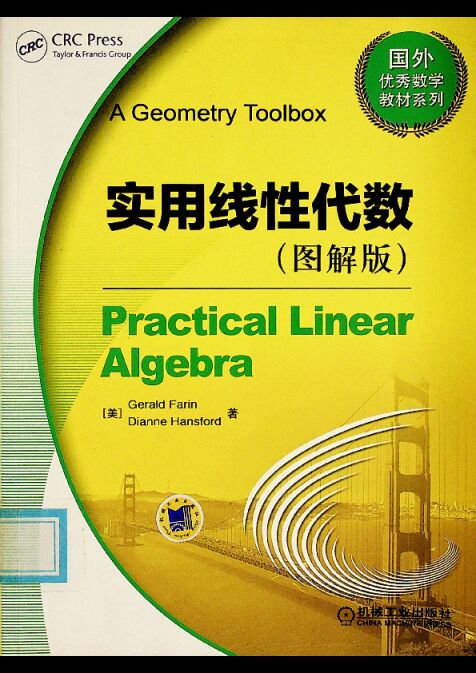
书名:Practical linear algebra
责任者:Gerald Farin | Dianne Hansford ; 李红玲 注释.
分类号:数学
版次:[Reprinted ed.].
前言
本书区别于以往线性代数的书籍,内容新颖,编排独特,作者以几何视角讲述线性代数,通过二维平面和三维空间中的例子解释线性代数中的各种概念和性质。本书强调直观性以及知识点的背景,结合计算机中各种图形的变换来理解线性变换,注重可读性的同时突出数学的基本思想,将直观图形与数学证明进行了巧妙的结合。作者在书籍侧边空白处手绘200余幅示意图给出了相关概念的解释,更好的帮助读者理解。本书可供非数学类专业的学生及数学爱好者使用,亦可作为数学专业学生和教师的参考用书。
查看更多
目录
Preface
Chapter 1 Descartes' Discovery 1
1.1 Local and Global Coordinates: 2D 2
1.2 Going from Global to Local 6
1.3 Local and Global Coordinates: 3D 8
1.4 Stepping Outside the Box 9
1.5 Creating Coordinates 10
1.6 Exercises 12
Chapter 2 Here and There: Points and Vectors in 2D 13
2.1 Points and Vectors 14
2.2 What's the Difference 16
2.3 Vector Fields 17
2.4 Length of a Vector 18
2.5 Combining Points 21
2.6 Independence 24
2.7 Dot Product 24
2.8 Orthogonal Projections 28
2.9 Inequalities 29
2.10 Exercises 30
Chapter 3 Lining Up: 2D Lines 33
3.1 Defining a Line 34
3.2 Parametric Equation of a Line 35
3.3 Implicit Equation of a Line 37
3.4 Explicit Equation of a Line 40
3.5 Converting Between Parametric and Implicit Equations 41
3.6 Distance of a Point to a Line 43
3.7 The Foot of a Point 47
3.8 A Meeting Place: Computing Intersections 48
3.9 Exercises 54
Chapter 4 Changing Shapes: Linear Maps in 2D 57
4.1 Skew Target Boxes 58
4.2 The Matrix Form 59
4.3 More about Matrices 61
4.4 Scalings 63
4.5 Reflections 65
4.6 Rotations 68
4.7 Shears 69
4.8 Projections 71
4.9 The Kernel of a Projection 73
4.10 Areas and Linear Maps: Determinants 74
4.11 Composing Linear Maps 77
4.12 More on Matrix Multiplication 81
4.13 Working with Matrices 83
4.14 Exercises 84
Chapter 5 2×2 Linear Systems 87
5.1 Skew Target Boxes Revisited 88
5.2 The Matrix Form 89
5.3 A Direct Approach: Cramer's Rule 90
5.4 Gauss Elimination 91
5.5 Undoing Maps: Inverse Matrices 93
5.6 Unsolvable Systems 99
5.7 Underdetermined Systems 100
5.8 Homogeneous Systems 100
5.9 Numerical Strategies: Pivoting 102
5.10 Defining a Map 103
5.11 Exercises 104
Chapter 6 Moving Things Around: Affine Maps in 2D 107
6.1 Coordinate Transformations 108
6.2 Affine and Linear Maps 110
6.3 Translations 111
6.4 More General Affine Maps 112
6.5 Mapping Triangles to Triangles 114
6.6 Composing Affine Maps 116
6.7 Exercises 120
Chapter 7 Eigen Things 123
7.1 Fixed Directions 124
7.2 Eigenvalues 125
7.3 Eigenvectors 127
7.4 Special Cases 129
7.5 The Geometry of Symmetric Matrices 132
7.6 Repeating Maps 135
7.7 The Condition of a Map 137
7.8 Exercises 138
Chapter 8 Breaking It Up: Triangles 141
8.1 Barycentric Coordinates 142
8.2 Affine Invariance 144
8.3 Some Special Points 145
8.4 2D Triangulations 148
8.5 A Data Structure 149
8.6 Point Location 150
8.7 3D Triangulations 151
8.8 Exercises 153
Chapter 9 Conics 155
9.1 The General Conic 156
9.2 Analyzing Conics 160
9.3 The Position of a Conic 162
9.4 Exercises 163
Chapter 10 3D Geometry 165
10.1 From 2D to 3D 166
10.2 Cross Product 168
10.3 Lines 172
10.4 Planes 173
10.5 Application: Lighting and Shading 177
10.6 Scalar Triple Product 180
10.7 Linear Spaces 181
10.8 Exercises 183
Chapter 11 Interactions in 3D 185
11.1 Distance Between a Point and a Plane 186
11.2 Distance Between Two Lines 187
11.3 Lines and Planes: Intersections 189
11.4 Intersecting a Triangle and a Line 191
11.5 Lines and Planes: Reflections 191
11.6 Intersecting Three Planes 193
11.7 Intersecting Two Planes 194
11.8 Creating Orthonormal Coordinate Systems 195
11.9 Exercises 197
Chapter 12 Linear Maps in 3D 199
12.1 Matrices and Linear Maps 200
12.2 Scalings 202
12.3 Reflections 204
12.4 Shears 204
12.5 Projections 207
12.6 Rotations 209
12.7 Volumes and Linear Maps: Determinants 213
12.8 Combining Linear Maps 216
12.9 More on Matrices 218
12.10 Inverse Matrices 219
12.11 Exercises 221
Chapter 13 Affine Maps in 3D 223
13.1 Affine Maps 224
13.2 Translations 225
13.3 Mapping Tetrahedra 225
13.4 Projections 229
13.5 Homogeneous Coordinates and Perspective Maps 232
13.6 Exercises 238
Chapter 14 General Linear Systems 241
14.1 The Problem 242
14.2 The Solution via Gauss Elimination 244
14.3 Determinants 250
14.4 Overdetermined Systems 253
14.5 Inverse Matrices 256
14.6 LU Decomposition 258
14.7 Exercises 262
Chapter 15 General Linear Spaces 265
15.1 Basic Properties 266
15.2 Linear Maps 268
15.3 Inner Products 271
15.4 Gram-Schmidt Orthonormalization 271
15.5 Higher Dimensional Eigen Things 272
15.6 A Gallery of Spaces 274
15.7 Exercises 276
Chapter 16 Numerical Methods 279
16.1 Another Linear System Solver: The Householder Method 280
16.2 Vector Norms and Sequences 285
16.3 Iterative System Solvers: Gauss-Jacobi and Gauss-Seidel 287
16.4 Finding Eigenvalues: the Power Method 290
16.5 Exercises 294
Chapter 17 Putting Lines Together: Polylines and Polygons 297
17.1 Polylines 298
17.2 Polygons 299
17.3 Convexity 300
17.4 Types of Polygons 301
17.5 Unusual Polygons 302
17.6 Turning Angles and Winding Numbers 304
17.7 Area 305
17.8 Planarity Test 309
17.9 Inside or Outside 310
17.10 Exercises 313
Chapter 18 Curves 315
18.1 Application: Parametric Curves 316
18.2 Properties of Bézier Curves 321
18.3 The Matrix Form 323
18.4 Derivatives 324
18.5 Composite Curves 326
18.6 The Geometry of Planar Curves 327
18.7 Moving along a Curve 329
18.8 Exercises 331
Appendix A PostScript Tutorial 333
A.1 A Warm-Up Example 333
A.2 Overview 336
A.3 Affine Maps 338
A.4 Variables 339
A.5 Loops 340
A.6 CTM 341
Appendix B Selected Problem Solutions 343
Glossary 367
Bibliography 371
Index 373
查看更多
馆藏单位
中科院文献情报中心