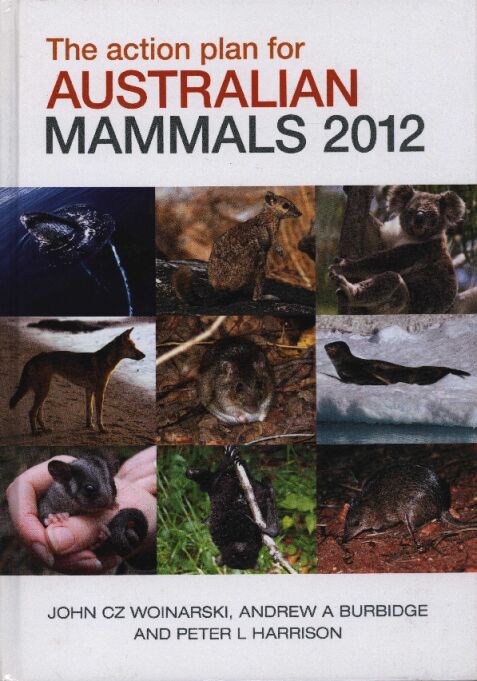
书名:The action plan for Australian mammals 2012
责任者:John CZ Woinarski | Andrew A Burbidge and Peter Harrison ; with maps and database management for terrestrial species Damian Milne. | Harrison, Peter Lynton.
ISBN\ISSN:9780643108738,0643108734,9780643108745,0643108742
出版时间:2014
出版社:CSIRO Publishing
摘要
The Australian mammal fauna is extraordinary. It includes much of the Worlds complement of mammals in the most ancient lineages. It includes some spectacular species, such as the Platypus, Tasmanian Devil, Koala, Red Kangaroo, Dugong and Blue Whale; but also very many other species that are small, nocturnal, cryptic, rarely-seen or largely unknown. Amongst the terrestrial mammal fauna, there is an extremely high rate of endemism (nearly 90%). This gives the fauna a special value and our society a special responsibility to sustain this natural asset: for most species, their continuing existence now depends upon how we manage them and their environment.
The Australian mammal fauna has fared catastrophically since European settlement. Previously common and widespread species have been forced to extinction; many surviving species now eke out an existence in a tiny fraction of their former range or are sustained in a type of emergency care under the life support system offered by island marooning, captive breeding or predator-proof fencing.
In this book, we provide a comprehensive review of the current conservation status of all Australian mammal species and subspecies. It has been a sobering task. We chronicle much that is now irretrievably lost, and much that, without urgent action, may now be doomed. But it is also an opportunity for realistic hope, and to help chart a direction for prioritising conservation activity in Australia that appropriately recognises our magnificent natural heritage and our obligation and capability to cherish and maintain that heritage. For perhaps all threatened mammal species, the capability and knowledge exists to identify and manage those threats that are jeopardising existence. But this is not always an easy or cheap task; mostly it requires a clear vision, long-term security of resourcing, the commitment of individual experts and of communities, and management accountability.
This book is modelled on The Action Plan for Australian Birds 2010 (Garnett et al. 2011), the third in a decadal-interval series of accounts of the conservation status of Australian birds. As with the regular bird accounts, we would hope that this account is updated in 10 years* time, and thereafte.
This book is timely, because many Australian mammal species are now in that "thin zone from the critically endangered to the living dead and thence into oblivion' (Wilson 2002). Indeed, at least one and possibly two Australian endemic mammal species have become extinct in the last 10 years. With dispassion, we can say that the need for conservation action is urgent. Here, we provide a context for the most strategic and effective program of such action.
In this book, we have assessed (using the now standard international criteria for evaluation) the conservation status of 315 terrestrial and 60 marine species, and a further 125 non-redundant1 terrestrial subspecies and 6 marine subspecies occurring (or formerly occurring) in Australia, including its marine and coastal environments and external territories. We provide detailed accounts for most terrestrial mammal and marine mammal taxa, omitting accounts only for vagrants, taxa not generally recognised as valid, or taxa whose conservation status is clearly of Least Concern. For every considered taxon, these accounts review the relevant conservation parameters (mostly relating to population size and its trends, and to distributional extent and its trends), seek to identify the threats with most impact, prioritise research and management responses, document ecological and other information relevant to conservation management, and compare the currently-accorded 'official' conservation status with the status that is most appropriate given current information on relevant parameters. In almost all cases, draft accounts were circulated widely to relevant experts, and modified appropriately in response to relevant (and typically very substantial) contributions from those reviewers. More than 200 such experts contributed to this work.
We conclude that 29 Australian mammal species have been made extinct since European settlement of this continent a little over 200 years ago. This represents more than 10% of the then Australian endemic mammal fauna. This tally is higher than previous estimates. Extinctions have occurred at a more or less consistent rate since the 1840s, the probable date of the first post-1788 extinction. Much of the cause of these extinctions, and of the decline of many other Australian mammals, is now deep-rooted and may take many decades or generations to repair. No other country has a record of mammal extinctions in modern times that is anywhere near as bad as that of Australia.
We also conclude that a further 56 terrestrial mammal species (18% of the Australian mammal species) and 33 terrestrial subspecies are threatened with extinction: this includes 11 species and one subspecies that are Critically Endangered. A further 52 terrestrial species and 19 terrestrial subspecies are rated here as Near Threatened:such species are likely to be eligible for listing as threatened in the near future if current trends continue.
For marine mammal species, the situation is markedly different. The proportion of taxa considered here to be threatened (seven species, or 11% of the Australian marine mammal fauna) is lower than for terrestrial mammals. Several previously highly endangered marine mammal species are now recovering, and no longer qualify as threatened. But for many others, the conservation status in Australian waters is affected by actions occurring beyond the Australian region, and the conservation security of such species is dependent upon international collaboration in conservation management. Furthermore, a much higher proportion of marine (61%) than terrestrial mammal taxa (1%) is rated here as Data Deficient. This categorisation is partly because of lack of knowledge of key conservation parameters for many marine taxa, in some cases because of unresolved taxonomic issues, and partly because it is difficult to predict impacts upon marine mammals across their typically long three generational period relevant to some criteria. Such Data Deficient categorisation occurred also for most of these marine species in the previous cetacean action plan (Bannister et al. 1996), and subsequent assessment (Ross 2006). For such species, there has been little resolution of uncertainty concerning parameters relevant to conservation assessment and management over the last two decades.
There are marked disparities between our assessments of the current conservation status of Australian mammals and those statuses currently listed under national (Environment Protection and Biodiversity Conservation Act 1999), state and territory legislation, and also those accorded under international initiatives (the IUCN Red List of Threatened Species). In all cases, we have provided a comprehensive evidence-based account of the rationale for our evaluation. These disparities suggest that at least some current conservation protection and management resourcing is off target, not necessarily focusing on the most pressing concerns. We hope that our documentation can be used constructively to review, refine and update such listings, and hence improve the likelihood of most effectively delivering conservation outcomes.
Based on retrospective assessment informed by current knowledge, we evaluated trends in the overall conservation status of the Australian mammal fauna over the 20-year period 1992 to 2012. Overall, that status has deteriorated substantially over this period, although trends have been inconsistent across taxa. The conservation status of 53 terrestrial mammal taxa moved to a higher threat category over this period; that of 15 terrestrial mammal taxa moved to a lower threat category over this period. Most of the improvements were as a result of intensive, well focused and sustained management efforts: examples include the Chud itch Dasyurus geof-froii, Boodie Bettongia lesueur, Bridled Nailtail Wallaby Onychogalea fraenata, Yellow-footed Rock-wallaby Petrogale xanthopus and Greater Stick-nest Rat Leporillus con-ditor. There was some geographic patterning of changing status, with declines most evident and marked in northern Australia. Trends were notably different for the set of marine mammals, although any interpretation is hampered by the high proportion of marine mammals for which the available data are inadequate for interpretation of status, and also because most of the marine mammal taxa considered here are substantially affected by factors occurring beyond Australian waters. No marine mammal taxa moved to a higher threat category over the last 20 years, whereas four taxa moved to a lower threat category over this period. These improvements result from some recovery following the decline in the extent of exploitation, and from the application of some management actions that have reduced the impacts of other threats.
We compiled tallies of threats affecting all extinct, threatened and near threatened mammals. For Australian terrestrial mammals, the threat with the greatest overall impact was predation by feral Cats, which was recognised as a threat to the survival of more than 100 extant native mammal taxa and a major contributor to the extinction of 28 taxa. Currently, policy settings, and capability to manage feral Cats are inadequate, but more conservation benefit can be delivered by developing effective broad-scale control of feral Cats than for any other single factor affecting the Australian mammal fauna. The next most important threats affecting Australia's terrestrial mammals were inappropriate fire regimes and predation by the introduced Red Fox. This ordering of threats is notably different to that affecting terrestrial mammals in most other parts of the world, where habitat loss and hunting have had (and continue to have) most impact. Climate change is not recognised here to be amongst the threats currently having the most detrimental impacts to Australian mammals, largely because its likely impact falls outside the relevant time period for consideration, which in many cases (due to the short generational length of many Australian terrestrial mammal species) is only 10 years. However, climate change is predicted to be a major future threat to many taxa.
For marine mammals in Australian waters, the threats are very different. Many species have been severely depleted by previous episodes of exploitation. Some species have recovered well (e.g. Humpback Whale Meg-aptera novaeangliae), but others (such as the Blue Whale Balaenoptera musculus, Fin Whale B. physalus and Sei Whale B. borealis) haven't. For some marine species, populations occurring in Australian waters are affected by ongoing exploitation beyond those waters. Other key threats affecting marine mammals in Australian waters include fisheries bycatch and entanglement, anthropogenic noise (including seismic surveys and potential use of military active sonar), habitat degradation, pollution, prey depletion due to fisheries, and climate change.
Our accounts indicate some major shortcomings in the available knowledge of the Australian mammal fauna, with only threadbare information available for some species, particularly the less charismatic terrestrial species occurring in more remote areas, and very many marine species, particularly smaller cetaceans occurring in oceanic waters. Such ignorance severely compromises the ability to deliver effective conservation management.Although there is some monitoring undertaken for many threatened mammal species, there are few robust monitoring programs that sample broadly across a species' range and can measure responses to management inputs; and little of the available monitoring information is readily accessible. Without a more strategic, systematic, comprehensive and long-lasting series of monitoring programs, it will remain difficult to chart progress in response to conservation efforts (or deterioration as a consequence of lack of focussed effort).
Islands have been pivotal to the conservation fate of Australian terrestrial mammals, and remain so. Many mammals have persisted on islands but disappeared from their former much more extensive mainland ranges: those island subpopulations have forestalled extinction. Many more mammals that have disappeared from much of their mainland range have island subpopulations, providing a buffer against extinction. Active translocations of threatened mammals to 'colonise' additional (threat-free) islands is now a hallmark of some successful mammal recovery programs. More recently, such translocations have been made to "mainland islands; typically areas fenced to exclude the introduced Red Fox and Cat. With a rapidly increasing area of such sites across parts of Australia, the outlook for some threatened mammal species is improving. In many cases, these sites have been instrumental in demonstrating the validity of hypotheses about the factors causing decline: they offer proof about the threats, and demonstrate that many Australian threatened mammals can flourish again if these simple threats are controlled. Outside fences, there are also some strikingly successful examples of broader-scale threat control, most notably through regional baiting programs for Red Fox in southwestern Australia and, more recently south-eastern Australia. These programs have shown some impressive responses by some threatened mammal species.
We have sought here to contribute to the conservation of what we regard as a wonderful legacy and a significant part of the heritage of all Australians, and indeed of the entire world. For such a legacy to endure, our society must be more aware of and empathetic with our distinctively Australian environment, and particularly its marvellous mammal fauna; relevant information must be readily accessible; environmental policy and law must be based on sound evidence; those with responsibility for environmental management must be aware of what priority actions they should take; the urgency for action (and consequences of inaction) must be clear; and the opportunity for hope and success must be recognised. It is in this spirit that we offer this account.
查看更多
目录
Summary v
About the authors ix
Acknowledgeme nts xi
About our sponsors xiii
1. Introducti on 1
The Australian mammal fauna and its fate 1
Aims of this action plan 3
Methods and definitions 3
Distributional database and mapping 6
Information base 7
Template for accounts for individual taxa 7
Consequences of status assigned here 13
2. A list of native Australian mammal species and subspecies(A.A. Burbidge, M.D.B. Eldridge, C. Groves, P.L. Harrison, S.M. Jackson, T.B. Reardon, M. Westerman and J.C.Z.Woinarski) 15
Introduction 15
Rationale for taxonomic treatments used in this Action Plan 16
Working list of native Australian mammal species and subspecies 27
3. Evaluation of taxa that have been translocated to islands and 'mainland islands' 33
Introduction 33
Assisted colonisation and red list evaluations 35
Conclusions 35
Acknowledgements 36
4. Conservation status assigned to all Australian mammal species and subspecies 37
Listing of accounts provided for 'Not Evaluated'taxa 49
5. Taxon profiles 51
6. Analysis: the status and trends of Australian mammals 859
Tallies of conservation status 859
Comparisons with current IUCN and EPBC Act status 862
Trends in conservation status 864
Threats 867
Research and management 879
Recovery planning 879
Monitoring 880
Geographic pattern 882
Islands 882
7. Conclusions 895
Appendix A. Accounts for taxa that are Not Evaluated 899
Appendix B: Calculation of taxonomic distinctiveness scores for species and subspecies 906
References 912
Index 1025
查看PDF
查看更多
馆藏单位
中国农科院农业信息研究所