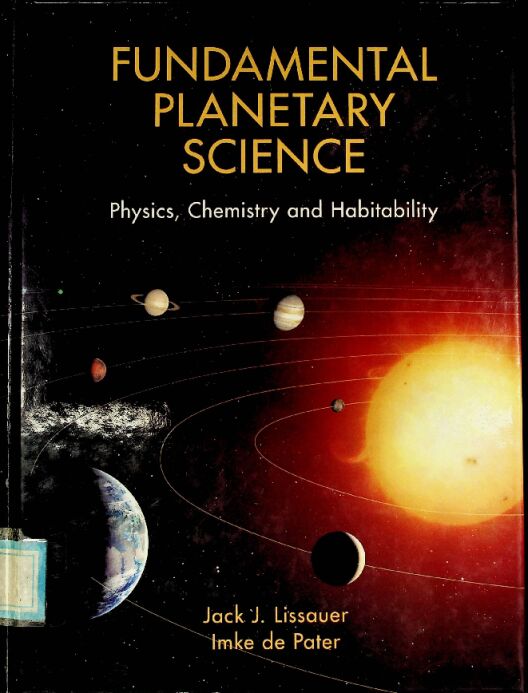
书名:Fundamental planetary science
责任者:Jack J. Lissauer and Imke de Pater. | De Pater, Imke,
ISBN\ISSN:9780521853309,9780521618557
出版时间:2013
出版社:Cambridge University Press
前言
A quantitative introduction to the Solar System and planetary systems science for advanced undergraduate students, this engaging new textbook explains the wide variety of physical, chemical, and geological processes that govern the motions and properties of planets. The authors provide an overview of our current knowledge and discuss some of the unanswered questions at the forefront of research in planetary science and astrobiology today. They combine knowledge of the Solar System and the properties of extrasolar planets with astrophysical observations of ongoing star and planet formation, offering a comprehensive model for understanding the origin of planetary systems. The book concludes with an introduction to the fundamental properties of living organisms and the relationship that life has to its host planet. With more than 200 exercises to help students learn how to apply the concepts covered, this textbook is ideal for a one-semester or two-quarter course for undergraduate students.
查看更多
目录
Tables page xi
Preface xiii
Color plates follow page xvi
1 Introduction 1
1.1 A Brief History of the Planetary Sciences 2
1.2 Inventory of the Solar System 3
1.2.1 Giant Planets 4
1.2.2 Terrestrial Planets 5
1.2.3 Minor Planets and Comets 7
1.2.4 Satellite and Ring Systems 8
1.2.5 Tabulations 8
1.2.6 Heliosphere 9
1.3 What Is a Planet? 10
1.4 Planetary Properties 11
1.4.1 Orbit 11
1.4.2 Mass 12
1.4.3 Size 13
1.4.4 Rotation 14
1.4.5 Shape 15
1.4.6 Temperature 16
1.4.7 Magnetic Field 16
1.4.8 Surface Composition 17
1.4.9 Surface Structure 17
1.4.10 Atmosphere 17
1.4.11 Interior 18
1.5 Formation of the Solar System 19
Key Concepts 20
Further Reading 20
Problems 21
2 Dynamics 24
2.1 The Two-Body Problem 25
2.1.1 Kepler's Laws of Planetary Motion 26
2.1.2 Newton's Laws of Motion and Gravity 27
2.1.3 Reduction of the Two-Body Problem to the One-Body Problem 27
2.1.4* Generalization of Kepler's Laws 27
2.1.5 Orbital Elements 29
2.1.6 Bound and Unbound Orbits 30
2.2 The Three-Body Problem 31
2.2.1 Jacobi's Constant and Lagrangian Points 32
2.2.2 Horseshoe and Tadpole Orbits 34
2.2.3 Hill Sphere 34
2.3 Perturbations and Resonances 36
2.3.1 Resonant Forcing 36
2.3.2 Mean Motion Resonances 36
2.3.3 Secular Resonances 37
2.3.4 Resonances in the Asteroid Belt 38
2.3.5 Regular and Chaotic Motion 38
2.4 Stability of the Solar System 40
2.4.1 Orbits of the Eight Planets 41
2.4.2 Survival Lifetimes of Small Bodies 43
2.5* Dynamics of Spherical Bodies 43
2.5.1 Moment of Inertia 44
2.5.2 Gravitational Interactions 45
2.6 Orbits about an Oblate Planet 46
2.6.1* Gravity Field 46
2.6.2 Precession of Particle Orbits 47
2.6.3 Torques on an Oblate Planet 47
2.7 Tides 48
2.7.1 The Tidal Force and Tidal Bulges 50
2.7.2 Tidal Torque 51
2.7.3 Tidal Heating 53
2.8 Dissipative Forces and the Orbits of Small Bodies 54
2.8.1 Radiation Pressure (Micrometer Grains) 54
2.8.2 Poynting-Robertson Drag (Small Macroscopic Particles) 55
2.8.3 Yarkovsky Effect (1–10 4 -Meter Objects) 56
2.8.4 Corpuscular Drag (Submicrometer Dust) 56
2.8.5 Gas Drag 57
2.9 Orbits about a Mass-Losing Star 58
Key Concepts 58
Further Reading 59
Problems 60
3 Physics and Astrophysics 64
3.1 Thermodynamics 65
3.1.1 Laws of Thermodynamics 65
3.1.2 Enthalpy 66
3.1.3 Entropy 67
3.1.4 Gibbs Free Energy 67
3.1.5 Material Properties: Phase Changes 68
3.2 Barometric Law and Hydrostatic Equilibrium 68
3.3 Stellar Properties and Lifetimes 71
3.3.1 Virial Theorem 71
3.3.2 Luminosity 71
3.3.3 Size 73
3.3.4 Sizes and Densities of Massive Planets 74
3.4 Nucleosynthesis 76
3.4.1 Primordial Nucleosynthesis 77
3.4.2 Stellar Nucleosynthesis 79
3.4.3 Radioactive Decay 82
Key Concepts 82
Further Reading 83
Problems 83
4 Solar Heating and Energy Transport 85
4.1 Energy Balance and Temperature 86
4.1.1 Thermal (Blackbody) Radiation 87
4.1.2 Albedo 89
4.1.3 Temperature 90
4.2 Energy Transport 91
4.3 Conduction 92
4.4 Convection 93
4.4.1 Adiabatic Gradient 93
4.5 Radiation 94
4.5.1 Photons and Energy Levels in Atoms 95
4.5.2 Spectroscopy 97
4.5.3 Radiative Energy Transport 100
4.5.4 Radiative Equilibrium 102
4.6 Greenhouse Effect 102
4.6.1 Quantitative Results 103
4.6.2* Derivations 104
Key Concepts 105
Further Reading 106
Problems 106
5 Planetary Atmospheres 109
5.1 Thermal Structure 110
5.1.1 Sources and Transport of Energy 113
5.1.2 Observed Thermal Profiles 114
5.2 Atmospheric Composition 115
5.3 Clouds 118
5.4 Meteorology 119
5.4.1 Coriolis Effect 120
5.4.2 Winds Forced by Solar Heating 121
5.5 Photochemistry 123
5.5.1 Photolysis and Recombination 123
5.5.2 Photoionization: Ionospheres 125
5.6 Molecular and Eddy Diffusion 126
5.6.1 Eddy Diffusion 126
5.6.2 Molecular Diffusion 126
5.7 Atmospheric Escape 127
5.7.1 Thermal (Jeans) Escape 127
5.7.2 Nonthermal Escape 128
5.7.3 Hydrodynamic Escape and Impact Erosion 128
5.8 History of Secondary Atmospheres 129
5.8.1 Formation 129
5.8.2 Climate Evolution 130
5.8.3 Summary of Secondary
Atmospheres 136
Key Concepts 136
Further Reading 137
Problems 137
6 Surfaces and Interiors 141
6.1 Mineralogy and Petrology 142
6.1.1 Minerals 142
6.1.2 Rocks 143
6.1.3 Material under High Temperature and Pressure 147
6.1.4 Cooling of a Magma 149
6.2 Planetary Interiors 150
6.2.1 Interior Structure of the Earth 150
6.2.2 Shape and Gravity Field 151
6.2.3 Internal Heat: Sources, Losses and Transport 153
6.3 Surface Morphology 155
6.3.1 Tectonics 155
6.3.2 Volcanism 159
6.3.3 Atmospheric Effects on Landscape 163
6.4 Impact Cratering 167
6.4.1 Crater Morphology 168
6.4.2 Crater Formation 170
6.4.3 Impact Modification by Atmospheres 177
6.4.4 Spatial Density of Craters 178
6.4.5 Impacts on Earth 181
Key Concepts 182
Further Reading 183
Problems 184
7 Sun, Solar Wind and Magnetic Fields 187
7.1 The Sun 188
7.2 The Interplanetary Medium 191
7.2.1 Solar Wind 191
7.2.2 The Parker Model 193
7.2.3 Space Weather 195
7.2.4 Solar Wind–Planet Interactions 196
7.3 Planetary Magnetospheres 198
7.3.1 Earth's Magnetosphere 198
7.3.2 Aurora 199
7.3.3 Magnetospheric Plasmas 200
7.3.4 Radio Emissions 203
7.4 Generation of Magnetic Fields 203
7.4.1 Variability of Earth's Magnetic Field 203
7.4.2 Magnetic Dynamo Theory 204
Key Concepts 204
Further Reading 205
Problems 205
8 Giant Planets 206
8.1 Jupiter 207
8.1.1 Atmosphere 207
8.1.2 Impacts on Jupiter 211
8.1.3 Interior Structure 214
8.1.4 Magnetic Field 214
8.2 Saturn 216
8.2.1 Atmosphere 216
8.2.2 Interior Structure 218
8.2.3 Magnetic Field 218
8.3 Uranus and Neptune 219
8.3.1 Atmospheres 219
8.3.2 Interiors 220
8.3.3 Magnetic Fields 222
Key Concepts 223
Further Reading 224
Problems 224
9 Terrestrial Planets and the Moon 226
9.1 The Moon 228
9.1.1 Surface 228
9.1.2 Atmosphere 230
9.1.3 Interior 230
9.1.4 Magnetic Field 231
9.2 Mercury 231
9.2.1 Surface 231
9.2.2 Atmosphere 236
9.2.3 Interior 236
9.2.4 Magnetic Field 236
9.3 Venus 238
9.3.1 Surface 238
9.3.2 Atmosphere 241
9.3.3 Interior 242
9.4 Mars 242
9.4.1 Global Appearance 243
9.4.2 Interior 243
9.4.3 Atmosphere 244
9.4.4 Frost, Ice and Glaciers 247
9.4.5 Water on Mars 248
9.4.6 Geology at Rover Sites 250
9.4.7 Magnetic Field 253
Key Concepts 255
Further Reading 255
Problems 256
10 Planetary Satellites 258
10.1 Moons of Mars: Phobos and Deimos 259
10.2 Satellites of Jupiter 260
10.2.1 Io 260
10.2.2 Europa 263
10.2.3 Ganymede and Callisto 267
10.2.4 Jupiter's Small Moons 269
10.3 Satellites of Saturn 269
10.3.1 Titan 270
10.3.2 Midsized Saturnian Moons 272
10.3.3 Enceladus 273
10.3.4 Small Regular Satellites of Saturn 275
10.3.5 Saturn's Irregular Moons 275
10.4 Satellites of Uranus 276
10.5 Satellites of Neptune 278
Key Concepts 281
Further Reading 281
Problems 282
11 Meteorites 284
11.1 Classification 286
11.2 Source Regions 289
11.3 Fall Phenomena 292
11.4 Chemical and Isotopic Fractionation 295
11.4.1 Chemical Separation 296
11.4.2 Isotopic Fractionation 296
11.5 Main Components of Chondrites 297
11.6 Radiometric Dating 298
11.6.1 Decay Rates 298
11.6.2 Dating Rocks 300
11.6.3 Extinct-Nuclide Dating 300
11.6.4 Cosmic-Ray Exposure Ages 301
11.7 Meteorite Clues to Planet Formation 301
11.7.1 Meteorites from Differentiated Bodies 302
11.7.2 Primitive Meteorites 303
11.7.3 Presolar Grains 304
Key Concepts 305
Further Reading 305
Problems 306
12 Minor Planets and Comets 309
12.1 Nomenclature 310
12.2 Orbits 311
12.2.1 Asteroids 312
12.2.2 Trans-Neptunian Objects, Centaurs 314
12.2.3 Oort Cloud 316
12.2.4 Nongravitational Forces 317
12.3 Size Distribution and Collisions 318
12.3.1 Size Distribution 318
12.3.2 Collisions and Families 319
12.3.3 Collisions and Rubble Piles 320
12.3.4 Binary and Multiple Systems 321
12.3.5 Comet-Splitting Events 322
12.3.6 Mass and Density 323
12.3.7 Rotation 324
12.3.8 Interplanetary Dust 325
12.4 Bulk Composition and Taxonomy 325
12.4.1 Asteroid Taxonomy 326
12.4.2 Taxometric Spatial Distribution 327
12.4.3 Trans-Neptunian Object Spectra 328
12.5 Individual Minor Planets 328
12.5.1 Near-Earth Asteroids 328
12.5.2 Main Belt Asteroids 330
12.5.3 Trans-Neptunian Objects 333
12.6 Shape and Structure of Comet Nuclei 334
12.7 Comas and Tails of Comets 336
12.7.1 Brightness 337
12.7.2 Ultimate Fate of Coma Gas 338
12.7.3 Dust Entrainment 338
12.7.4 Morphology and Composition of Dust Tails 339
12.7.5 Ion Tails 341
12.7.6 Comet Composition 342
12.8 Temporal Evolution of the Population of Asteroids and Comets 343
Key Concepts 344
Further Reading 344
Problems 345
13 Planetary Rings 348
13.1 Tidal Forces and Roche's Limit 351
13.2 Flattening and Spreading of Rings 354
13.3 Observations 355
13.3.1 Jupiter's Rings 355
13.3.2 Saturn's Rings 356
13.3.3 Uranus's Rings 364
13.3.4 Neptune's Rings 366
13.4 Ring– Moon Interactions 366
13.4.1 Resonances 366
13.4.2 Spiral Waves 367
13.4.3 Shepherding 369
13.5 Origins of Planetary Rings 371
Key Concepts 373
Further Reading 374
Problems 374
14 Extrasolar Planets 377
14.1 Detecting Extrasolar Planets 378
14.1.1 Timing Pulsars and Pulsating Stars 378
14.1.2 Radial Velocity 379
14.1.3 Astrometry 380
14.1.4 Transit Photometry 381
14.1.5 Transit Timing Variations 382
14.1.6 Microlensing 383
14.1.7 Imaging 384
14.1.8 Other Techniques 385
14.1.9 Exoplanet Characterization 385
14.1.10 Planets in Multiple Star Systems 386
14.2 Observations of Extrasolar Planets 387
14.2.1 Pulsar Planets 387
14.2.2 Radial Velocity Detections 389
14.2.3 Transiting Planets 391
14.2.4 NASA's Kepler Mission 394
14.2.5 Mass–Radius Relationship 396
14.2.6 Planets Orbiting Pulsating Stars 398
14.2.7 Microlensing Detections 398
14.2.8 Images and Spectra of Exoplanets 398
14.2.9 Planets in Multiple Star Systems 399
14.3 Exoplanet Statistics 400
14.3.1 Radial Velocity Surveys 400
14.3.2 Kepler Planet Candidates 401
14.3.3 Microlensing 403
14.4 Physics of Exoplanets 404
14.5 Conclusions 407
Key Concepts 410
Further Reading 410
Problems 410
15 Planet Formation 413
15.1 Solar System Constraints 414
15.2 Star Formation: A Brief Overview 417
15.2.1 Molecular Cloud Cores 417
15.2.2 Collapse of Molecular Cloud Cores 418
15.2.3 Young Stars and Circumstellar Disks 419
15.3 Evolution of the Protoplanetary Disk 420
15.3.1 Infall Stage 420
15.3.2 Disk Dynamical Evolution 422
15.3.3 Chemistry in the Disk 423
15.3.4 Clearing Stage 425
15.4 Growth of Solid Bodies 425
15.4.1 Planetesimal Formation 425
15.4.2 From Planetesimals to Planetary Embryos 426
15.5 Formation of the Terrestrial Planets 430
15.5.1 Dynamics of the Final Stages of Planetary Accumulation 430
15.5.2 Accretional Heating and Planetary Differentiation 430
15.5.3 Accumulation (and Loss) of Atmospheric Volatiles 433
15.6 Formation of the Giant Planets 434
15.7 Planetary Migration 437
15.7.1 Torques from Protoplanetary Disks 437
15.7.2 Scattering of Planetesimals 437
15.8 Small Bodies Orbiting the Sun 438
15.8.1 Asteroid Belt 438
15.8.2 Comet Reservoirs 439
15.9 Planetary Rotation 440
15.10 Satellites of Planets and of Minor Planets 440
15.10.1 Giant Planet Satellites 440
15.10.2 Formation of the Moon 441
15.10.3 Satellites of Small Bodies 443
15.11 Exoplanet Formation Models 443
15.12 Confronting Theory with Observations 444
15.12.1 Solar System's Dynamical State 444
15.12.2 Composition of Planetary Bodies 445
15.12.3 Extrasolar Planets 446
15.12.4 Successes, Shortcomings and Predictions 446
Key Concepts 447
Further Reading 447
Problems 448
16 Planets and Life 452
16.1 Drake Equation 453
16.2 What Is Life? 454
16.3 Biological Thermodynamics 456
16.4 Why Carbon and Water? 458
16.5 Circumstellar Habitable Zones 459
16.6 Planetary Requirements for Life 462
16.6.1 Biogeochemical Cycles 463
16.6.2 Gravitational and Magnetic Fields 465
16.6.3 Can Moonless Planets Host Life? 465
16.6.4 Giant Planets and Life 466
16.7 Impacts and Other Natural Disasters 467
16.7.1 K–T Event 468
16.7.2 Frequency of Impacts 470
16.7.3 Volcanos and Earthquakes 471
16.8 How Life Affects Planets 472
16.9 Origin of Life 473
16.9.1 Synthesis of Organic Molecules 474
16.9.2 The Phylogenetic Tree and Last Universal Common Ancestor 475
16.9.3 Young Earth and Early Life 478
16.10 Darwinian Evolution 479
16.10.1 Sex, Gene Pools and Inheritance 481
16.10.2 Development of Complex Life 482
16.10.3 Intelligence and Technology 484
16.11 Mass Extinctions 485
16.12 Panspermia 486
16.13 Detecting Extraterrestrial Life 488
16.13.1 Signs of (Past) Life on Mars? 489
16.13.2 Search for Extra-Terrestrial Intelligence 491
16.14 Are We Alone? 492
Key Concepts 493
Further Reading 494
Problems 496
Appendix A: Symbols Used 501
Appendix B: Acronyms Used 505
Appendix C: Units and Constants 509
Appendix D: Periodic Table of Elements 513
Appendix E: Solar System Tables 515
Appendix F: Interplanetary Spacecraft 527
Appendix G: Recent Planetary Images 533
References 553
Index 561
查看PDF
查看更多
馆藏单位
中科院文献情报中心