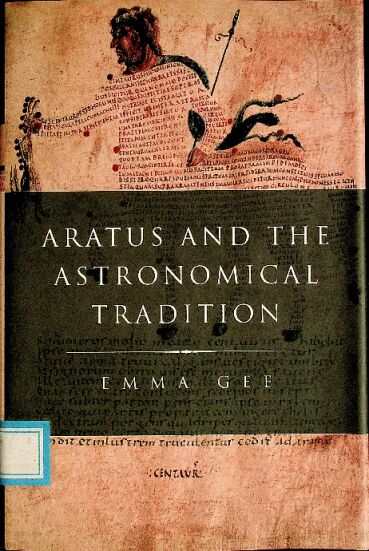
书名:Aratus and the astronomical tradition
ISBN\ISSN:9780199781683,0199781680
出版时间:2013
出版社:Oxford University Press
摘要
Why were the stars so important in Rome? Their literary presence far outweighs their role as a time-reckoning device, which was in any case superseded by the synchronization of the civil and solar years under Julius Caesar. One answer is their usefulness in symbolizing a universe built on "intelligent design." Predominantly in ancient literature, the stars are seen as the gods' graffiti in the ordered heaven. Moreover, particularly in the Roman world, divine and human governance came to be linked, with one striking manifestation of this connection being the predicted enjoyment of a celestial afterlife by emperors. Aratus' Phaenomena, which describes the layout of the heavens and their effect, through weather, on the lives of men, was an ideal text for expressing such relationships: its didactic style was both accessible and elegant, and it combined the stars with notions of divine and human order. In especially the late Republic extending until the age of Christian humanism, the impact of this poem on the literary environment is out of all proportion to its relatively modest size and the obscurity of its subject matter. It was translated into Latin many times between the first century BC and the Renaissance, and carried lasting influence outside its immediate genre.
Aratus and the Astronomical Tradition answers the question of Aratus' popularity by looking at the poem in the light of Western cosmology. It argues that the Phaenomena is the ideal vehicle for the integration of astronomical 'data' into abstract cosmology, a defining feature of the Western tradition. This book embeds Aratus' text into a close network of textual interactions, beginning with the text itself and ending in the sixteenth century, with Copernicus. All conversations between the text and its successors experiment in some way with the balance between cosmology and information. The text was not an inert objet d'art, but a dynamic entity which took on colors often contradictory in the ongoing debate about the place and role of the stars in the world. In this debate Aratus plays a leading, but by no means lonely, role. With this study, students and scholars will have the capability to understand this mysterious poem's place in the unique development of Western cosmology.
查看更多
目录
Preface and Acknowledgments ix
Abbreviations xi
Introduction 3
1. Poetic Justice 22
2. Roman Justice 36
3. Wandering Stars 57
4. Lucretius' Aratea 81
5. Planetary Motion 110
6. Late Antique Aratus 148
Epilogue 180
Appendix A 185
Appendix B 189
Appendix C 232
Notes 241
Bibliography 275
Index 291
Index Locorum 293
Endpiece 299
查看PDF
查看更多
馆藏单位
中科院文献情报中心