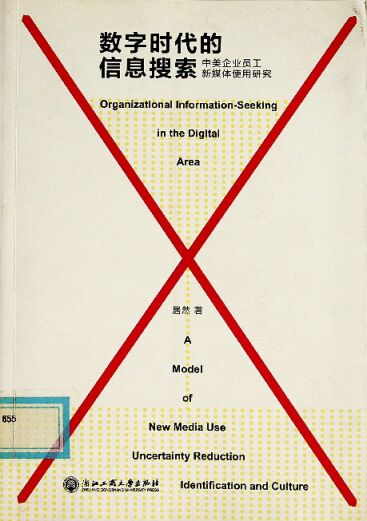
书名:Organizational information-seeking in the digital area
摘要
This dissertation examines the role of new media in individuals' organizational socialization process across cultures. First, this study explores individuals' use of new media in their organizational socialization process in two countries, China and the United States, to gain a general understanding of the usage patterns. Second, this study proposes that identification should be a more communicative-related outcome of the socialization process; it also tests the relationship between information-seeking behaviors through social media, as a socialization effort, and individuals' identification levels. Third, this study proposes that in the relationship among information-seeking behaviors, uncertainty level serves as a mediator, and tests the mediating model of information-seeking, uncertainty level and identification levels. In particular, this dissertation highlights the role of social context in individuals' daily interactions. It compares the different new media use patterns and levels of different identifications (local and global) across the two cultures to emphasize social context's influence. This dissertation reveals the general information of new media usage in the working setting, informs the relationship among information-seeking through new media, identification and uncertainty across the two cultures.
Chapter 1 presents a conceptual foundation of this dissertation. Using pragmatism as the meta-theory, this chapter argues that new media provide opportunities for scholars to update current knowledge and suggests that culture, as a social context, should be taken into consideration.
Chapter 2 provides a systematic review of both empirical and theoretical literature. The literature covers topics of uncertainty reduction theory, socialization, and social information processing theory, suggesting that organizational members in divergent cultures may rely on very different modes of uncertainty reducing communication strategies. From a pragmatic point of view, the practical implications of these divergent behaviors must be accounted for; therefore, organizational identification is proposed as an outcome measure to explore the repercussions of the different meanings and behaviors surfacing across cultures. Research questions and hypotheses are presented in this chapter, resulting in a conceptual model presenting the predicted relationships among the above-mentioned topics.
Chapter 3 offers an in-depth description of the research methods used to collect and analyze data. The sampling method, participants, procedures, and methods of assessing organizational members' new media usage, levels of uncertainty and organizational identification are described.
Chapter 4 explains the statistical procedures used to analyze the data and reveals the results of research questions and hypotheses suggested in Chapter 2. At last, the result of the conceptual model is presented.
The final chapter (Chapter 5) outlines the findings of this study and discusses them within the context of prior theories and research. Theoretical and practical implications are offered. The limitations of the study and areas of future research are also outlined.
查看更多
目录
Chapter 1 Plurality of Innovations in Practice 001
1. Pragmatism 003
2. Shared Perspectives: Pragmatism and Culture 004
3. Pragmatism and Communication 005
4. Changes as Pragmatic Opportunities 006
4.1 Industrial Revolution 007
4.2 World War I and World War II 008
5. Plurality of New Media 008
6. New Media and Organizational Sense-Making: A Dissertation on Culturally-Situated Information-Seeking Efforts 010
7. Preview 012
Chapter 2 Uncertainty Reduction, Information 013
1. Culture 016
2. Uncertainty Reduction 018
3. Socialization 021
3.1 Traditional Socialization Research 021
3.2 Social Information Processing Theory and Socialization 022
3.3 Socialization and New Media: Reducing Uncertainty in the Modern Era 024
3.4 Culture and Socialization 027
4. Organizational Identification 029
5. Summary 033
Chapter 3 Methodology 037
1. Procedures 037
1.1 Sampling and Participants 037
1.2 Data Collection 038
2. Measurement 038
2.1 New Media Usage 038
2.2 Uncertainty 039
2.3 Identification 040
2.4 Cultural Differences 041
2.5 Demographic Data 042
3. Demographic Information 042
3.1 Chinese Respondents 042
3.2 American Respondents 043
4. Cross-Sample Equivalence 043
5. Plan of Data Analysis 043
6. Primary Data Analysis Plan 044
Chapter 4 Results 049
1. Preliminary Analysis to Clear Up Variable Measurement 049
1.1 Uncertainty Factors 049
1.2 Measuring Identification: A Comparison of Verbal and Graphic Scales 051
2. Primary Analysis of Data 052
2.1 Information-Seeking and Uncertainty 052
2.2 Cross-Cultural Information-Seeking 057
2.3 Local and Global Identification across Cultures 059
2.4 Model Proposed 062
3. Summary of Results 068
Chapter 5 Discussions 071
1. Discussions on the Findings 071
1.1 Information-Seeking and Uncertainty 072
1.2 Cross-Cultural Information-Seeking Patterns 081
1.3 Local and Global Identification across Cultures 083
2. Model Proposed 086
3. Theoretical Implications 089
4. Pragmatic Implications 094
5. Practical Implications 097
6. Limitations and Future Research Directions 099
7. Conclusion 100
References 103
Appendix A English Version of the Survey 121
Appendix B Chinese Version of the Survey 133
查看PDF
查看更多
馆藏单位
中科院文献情报中心