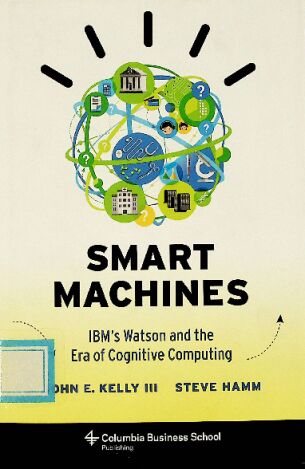
书名:Smart Machines
责任者:John E. Kelly III | Steve Hamm.
ISBN\ISSN:9780231168564,023116856X
出版时间:2013
出版社:Columbia Business School Publishing
摘要
We are crossing a new frontier in the evolution of computing and entering the era of cognitive systems. The victory of IBM's Watson on the television quiz show Jeopardy! revealed how scientists and engineers at IBM and elsewhere are pushing the boundaries of science and technology to create machines that sense, learn, reason, and interact with people in new ways to provide insight and advice.
In Smart Machines, John E. Kelly III, director of IBM Research, and Steve Hamm, a writer at IBM and a former business and technology journalist, introduce the fascinating world of "cognitive systems" to general audiences and provide a window into the future of computing. Cognitive systems promise to penetrate complexity and assist people and organizations in better decision making. They can help doctors evaluate and treat patients, augment the ways we see, anticipate major weather events, and contribute to smarter urban planning. Kelly and Hamm's comprehensive perspective describes this technology inside and out and explains how it will help us conquer the harnessing and understanding of "big data," one of the major computing challenges facing businesses and governments in the coming decades. Absorbing and impassioned, their book will inspire governments, academics, and the global tech industry to work together to power this exciting wave in innovation.
查看更多
前言
When I was a kid, my dad worked at General Electric's R&D lab in Niskayuna, N. Y. I would visit and watch him work with vacuum tubes, which looked like light-bulbs and directed electrical current in all sorts of devices, from radios and TVs to radar and computers. At the time, I didn't fully understand how vacuum tubes worked, but those visits inspired me to study science and, ultimately, to get two degrees in physics and my Ph. D. in materials engineering. I later came to realize that I had witnessed one of the important transitions in the history of technol-ogy. While my dad was showing me vacuum tubes, other engineers were experimenting with the vacuum tube's suc-cessor, the transistor, which ultimately ushered in modern electronics and personal computing.
Now we are at the dawn of a much bigger shift in the evolution of technology—a new era affecting nearly every aspect of the field. The changes that are coming over the next two decades will transform the way we live and work just as the computing revolution has transformed the human landscape over the past half century. At IBM, we call this the era of cognitive computing.
I have had the pleasure of participating in the march of progress in computer science since I joined IBM in 1980 as an engineer. I've led organizations that contributed major breakthroughs in science and technology, including the company's microelectronics division and, presently, IBM Research, one of the most extensive corporate scientific-research organizations in the world, with 3,000 scientists and engineers at 12 labs in 10 countries.
Today, society is faced with a host of opportunities and challenges that require a new generation of technologies and a rewriting of the rules of computing. The availabil-ity of huge amounts of data should help people to better understand complex situations. In reality, though, more data often lead to more confusion. We make too many decisions with irrelevant or incorrect information, or with data that represent only part of the picture. We need a new generation of tools—cognitive technologies—that help us to penetrate complexity and comprehend the world around us so that we can make better decisions and live more successfully and sustainably. Yet some of the tech-niques of computer science and engineering are reaching their limits. The technology industry must change the way it designs and uses computers and software if it is to con-tinue to make progress in how people work and live.
The vision of the future of information technology presented in this brief book is the result of a large group effort. Several years ago, I asked a handful of IBM scien-tists to look decades into the future and sketch out how computing will change. Their work sparked discussions and debates among a wide range of IBMers, including the company's top executives, which, ultimately, evolved into a shared belief about the future of computing.
We want to expose our thoughts to others and engage in a conversation, so I asked Steve Hamm, a former journal-ist who is now a writer at IBM, to help lay out our vision in this book. Steve has been writing and editing stories about the tech industry for nearly twenty-five years and has witnessed the beginnings of several waves of innova-tion. For instance, in 1994 he visited the founding engi-neers of Mosaic Communications (later to be renamed Netscape) shortly after they setup shop in a tiny office on Castro Street in Mountain View, Calif. That was the dawn of the Internet era. Since then he has written hundreds of stories about innovation. In addition, he has authored books about the rise of the Indian tech industry, mobile computing, and the future of work. With that kind of deep experience, Steve's a natural partner for me in this project. He interviewed dozens of IBM's scientists and engineers plus numerous outside experts to flesh out the vision and shape the narrative.
The creation of this newer a of computing is a monu-mental endeavor, and, while IBM possesses a vision of the future and a broad portfolio of expertise, no company can take on this sort of challenge alone. So we look to our cli-ents, university researchers, government policy makers, industry partners, and entrepreneurs—indeed, the entire tech industry-to take this journey with us. Already, other companies, such as Google and Microsoft, are carving out roles in the era of cognitive computing. The European Union, with its Human Brain Project, is coordinating cog-nitive scientists worldwide in an effort to map the inner workings of the brain and mimic them in computing. Among the leading universities in the field are MIT, Carn-egie Mellon, and Stanford. Many other organizations are also in the game.
With this book, which is aimed at abroad audience rather than just the technical community, we hope to greatly expand the search for answers by stimulating new thinking within industry, government, and academia. And, just as importantly, we hope to inspire university and high school students to pursue careers in science, tech-nology, engineering, and mathematics. Together, we can drive the exploration and invention that will shape society, the economy, and business for the next fifty years.
查看更多
目录
Preface by john E. Kelly III vii
1 ANEW ERA OF COMPUTING 1
2 BUILDING LEARNING SYSTEMS 23
3 HANDLING BIG DATA 43
4 AUGMENTING OUR SENSES 69
5 DESIGNING DATA-CENTRIC COMPUTERS 87
6 INVENTING A NEW PHYSICS OF COMPUTING 101
7 IMAGINING THE COGNITIVE CITY 117
Code: An Alliance of Human AND Machine 137
Notes 141
查看更多
作者简介
Steve Hamm is a writer and videographer for IBM after working in business and technology journalism. Most recently, he was a senior writer at BusinessWeek magazine. He is the author of two books, Bangalore Tiger: How Indian Tech Upstart Wipro Is Rewriting the Rules of Global Competition and The Race for Perfect: Inside the Quest to Design the Ultimate Portable Computer.
查看更多
馆藏单位
中科院文献情报中心