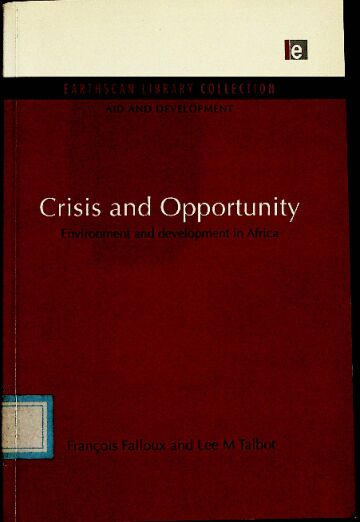
书名:Crisis and opportunity
责任者:Francois Falloux and Lee M Talbot. | Talbot, Lee M.
前言
The 1972 United Nations Conference on the Human Environment placed the issue of environment squarely on the agenda of the world's governments. Twenty years later the Rio UN Conference on Environ�ment and Development has sharpened the focus on the key issue of sustainability and has led to a renewed interest in and commitment on the part of the United Nations and its member states to environmental planning for sustainable development. In the same year the 1992 World Development Report prepared by the World Bank evaluated the linkages between environmental change and economic development. The report concluded that not only were environment and development mutually reinforcing and essential, but also that with effective planning it is possible to obtain both environmental and development benefits.
That planning is the focus of this timely book. It describes the process of incorporating environment into the economic and social development of African nations. Working from their combined experience of nearly 65 years in environment and development, Francois Falloux and Lee Talbot have analysed the history of such eftorts and have focused on National Environmental Action Plans (NEAPs), a recent process of environmental planning developed in Africa, largely by Africans, which is now being undertaken in other developing and developed countries throughout the world.
查看更多
目录
Preface vii
Acknowledgements ix
"Letter from ti Mother" xi
Introduction xiii
PART 1 NATIONAL ENVIRONMENTAL ACTION PLANS IN SUB-SAHARAN AFRICA: ORIGINS, DESCRIPTION AND
PRESENT STATUS
Summary 1
1 Past attempts at environmental planning in Africa 3
2 What is a NEAP and why is it different? 19
3 The pioneers: the NEAP of Madagascar 31
4 Forging the NEAP approach: Lesotho 52
5 Forging the NEAP approach: Mauritius 70
6 Green plans of the north 81
7 Over thirty African NEAPs 88
PART II THE NEAP PROCESS, ITS COMPONENTS AND ITS PROBLEMS
Summary 99
8 Political involvement and popular participation 101
9 A dynamic and evolving institutional framework 117
10 Indispensable environmental information 129
11 An economic foundation: guarantee of credibility 143
12 Education, training and public awareness 158
13 The inescapable population problem 175
14 Land tenure and the environment 186
15 The vital challenge of conserving biodiversity 200
16 Urban cancers, an inevitable problem 217
17 African culture: opportunities and dangers for the environment 228
18 Rural development revisited in the era of environment 239
19 A path full of obstacles: lessons from a learning process 249
PART III RESULTS AND IMPACT TO DATE
Summary 259
20 Environmental programs at work 261
21 Green opportunities tor private enterprise 269
22 NGOs: from confrontation to cooperation 274
23 The environmental revolution of the donors: a continuing process 283
PART IV FUTURE DIRECTIONS
Summary 295
24 The Club of Dublin, now called NESDA 297
25 Local, national and continental green plans 306
26 A new north-south relationship 312
27 Who listens to Africa? 319
28 A continental plan for environment and sustainable development? 322
A Presidential Memorandum 331
Glossary of acronyms 348
References 350
Index 355
查看更多
作者简介
Dr Lee M. Talbot is an ecologist and specialist in international environmental affairs, with over 37 years' experience involving work on environment and development in 120 countries. He has served as Senior Environmental Advisor or Consultant to the World Bank, the Asian and Inter-American Development Banks, UN bodies, govern�ments and universities. He was formerly Director-General of the IUCN, was Chief Scientist and Director of International Affairs in the Presi�dent's Council on Environmental Quality for three US presidents, and was head of environmental sciences at the Smithsonian Institution. He has received a number of major awards for his work, and has written widely on the issues of environment and development.
查看更多
馆藏单位
中科院文献情报中心