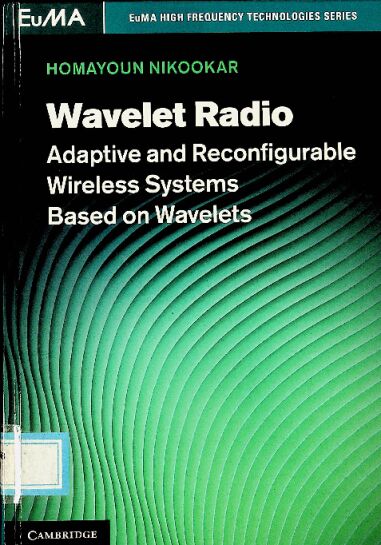
书名:Wavelet radio
出版时间:2013
出版社:Cambridge University Press,
摘要
The first book to provide a detailed discussion of the application of wavelets in wireless communications, this is an invaluable source of information for graduate students, researchers, and telecommunications engineers, managers and strategists. It surveys applications, explains how to design new wavelets, and compares wavelet technology with existing OFDM technology.
Addresses the applications and challenges of wavelet technology for a range of wireless communication domains
Aids in the understanding of wavelet packet modulation and compares it with OFDM
Includes tutorials on convex optimisation and spectral factorisation for the design of wavelets
Explains design methods for new wavelet technologies for wireless communications, addressing many challenges, such as peak-to-average power ratio reduction, interference mitigation, reduction of sensitivity to time, frequency and phase offsets, and efficient usage of wireless resources
Describes the application of wavelet radio in spectrum sensing of cognitive radio systems.
查看更多
前言
Wavelets provide promising potential applications in wireless communication. The main property of wavelets for these applications is their ability and flexibility to characterize signals with adaptive time–frequency resolution. The convergence of information, multimedia, entertainment and wireless communications has raised hopes of realizing the vision of ubiquitous communication. To actualize this, there is a challenge of developing technologies and architectures capable of handling large volumes of data under severe constraints of resources such as power and bandwidth. Wavelets are uniquely qualified to address this challenge. They have strong advantage of being generic schemes whose actual characteristics can be widely customized to fulfil the various requirements and constraints of advanced mobile communications systems. The wavelet technology is the choice for smart and resource aware wireless systems.
In the light of this, the objective of this book is to utilize the wavelet technology for smart and resource aware radio systems and to develop wavelet based radio systems that cleverly and efficiently use available resources to guarantee the required quality of service. Adaptation, smartness, context aware, robustness and reconfigurability are the major accents of wavelet radio, which will be concentrated on in this book. This is actualized by developing a wavelet-packet-based multi-carrier modulation radio that can be adaptively reconfigured to operate under different use cases even while maximizing resource utilization.
In a recent paper in the IEEE Communication magazine, Steve Weinstein [1], a pioneer in the development of OFDM, traces back the journey of OFDM right from its inception in 1966 when Chang [2] published the first paper on multi-carrier modulation, to the development of the first proof of concept by Bell Labs in 1985 [3] and its first major consumer deployment as ADSL in 1993 and finally its standardization as IEEE 802.11a in 1999. And in his concluding remarks he advocates wavelet based systems as true successors of OFDM, especially for the development of futuristic low power “Green Radios” which are intelligent and adaptable.
The research and investigation on the utilization of wavelet technology for smart resource aware radio systems as presented in this book, not only aims at tackling the various technical questions that will shorten the development time from conception to practical realization of wavelet radios (vis-a-vis the OFDM cycle which took close to ` 35 years), but also to give the wireless radio research community a lead in this exciting new line of research. Furthermore, in an era when bold predictions that the PHY Layer is Dead [4] are made, the work on wavelet radio will increase the capacities of the wireless link and open new vistas for an exciting line of research topics on radio design.
The book addresses the physical layer challenges of wavelet radio transmission and is organized in eight chapters. The material is categorized into three broad divisions, namely, theoretical background (Chapters 1, 2), wavelet radio (Chapters 3–5) and wavelet applications in cognitive radio design (Chapters 6 and 7). Finally, the book rounds off in Chapter 8 with conclusions and recommendations for future research. I would greatly appreciate the readers’ comments on this work; collaboration and cooperation will leverage the knowledge of the research community.
References
[1] S.B. Weinstein, “Introduction to the History of OFDM,” IEEE Communications Magazine, November 2009, Volume 47, No. 11.
[2] R.W. Chang, “High-Speed Multichannel Data Transmission with Bandlimited Orthogonal Signals,” Bell Sys. Tech. J., vol. 45, Dec. 1966, pp. 1775–96; see also U.S. Patent 3,488,445, Jan. 6, 1970.
[3] “A Brief History of OFDM”, 2010, Web link: http://www.wimax.com/commentary/wimax weekly/sidebar-1-1-a-brief-history-of-ofdm.
[4] Panel Discussions at IEEE 69th Vehicular Technology Conference (VTC-Spring), April 2009, Barcelona, Web link: http://www.ieeevtc.org/vtc2009spring/panels.php#Panel02.
查看更多
目录
Preface page ix
Acknowledgement xi
1 Introduction 1
1.1 Background 1
1.1.1 The need 2
1.1.2 The means 3
1.2 Wavelet transform as a tool for wireless communications 3
1.2.1 Wavelets and wavelet transform 3
1.2.2 Advantages of wavelet transform for wireless communication 4
1.2.3 Application of wavelets for wireless transmission 6
1.2.4 Wavelet-packet-based multi-carrier modulation (WPM) system 6
1.3 Scope of the book 8
1.3.1 Theoretical background (Chapters 1 and 2) 8
1.3.2 Wavelet radio (Chapters 3, 4 and 5) 8
1.3.3 Wavelet applications in cognitive radio design (Chapters 6 and 7) 9
2 Theory of wavelets 11
2.1 Introduction 12
2.1.1 Representation of signals 12
2.1.2 Fourier analysis 13
2.1.3 Gabor transform 13
2.1.4 Wavelet analysis 14
2.2 Continuous wavelet transform 14
2.2.1 Orthonormal wavelets 17
2.2.2 Non-dyadic wavelets 18
2.3 Multi-resolution analysis 18
2.4 Discrete wavelet transform 20
2.5 Filter bank representation of DWT 21
2.5.1 Analysis filter bank 21
2.5.2 Synthesis filter bank 24
2.6 Wavelet packet transform 26
2.7 Wavelet types 28
2.7.1 Wavelet properties 29
2.7.2 Popular wavelet families 32
2.8 Summary 33
3 Wavelet packet modulator 35
3.1 Modulation techniques for wireless communication 36
3.1.1 Single-carrier transmission 36
3.2 Orthogonal frequency division multiplexing 38
3.3 Filter bank multi-carrier methods 41
3.3.1 Filtered multi-tone (FMT) 42
3.3.2 Cosine modulated multi-tone (CMT) 43
3.3.3 OFDM-offset QAM/staggered multi-tone (SMT) 44
3.4 Wavelet and wavelet-packet-based multi-carrier modulators 45
3.4.1 Wavelet packet modulator (WPM) 45
3.4.2 Variants of wavelet packet modulator 48
3.4.3 Interpolated tree orthogonal multiplexing (ITOM) 51
3.5 Summary 52
4 Synchronization issues of wavelet radio 55
4.1 Introduction 55
4.2 Frequency offset in multi-carrier modulation 56
4.2.1 Modelling frequency offset errors 56
4.2.2 Frequency offset in OFDM 57
4.2.3 Frequency offset in WPM 58
4.2.4 Numerical results for frequency offset 59
4.3 Phase noise in multi-carrier modulation 65
4.3.1 Modelling the phase noise 66
4.3.2 Phase noise in OFDM 67
4.3.3 Phase noise in WPM 68
4.3.4 Numerical results for phase noise 70
4.4 Time offset in multi-carrier modulation 76
4.4.1 Modelling time offset errors 76
4.4.2 Time offset in OFDM 78
4.4.3 Time synchronization error in WPM 80
4.4.4 Modulation scheme 81
4.4.5 Numerical results for time offset 82
4.5 Summary 90
5 Peak-to-average power ratio 93
5.1 Background 93
5.2 Introduction 93
5.3 PAPR distribution of multi-carrier signal 94
5.3.1 OFDM 94
5.3.2 WPM 95
5.4 PAPR reduction techniques 99
5.4.1 Signal-scrambling techniques 100
5.4.2 Signal-distortion techniques 101
5.4.3 Criteria for selection of PAPR reduction technique 102
5.5 Selected mapping with phase modification 103
5.5.1 Description of algorithm 103
5.5.2 Numerical results 105
5.6 Summary 109
6 Wavelets for spectrum sensing in cognitive radio applications 112
6.1 Background 112
6.2 Spectrum sensing in cognitive radio 112
6.3 Spectrum sensing methods 114
6.3.1 Periodogram 114
6.3.2 Correlogram 115
6.4 Advantages and disadvantages of conventional spectrum sensing techniques in cognitive radio 116
6.4.1 Pilot detection via matched filtering 116
6.4.2 Energy detection 116
6.4.3 Cyclostationary feature detection 116
6.4.4 Multi-taper spectrum estimation (MTSE) 117
6.4.5 Filter bank spectrum estimation (FBSE) 119
6.5 Advantages of wavelets in spectrum estimation 120
6.6 Performance evaluation of spectrum sensing in cognitive radio 121
6.6.1 Basic principle of energy detector 121
6.6.2 Evaluation of receiver operating characteristic (ROC) 122
6.7 Wavelet packet spectrum estimator (WPSE) 123
6.7.1 Evaluation of ROC performance of WPSE 125
6.8 An efficient model of wavelet-packet based spectrum estimator 129
6.8.1 WPSE model 129
6.8.2 Study of the detection performance of the developed model 131
6.9 Wavelet-packet-based spectrum estimator (WPSE) and compressed sensing 132
6.9.1 Introduction to compressed sensing 132
6.9.2 Compressed sensing and WPSE 133
6.10 Summary 136
7 Optimal wavelet design for wireless communications 139
7.1 Introduction 139
7.2 Criteria for design of wavelets 140
7.2.1 Design procedure 140
7.2.2 Filter bank implementation of WPM 141
7.2.3 Important wavelet properties 141
7.2.4 Degrees of freedom to design 144
7.3 Example 1 – Maximally frequency selective wavelets 144
7.3.1 Formulation of design problem 146
7.3.2 Transformation of non-convex problem to linear/convex problem 147
7.3.3 Reformulation of optimization problem in the Q(ω) function domain 151
7.3.4 Solving the convex optimization problem 154
7.3.5 Results and analysis 154
7.4 Example 2 – Wavelets with low cross-correlation error 162
7.4.1 Time offset errors in WPM 165
7.4.2 Formulation of design problem 165
7.4.3 Transformation of the mathematical constraints from a non-convex problem to a convex/linear one 167
7.4.4 Results and analysis 168
7.5 Summary 177
8 Conclusion 180
8.1 Study of wavelet radio performance under loss of synchronization 182
8.2 PAPR performance studies 183
8.3 Wavelet-based spectrum sensing for cognitive radio 183
8.4 Design of wavelets 184
8.5 Future research topics 185
8.5.1 Study of WPM performance under loss of synchronization 185
8.5.2 PAPR performance studies 185
8.5.3 Equalization of channel 186
8.5.4 Wavelet packet spectrum estimator (WPSE) 186
8.5.5 Design of wavelets 187
8.6 Related studies 187
8.7 Beyond this book 188
8.7.1 Wavelet-based modelling of time-variant wireless channels 188
8.7.2 Multiple-access communication 189
8.7.3 Wavelet radio for green communication 189
8.7.4 Wavelet-based multiple-input–multiple-output communications (MIMO) 190
8.8 Concluding remarks 191
Appendix 1: Semi-definitive programming 193
Appendix 2: Spectral factorization 194
Appendix 3: Sum of squares of cross-correlation 195
Index 196
查看更多
作者简介
Homayoun Nikookar is an Associate Professor in the Faculty of Electrical Engineering, Mathematics, and Computer Science at Delft University of Technology, where he leads the Radio Advanced Technologies and Systems (RATS) programme, and supervises a team of researchers carrying out cutting-edge research in the field of advanced radio transmission. He has received several paper awards at international conferences and symposiums and the “Supervisor of the Year Award” at Delft University in 2010.
查看更多
馆藏单位
中科院文献情报中心