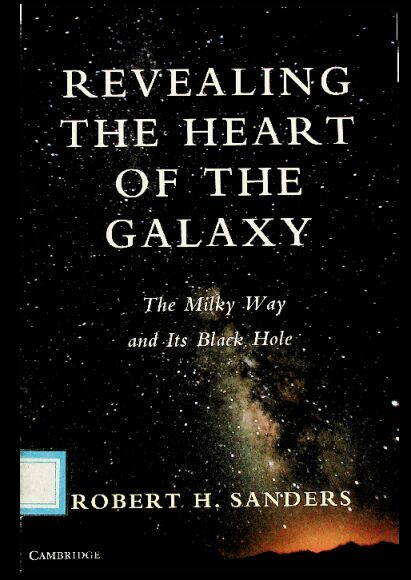
书名:Revealing the heart of the galaxy
ISBN\ISSN:9781107039186,1107039185
出版时间:2014
出版社:Cambridge University Press,
前言
Written in an informal and engaging style, this volume traces the discoveries that led to our understanding of the size and structure of the Milky Way, and the conclusive evidence for a massive black hole at its center. Robert H. Sanders, an astronomer who witnessed many of these developments, describes how we parted the veil of interstellar dust to probe the strange phenomena within. We now know that the most luminous objects in the Universe – quasars and radio galaxies – are powered by massive black holes at their hearts. But how did black holes emerge from being a mathematical peculiarity, a theoretical consequence of Einstein's theory of gravity, to become part of the modern paradigm that explains active galactic nuclei and galaxy evolution in normal galaxies such as the Milky Way? This story, aimed at non-specialist readers and students and historians of astronomy, will both inform and entertain.
查看更多
目录
Acknowledgements page ix
1 Introduction: The Luminous Pathway 1
2 The Discovery of the Milky Way Galaxy 13
2.1 Kapteyn’s Universe 13
2.2 Pickering’s Harem 16
2.3 Shapley’s Supergalaxy 18
2.4 The Legacy ofJ. C. Kapteyn 23
3 The New Physics 25
3.1 Revolution 25
3.2 The Power ofPrinciple 28
3.3 Arthur Eddington Boosts Einstein to World Acclaim 32
3.4 The Solution from the Trenches 34
4 Parting the Veil with Radio Astronomy 38
4.1 Kapteyn’s Famous Student 38
4.2 Radio Astronomy and the 21-cm Line 42
4.3 Toward the Galactic Center 47
4.4 Jan Oort and the Galaxy: An Assessment 49
5 The Violent Universe 51
5.1 A New Constituent ofthe Universe 51
5.2 Active Galaxies: Radio Galaxies and Seyferts 56
5.3 Twinkle, Twinkle Little Quasar: Early Models ofthe QSO Phenomenon 59
5.4 Where Have All the Quasars Gone? 64
5.5 Summing Up a Decade ofDiscovery 67
6 New Windows on the Galactic Center 69
6.1 The Near Infrared and the Distribution ofStars in the
Galactic Center 69
6.2 A Unique Source at a Unique Location 73
6.3 Mid- and Far-Infrared Radiation 76
6.4 The “Mini-Spiral” in Sgr A 79
6.5 Molecular Clouds in the Central Region 80
7 The Milky Way as a Barred Spiral Galaxy 83
7.1 Ejections and Explosions 83
7.2 Gas Motion in Barred Spiral Galaxies 89
7.3 Controversy in Astronomy 97
8 The Evolving View of Active Galactic Nuclei 99
8.1 The Jet Set 99
8.2 The View from Cambridge 101
8.3 A Massive Black Hole in NGC 4258 106
8.4 Are There Alternatives to a Black Hole? 110
8.5 Reflections 113
9 The “Paradox of Youth”: Young Stars in the Galactic Center 115
9.1 The View from Groningen, 1983 115
9.2 A Nuclear Starburst 118
9.3 Gas Distribution and Motions Near Sgr A* 121
9.4 Distribution and Motion ofYoung Stars Near the Galactic Center 123
9.5 Star Formation in the Near Tidal Field ofa Black Hole 126
10 Stellar Orbits in the Galactic Center, QED 129
10.1 Two Mountains, Two Legends 129
10.2 New Technology for a New Millennium 131
10.3 Inward Bound: Leapfrog to the Black Hole 137
10.4 Individual Star Orbits: The Black Hole Gains Weight 139
10.5 Youth, Even More Paradoxical 143
10.6 Pele and the Alicanto 145
10.7 Summing Up: What Have We Learned? 146
11 Black Holes Here, Black Holes There... 149
11.1 Nearby, “Normal” Galaxies 149
11.2 Bigger Black Holes Live in Bigger Spheroids 153
11.3 Blast from the Past 158
11.4 The Early Formation ofBlack Holes 161
12 Traces of Activity: Past, Present, and Future 165
12.1 Effects ofBlack Hole Outbursts on the Galactic Center Gas 165
12.2 X-Ray Echos 169
12.3 Fermi Bubbles 171
12.4 A Snack for Pele 173
12.5 The Face ofPele: The Event Horizon Telescope 175
13 After Words: Progress in Astronomy 177
References 185
Index 193
查看更多
馆藏单位
中科院文献情报中心