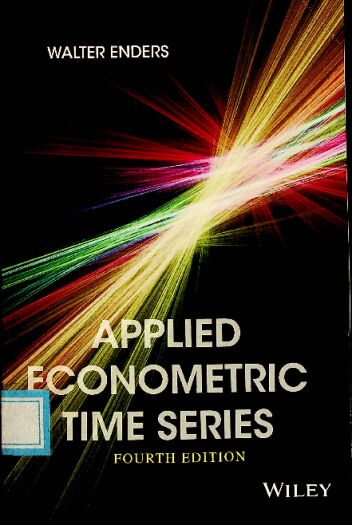
书名:Applied econometric time series
出版时间:2015
出版社:John Wiley and Sons, Inc.,
摘要
Applied Econometric Time Series, 4th Edition demonstrates modern techniques for developing models capable of forecasting, interpreting, and testing hypotheses concerning economic data. In this text, Dr. Walter Enders commits to using a "learn-by-doing" approach to help readers master time-series analysis efficiently and effectively.
查看更多
目录
PREFACE vii
ABOUT THE AUTHOR x
CHAPTER 1 DIFFERENCE EQUATIONS 1
Introduction 1
1 Time-Series Models 1
2 Difference Equations and Their Solutions 7
3 Solution by Iteration 10
4 An Alternative Solution Methodology 14
5 The Cobweb Model 18
6 Solving Homogeneous Difference Equations 22
7 Particular Solutions for Deterministic Processes 31
8 The Method of Undetermined Coefficients 34
9 Lag Operators 40
10 Summary 43
Questions and Exercises 44
CHAPTER 2 STATIONARY TIME-SERIES MODELS 47
1 Stochastic Difference Equation Models 47
2 ARMA Models 50
3 Stationarity 51
4 Stationarity Restrictions for an ARMA (p, q) Model 55
5 The Autocorrelation Function 60
6 The Partial Autocorrelation Function 64
7 Sample Autocorrelations of Stationary Series 67
8 Box—Jenkins Model Selection 76
9 Properties of Forecasts 79
10 A Model of the Interest Rate Spread 88
11 Seasonality 96
12 Parameter Instability and Structural Change 102
13 Combining Forecasts 109
14 Summary and Conclusions 112
Questions and Exercises 113
CHAPTER 3 MODELING VOLATILITY 118
1 Economic Time Series: The Stylized Facts 118
2 ARCH and GARCH Processes 123
3 ARCH and GARCH Estimates of Inflation 130
4 Three Examples of GARCH Models 134
5 A GARCH Model of Risk 141
6 The ARCH-M Model 143
7 Additional Properties of GARCH Processes 146
8 Maximum Likelihood Estimation of GARCH Models 152
9 Other Models of Conditional Variance 154
10 Estimating the NYSE U.S. 100 Index 158
11 Multivariate GARCH 165
12 Volatility Impulse Responses 172
13 Summary and Conclusions 174
Questions and Exercises 176
CHAPTER 4 MODELS WITH TREND 181
1 Deterministic and Stochastic Trends 181
2 Removing the Trend 189
3 Unit Roots and Regression Residuals 195
4 The Monte Carlo Method 200
5 Dickey—Fuller Tests 206
6 Examples of the Dickey—Fuller Test 210
7 Extensions of the Dickey—Fuller Test 215
8 Structural Change 227
9 Power and the Deterministic Regressors 235
10 Tests with More Power 238
11 Panel Unit Root Tests 243
12 Trends and Univariate Decompositions 247
13 Summary and Conclusions 254
Questions and Exercises 255
CHAPTER 5 MULTIEQUATION TIME-SERIES MODELS 259
1 Intervention Analysis 281
2 ADLs and Transfer Functions 287
3 An ADL of Terrorism in Italy 277
4 Limits to Structural Multivariate Estimation 281
5 Introduction to VAR Analysis 285
6 Estimation and Identification 290
7 The Impulse Response Function 294
8 Testing Hypotheses 303
9 Example of a Simple VAR: Domestic and Transnational Terrorism 309
10 Structural VARs 313
11 Examples of Structural Decompositions 317
12 Overidentified Systems 321
13 The Blanchard—Quah Decomposition 325
14 Decomposing Real and Nominal Exchange Rates: An Example 331
15 Summary and Conclusions 335
Questions and Exercises 337
CHAPTER 6 COINTEGRATION AND ERROR-CORRECTION MODELS 343
1 Linear Combinations of Integrated Variables 344
2 Cointegration and Common Trends 351
3 Cointegration and Error Correction 353
4 Testing for Cointegration: The Engle—Granger Methodology 360
5 Illustrating the Engle—Granger Methodology 364
6 Cointegration and Purchasing Power Parity 370
7 Characteristic Roots. Rank, and Cointegration 373
8 Hypothesis Testing 380
9 Illustrating the Johansen Methodology 389
10 Error-Correction and ADL Tests 393
11 Comparing the Three Methods 397
12 Summary and Conclusions 400
Questions and Exercises 401
CHAPTER 7 NONLINEAR MODELS AND BREAKS 407
1 Linear Versus Nonlinear Adjustment 408
2 Simple Extensions of the ARMA Model 410
3 Testing for Nonlinearity 413
4 Threshold Autoregressive Models 420
5 Extensions of the TAR Model 427
6 Three Threshold Models 433
7 Smooth Transition Models 439
8 Other Regime Switching Models 445
9 Estimates of STAR Models 449
10 Generalized Impulse Responses and Forecasting 453
11 Unit Roots and Nonlinearity 461
12 More on Endogenous Structural Breaks 466
13 Summary and Conclusions 474
Questions and Exercises 475
INDEX 479
REFERENCES (ONLINE)
ENDNOTES (ONLINE)
STAT/ST/CAL TABLES (ONLINE)
查看PDF
查看更多
作者简介
Walter Enders holds the Bidgood Chair of Economics and Finance at the University of Alabama. He received his doctorate in economics in 1975 from Columbia University in New York. Dr. Enders has published numerous research articles in such journals as the Review of Economics and Statistics, Quarterly Journal of Economics, and the Journal of International Economics. He has also published articles in the American Economic Review (a journal of the American Economic Association), the Journal of Business and Economic Statistics (a journal of the American Statistical Association), and the American Political Science Review (a journal of the American Political Science Association). Dr. Enders (along with Todd Sandler) received the National Academy of Sciences' Estes Award for Behavioral Research Relevant to the Prevention of Nuclear War. The award recognizes "basic research in any field of cognitive or behavioral science that has employed rigorous formal or empirical methods, optimally a combination of these, to advance our understanding of problems or issues relating to the risk of nuclear war." The National Academy presented the award for their "joint work on transnational terrorism using game theory and time-series analysis to document the cyclic and shifting nature of terrorist attacks in response to defensive counteractions."
查看更多
馆藏单位
中科院文献情报中心