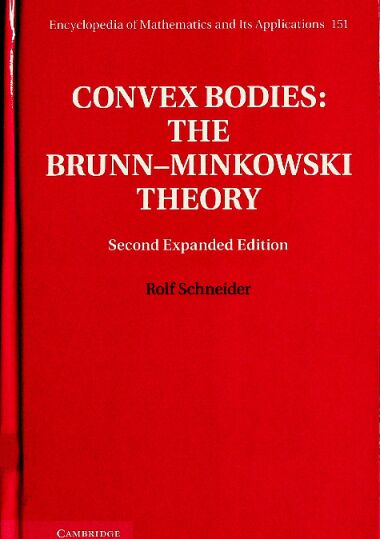
书名:Convex bodies
出版时间:2014
出版社:Cambridge University Press,
分类号:数学
版次:Second expanded edition.
前言
Preface to the second edition
Wie machen wirs, daf alles frisch und neu Und mit Bedeutung auch gefillig sei?
Goethe, Faust 1
The past 20 years have seen considerable progress and lively activity in various different areas of convex geometry.In order that this book still meet its intended purpose,it had to be updated and expanded.It remains the aim of the book to serve the newcomer to the field who wants an introduction from the very beginning,as well as theexperienced reader who is either doing research in the field oris looking for some special result to be used elsewhere.In the introductory parts of the book, no greater changes have been necessary, but already here recent developments are reflected in a number of supplements. The main additions to the book are three new chapters,on valuations, on extensions and analogues of the Brunn-Minkowski theory,and on affine constructions and inequalities in the theory of convex bodies. The contents of Chapter 7 from the first edition are now found in Chapters8and 10 of the second edition,considerably extended. The structure of some other chapters has also been changed by, for example,dividing them into subsections,regrouping somematerial, or adding a new section.A few more technicalproofs, which had been carried out in the first edition, have been replaced by hints to the original literature. While the new topics added to the book all have their origins in the Brunn- Minkowski theory, their natural intrinsic developments may gradually have led them farther away.Proofs in this book are restricted to results which may have been basic for further developments, but arestillclose to the classical Brunn-Minkowski theory. In the remaining parts, we survey many recent results without giving proofs,but we always provide references to the sources where the proofs can be found.The section notes contain additional information.
It has become clear that this book,even with its restrictionto the Brunn-Minkowski theory and its ramifications,could never be exhaustive.Therefore,Ifelt comfortable with being brief in the treatment of projections and sections of convex bodies and related topics,subsumed under geometric tomography, having the chance to refer instead to the book by Gardner [675], which already exists in its second edition.
The Fourier analytic approach to sections and projections is fully covered by the books of Koldobsky [136] and of Koldobsky and Yaskin [1142].For all questions related to projections or sections of convex bodies, these are the three books the reader should consult.
It was also comforting to lear that the important developments in another active branch of convexity, the asymptotic theory, will be the subject of forthcoming books With an easy conscienceIcould,therefore,refrain from inadequate attempts tocross my borders in this direction.
This second edition would not have come into life without Erwin Lutwak's friendly persuasion and without his invaluablehelp.In particular,he formed a team of young collaborators who produced a LTX version of the first edition, thus providing a highly appreciated technical basis for my later work. Special thanks for this very useful support go to Varvara Liti and Guangxian Zhu.An advanced version of the second edition was read by Franz Schuster, and selected chapters were read by Richard Gardner, Daniel Hug,Erwin Lutwak and Gaoyong Zhang. They all helped me with many useful comments and suggestions, for which I express my sincere thanks.
Freiburg i. Br., December 2012PF\Preface to the first edition
The Brunn-Minkowski theory is theclassical core of the geometry of convex bodies. It originated with the thesis of Hermann Brunn in 1887 and is in its essential parts thecreation of Hermann Minkowski,around the turn of the century. The well-known survey of Bonnesen and Fenchel in 1934 collected what was already an impressive body of results,though important developments were till to come,through the work of A. D. Aleksandrov and others in the thirties.In recent decades, the theory of convex bodies has expanded considerably; new topics have been developed and originally neglected branches of the subject have gained in interest. For instance, the combinatorial aspects, the theory of convex polytopes and the local theory of Banach spaces attract particular attention now. Nevertheless, the Brunn-Minkowski theory has remained of constant interest owing to its various new applications, its connections with other fields,and the challenge of some resistant open problems. Aiming at a brief characterization of Brunn-Minkowskitheory, one might say that it is the result of merging two elementary notions for point sets in Euclidean space: vector addition and volume. The vector addition of convex bodies, usually called Minkowski addition, has many facets of independent geometric interest. Combined with volume,itleads to the fundamental Brunn-Minkowskiinequality and thenotion of mixed volumes. The latter satisfy a series of inequalities which, due to their flex-ibility,solve many extremal problems and yield several uniqueness results.Looking at mixed volumes from a local point of view, one is led to mixed area measures. Quermassintegrals,or Minkowski functionals,and their local versions,surface area measures and curvature measures,are a special case of mixed volumes and mixed area measures. They are related to the differential geometry of convex hypersurfaces and to integral geometry.
Chapter 1 of the present book treats the basic properties of convex bodies and thus lays the foundations for subsequent developments.This chapter does not claim much originality; in large parts,it follows the procedures in standard books such as McMullen and Shephard [1398], Roberts and Varberg [1581]and Rockafellar[1583].Together with Sections 2.1,2.2,2.4 and2.5,it serves as a general introduc- tion to the metric geometry of convex bodies. Chapter2 is devoted to the boundaryPF\Preface to the first edition
structure of convex bodies. Most of its material is needed later,except for Section 2.6,on generic boundary structure, which just rounds off the picture. Minkowski addition is the subject of Chapter 3. Several different aspects are considered here such as decomposability, approximation problems with special regard to addition, additive maps and sums of segments. Quermassintegrals, which constitute a fun- damental class of functionals on convex bodies, are studied in Chapter 4, where they are viewed as specializations of curvature measures, their local versions. For these, some integral-geometric formulae are established in Section 4.5. Here I try to follow the tradition set by Blaschke and Hadwiger, of incorporating parts of integral geometry into the theory of convex bodies. Some of this, however,is also a necessary prerequisite for Section 4.6.The remaining part of the book is devoted to mixed volumes and their applications. Chapter 5 develops the basic properties of mixed volumes and mixed areameasures and treats special formulae,extensions,and analogues.2 Chapter6,the heart of the book, is devoted to the inequalities satisfied by mixed volumes, with special emphasis on improvements, the equality cases(as far as they are known) and stability questions. Chapter 7 presents a small selection of applications.The classical theorems of Minkowski and the Aleksandrov-Fenchel- Jessen theorem are treated here,the latter in refined versions. Section 7.4 serves as an overview of affine extremal problems for convex bodies.In this promising field, Brunn-Minkowski theory is of some use,but it appears that for the solution of some long-standing open problems new methods still have to be invented.
Concerning the choice of topics treated in this book,I wish to point out that it is guided by Minkowski's original work also in the following sense.Some subjects that Minkowski touched only briefly have later expanded considerably, and I pay special attention to these.Examples are projection bodies(zonoids),tangential bod- ies, the use of spherical harmonics in convexity and strengthenings of Minkowskian inequalities in the form of stability estimates.
The necessary prerequisites for reading this book are modest: the usual geometry of Euclidean space,elementary analysis,and basic measure and integration theory for Chapter 4. Occasionally, use is made of spherical harmonics; relevant informa- tion is collected in the Appendix. My intended attitude towards the presentation of proofscannot be summarized better than by quoting from the preface to the book on Hausdorf measures by C.A.Rogers: 'As the book is largely based on lectures,and as Ilikemy students to follow my lectures,proofs are given in great detail;this may bore the maturemathematician,but it will, Ibelieve,be a great help to anyone trying to learn the subjectab initio.'On the other hand,someimportant results are stated as theorems but not proved, since this would lead us too far from the main theme,and no proofs are given in the survey sections 5.4,6.8 and 7.4.
The notes at the end of nearly all sections are an essential part of the book.As a rule, this is where Ihave given references to original literature,considered questions 1 Section numbers here refer to the first edition; they may difer in the second edition.
2 This description of the chapters concerms the first edition.Beginning with Chapter 6,the secondedition has a different structure.of priority, made various comments and, in particular,given hints about applica- tions,generalizations and ramifications.As an important purpose of the notes is to demonstrate the connections of convex geometry with other fields,some notes do take us further from the main theme of the book,mentioning,for example,infinite- dimensional results or non-convexsets or giving more detailed information on appli- cations in, for instance, stochastic geometry.
The list of references does not have much overlap with the older bibliographies in the books by Bonnesen and Fenchel and by Hadwiger.Hence,areader wishing to have a more complete picture should consult these bibliographies also,as well as those in the survey articles listed in part B of the References.
My thanks go to Sabine Linsenbold for her careful typing of the manuscript and to Daniel Hug who read the typescript and made many valuable comments and suggestions.
查看更多
目录
Preface to the second edition page ix
Preface to the first edition xi
General hints to the literature xv
Conventions and notation xix
1 Basic convexity 1
1.1 Convex sets and combinations 1
1.2 The metric proiection 9
1.3 Support and separation 11
1.4 Extremal representations 15
1.5Convex functions 19
1.6Duality 32
1.7 Functions representing convex sets 44
1.8 The Hausdorff metric 60
2Boundary structure 74
2.1 Faclal structure74
2.2Singularities 81
2.3Segments in the boundary 90
2.4Polytopes 104
2.5Higher regularity and curvature 112
2.6 Generalized curvatures 125
2.7 Generic boundary structure 132
3Minkowski addition 139
3.1Minkowski aditonad subtraction 139
3.2Summands and decomposition 156
3.3Additive maps 172
3.4Approximation and addition 183
3.5 Minkowski classes and additive generation 189
4Support measures and intrinsic volumes 208
4.1 Local parallel sets 208
4.2 Steiner formula and support measures 211
4.3 Extensions of support measures 228
4.4Integral-geometric formulae 236
4.5 Local behaviour of curvature and area measures 265
5Mixed volumes and related concepts 275
5.1 Mixed volumes and mixed area measures 275
5.2Extensions of mixed volumes 290
5.3Special formulae for mixed volumes 295
5.4 Moment vectors,curvature centroids,Minkowski tensors 312
5.5 Mixed discriminants 322
6Valuations on convex bodies 329
6.1Basic facts and examples 329
6.2Extensions 332
6.3 Polynomiality 340
6.4 Translation invariant, continuous valuations 346
6.5 The modern theory of valuations 365
7Inequalities for mixed volumes 369
7.1 The Brunn-Minkowski theorem 369
7.2 The Minkowski and isoperimetric inequalities 381
7.3The Aleksandrov-Fenchel inequality 393
7.4 Consequences and improvements 399
7.5 Wulf shapes 410
7.6 Equality cases and stability 418
7.7 Linear inequalities 440
8Determination by area measures and curvatures 447
8.1 Uniqueness results 447
8.2 Convex bodies with given surface area measures 455
8.3The area measure of order one 464
8.4The intermediate area measures 473
8.5 Stability and further uniqueness results 478
9Extensions and analogues of the Brunn-Minkowski theory 489
9.1The LPBrunn-Minkowski theory 489
9.2 TheLP Minkowski problem and generalizations 498
9.3The dual Brunn-Minkowski theory 507
9.4Further combinations and functionals 512
9.5Log-concave functions and generalizations 516
9.6 A glimpse of other ramifications 525
10Affine constructions and inequalities 528
10.1 Covariogram and difference body 528
10.2 Qualitative characterizations of ellipsoids 535
10.3 Steiner symmetrization 536
10.4Shadow systems 541
10.5Curvature images and affine surface areas 543
10.6Floating bodies and similar constructions 560
10.7The volume product 563
10.8Moment bodies and centroid bodies 566
10.9Projection bodies 569
10.10 Intersection bodies 580
10.11 Volume comparison 583
10.12 Associated ellipsoids 587
10.13 Isotropic measures,special positions,reverse inequalities 595
10.14Lpzonoids 606
10.15 From geometric to analytic inequalities 610
10.16 Characterization theorems 614
Appendix Spherical harmonics 623
References 629
Notation index 715
Author index 719
Subject index 729
查看PDF
查看更多
馆藏单位
中科院文献情报中心