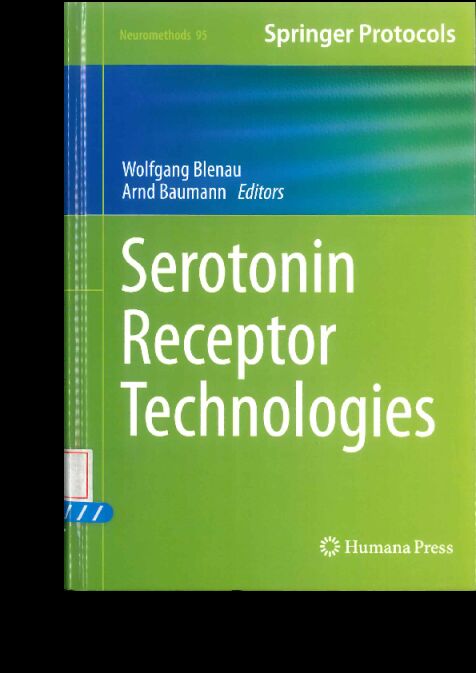
书名:Serotonin receptor technologies
责任者:Wolfgang Blenau | Arnd Baumann.
ISBN\ISSN:9781493921867,149392186X
出版时间:2015
出版社:Humana Press
前言
Serotonin (5-hydroxytryptamine, 5-HT) is an important signaling molecule, which plays a key role in regulating and modulating physiological and behavioral processes in both deuterostomes (e.g., mammals) and protostomes (e.g., ilatworms, nematodes, and arthropods). In the central nervous system (CNS), serotonin modulates mood, perception, reward, anger, aggression, appetite, memory, sexual behavior, and attention. In addition, serotonin has important functions outside the CNS, including the regulation of energy balance and food intake, gastrointestinal and endocrine function, and cardiovascular and pulmonary physiology. Thus it is not surprising that impairment of the seroto-nergic system has been implicated in the pathogenesis of several human diseases like depression, schizophrenia, anxiety and panic disorders, migraine, hypertension, eating disorders, vomiting, and irritable bowel syndromes.
Similar to other biogenic amines, serotonin is synthesized from an amino acid precursor. Two enzymatic steps, catalyzed by the enzymes tryptophan hydroxylase and 3,4-dihydroxyphenylalanine (DOPA) decarboxylase, are necessary to transform tryptophan to the primary amine serotonin. Specific functions of serotonin result from its binding to and subsequent activation of membrane receptors. Uncovering the precise molecular mechanism of serotonin signaling is complicated by the fact that humans express 14 serotonin-receptor subtypes. One of these belongs to the family of cys-loop ligand-gated ion channels (5-HT_3) whereas all other proteins are G-protein-coupled receptors (GPCRs). In mammals, serotonin-binding GPCRs fall into six distinct classes, with some classes containing several receptor subtypes. Additional 5-HT receptor heterogeneity originates from alternative splicing of primary transcripts, RNA editing, and potential formation of receptor heterodimers. Activation of 5-HT receptors causes transient changes in the concentration of intracellular messengers (e.g., cAMP, Ca~2+), ion channel activity, or reaction cascades that may lead to changes in gene regulation. The reuptake of serotonin from the synaptic cleft into the presynaptic terminus by the Na~+-dependent serotonin transporter (SERT) terminates the action of serotonin and allows functional recycling of the neurotransmitter. Notably, SERT is the target of antidepressant medications, e.g., sertraline, paroxetine, cita-lopram, and escitalopram, which serve in keeping the extracellular concentration of serotonin elevated.
In recent years, a vast amount of new information has been accumulated concerning the functional characteristics of the various 5-HT receptor subtypes and the SERT. Data are based on two main lines of research: (1) operational pharmacology applying selective ligands and (2) molecular biological tools. It is also worth mentioning that serotonin works in concert with other neurotransmitter systems, and crosstalk of signaling mechanisms is key to understanding various basic physiological functions and pathological states. To provide readers with state-of-the-art methodologies currently applied in serotonin research, we have assembled a collection of protocols provided by leading experts in the field. The approaches described in this volume vary from molecular biological and biochemical techniques (e.g., regarding receptor dimerization), fluorescence microscopy and imaging applications, flow cytometry, the use of organotypic slice and cell cultures to the generation of genetically modified animal models and the development of sophisticated behavioral tests, thus covering a wide spectrum of techniques to study serotonergic signaling in detail.
Compared to mammals, the serotonergic system of protostomian phyla (e.g., flat-worms, nematodes, and arthropods) is slightly less complex. However, similarities in modes of drug action, behavioral responses, and gene activity patterns between protostomian and mammalian serotonergic systems open alternative routes to studying and understanding fundamental neuropharmacological processes that are relevant to human diseases. In this context, simpler model organisms for which various analytical tools have been established allow high-throughput analyses at significantly reduced overall costs and thus provide promising perspectives for future serotonin research. For example, Caenorhabditis elegant is excellently suited to analyze serotonergic signaling because locomotion is regulated by serotonin in this nematode. Thus, some invertebrate models currently used in serotonin research are also covered in this volume.
Many of the experimental procedures described in this NEUROMETHODS volume will be also valuable for researchers working on similar problems with related GPCRs and neurotransmitter transporters. Therefore, we are confident that this collection of methods will foster both basic and translational research aiming to further deepen our understanding of the various facets aminergic systems provide. Last but not least, we would like to take this opportunity to express our sincere gratitude to all the authors for their efforts providing their valuable contributions to this volume of the NEUROMETHODS series. Koln, Germany Wolfgang Blenau; Julich, Germany Arnd Banmann
查看更多
目录
Series Preface v
Preface vii
Contributors xi
Part I Receptor Dimerization
1 Novel Approaches to Serotonin Receptor Interaction Studies 3
2 Techniques for the Study of GPCR Heteromerization in Living Cells and Animal Models 21
Part II Manipulation and Analysis of Serotonergic Signaling in Brain Slices
3 Organotypic Slices and Biolistic Itansfection for the Study of Serotonin Receptor Function in CNS Neurons 39
Part III Mouse Models to Study Serotonin-Associated Behavioral Disorders
4 Dissecting a Model of Depressive-Related Phenotype and Antidepressant Effects in 129S2/SvPas Mice 59
5 The Murine Serotonin Syndrome and the 5-HT_(1A) Receptor: Behavioral Effects and Hypothermia 83
6 5-HT_4 Receptor Subtype, beta-Arrestin Level,and Rapid-Onset Effects of Antidepressant Drugs 101
Part IV Serotonin Transporter
7 Autoshaplng Memory Formation and Retention Loss: Are Serotonin and Other Neurotransmitter Transporters Involved? 125
8 Flow Cytometry to Determine Serotonin Transporter Function in Human Peripheral Blood Cells 151
Part V Invertebrate Model Systems
9 Functional Genomics of Serotonin Receptors in Helminth Parasites: Elucidation of Receptor Function Through RNA Interference (RNAi) 171
10 Visualization of the Serotonin System in Drosophila Brain: Immunofluorescence and Confocal Microscopy 191
11 Serotonin Modulates Adult Neurogenesis in an Invertebrate Model: Approaches to Receptor Localization and Function 205
12 Immunolocalization of Serotonergic Neurons in Arthropod Developmental and Phylogenetic Neuroanatomy 223
Index 241
查看PDF
查看更多
馆藏单位
中国医科院医学信息研究所