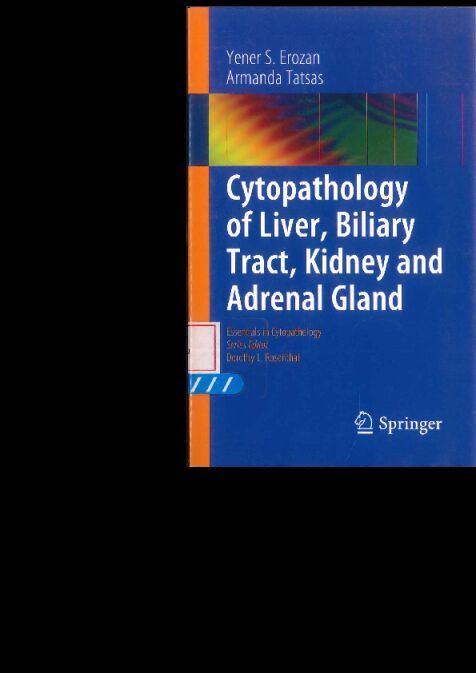
书名:Cytopathology of liver, biliary tract, kidney, and adrenal gland
责任者:Yener S. Erozan | Armanda Tatsas.
前言
Percutaneous and endoscopic ultrasound (EUS)-guided fine needle aspirations have been used widely in the diagnosis of intraabdominal lesions detected by imaging studies. These are safe, highly accurate, and minimally invasive techniques. Because FNA diagnosis also can aid in the selection of the type of therapy (surgical vs. nonsurgical) in some cases, high accuracy is critical. This can be achieved by teamwork between the radiologist (or other physician performing the FNA) and the pathologist. Collection of adequate specimens, proper preparation of the material, and the pathologist's experience are obvious factors in reaching the correct diagnosis.A\In Fine Needle Aspirations of Liver, Kidney and Adrenal Glands, the percutaneous approach is usually used. In recent literature, however, EUS-guided FNAs of these organs have been reported. The first chapter of the book, written by radiologists Dr. Stephanie Coquia and Dr. Ulrike M. Hamper, presents key clinical and technical features of image guidance methods for FNA of intraabdominal masses and organs. On-site evaluation, discussed in the second chapter, assures that adequate specimens are obtained and determines whether the specimen should be sent for special studies, e.g., flow cytometry. In the organ-specific chapters, although emphasis is on the cytomorphology of the lesions, additional studies, such as immunohistochemical stains in cell blocks or core biopsies, are presented as needed for the specific diagnosis.A\This book is meant to be a practical guide for the diagnosis of lesions, mostly neoplasms, of liver, kidney, and adrenal glands. We believe that the cytopathologic diagnosis of malignancy should be made cautiously after careful examination of the material, and it should be as accurate as a tissue diagnosis. Baltimore, MD, USA: Yener S. Erozan, M.D.; Baton Rouge, LA, USA: Armanda Tatsas, M.D.
查看更多
目录
1 Image-Guided Fine Needle Aspiration of Infra-abdominal Masses and Organs:Liver, Kidney, and Adrenal Gland 1
Indications 1
Contraindications 2
Complications 2
Patient Preparation 3
Image Guidance Methods 3
Ultrasound Guidance 4
CT Guidance 5
Endoscopic Guidance 5
Biopsy Technique 7
Needle Selection and Visualization 8
On-site Pathologic Evaluation 9
Specific Anatomic Applications 9
Liver 9
Kidney 10
Adrenal Gland 10
Other Issues 13
Conclusions 13
Suggested Reading 13
2 On-Site Evaluation and Specimen Preparation 15
Suggested Reading 16
3 Liver 17
Introduction 17
Approach 17
Sensitivity, Specificity, and Accuracy 19
Complications 19
Contraindications 19
Normal Components of Liver 20
Hepatocytes 20
Biliary Ductal Epithelium 22
Endothelial Cells 24
Kupffer Cells 24
Contaminants 24
Mesothelial Cells 24
Gastric Wall 25
Pulmonary/Respiratory Epithelium 25
Skeletal Muscle and Skin 26
Pigments (Table 3.2) 26
Lipofuscin 26
Bile 27
Hemosiderin 27
Melanin 28
Nonneoplastic Processes and Benign Nodules 28
Infections 28
Extramedullary Hematopoiesis 32
Hemangioma 34
Cirrhosis 36
Regenerative or Dysplastic Nodules 39
Macroregenerative Nodules 39
Dysplastic Nodules 40
Focal Nodular Hyperplasia (FNH) 40
Hepatic (Liver Cell) Adenoma 42
Bile Duct Adenoma 43
Angiomyolipoma 44
Hepatobiliary Cystadenoma 44
Primary Hepatic Malignant Neoplasms 45
Hepatocellular Carcinoma (HCC) 45
Special Types of Hepatocellular Carcinoma 55
Fibrolamellar HCC 55
Intrahepatic Cholangiocarcinoma 62
Combined HCC/Cholangiocarcinoma 65
Rare Primary Malignant Neoplasms 65
Hematopoietic Malignancies 65
Hepatoblastoma 66
Undifferentiated (Embryonal) Sarcoma 71
Angiosarcoma 71
Epithelioid Hemangioendothelioma 74
Metastatic Neoplasms to Liver 75
Metastatic Carcinomas 75
Metastatic Neuroendocrine Tumors 87
Metastatic Malignant Melanoma 91
Metastatic Spindle Cell Neoplasms 94
Metastatic Hematopoietic Neoplasms 95
Suggested Reading 99
Contraindications 99
Pigments 99
Hepatobiliary Cystadenoma 99
Rare Primary Malignant Neoplasms 100
Metastatic Neoplasms to Liver 101
4 Biliary Tract 103
Specimen Procurement and Preparation 103
Benign/Normal Biliary Epithelium 104
Reactive Biliary Epithelium 104
Infectious Organisms 108
Cholangiocarcinoma 109
Suggested Reading 113
5 Kidney 115
Introduction 115
Normal Components 115
Nonneoplastic Masses and Cystic Lesions 117
Xanthogranulomatous Pyelonephritis (XGP) 117
Abscess 118
Benign Cysts 119
Extramedullary Hematopoiesis (EMH) 120
Benign Neoplasms 121
Oncocytoma 121
Angiomyolipoma 123
Metanephric Adenoma 124
Malignant Neoplasms 125
Renal Cell Carcinomas (RCCs) 125
Grading of RCC 126
Accuracy of FNA in the Diagnosis of RCCs 128
Clear Cell (Conventional) Renal Cell Carcinoma (CRCC) 128
Papillary Renal Cell Carcinoma (PRCC) 131
Chromophobe Renal Cell Carcinoma 135
Collecting Duct Carcinoma (CDC) 138
Medullary Renal Cell Carcinoma (MRCC) 139
Mucinous Tubular and Spindle Cell Carcinoma 141
Renal Cell Carcinoma with Xp11.2 Translocation 142
Unclassified RCC 144
Sarcomatoid RCC 144
Metastatic Neoplasms 145
Urothelial Carcinoma of Renal Pelvis 146
Nephroblastoma (Wilms Tumor) 150
Rhabdoid Tumor 152
Suggested Reading 154
General 154
Adequacy and Accuracy 155
Benign Lesions 155
Renal Cell Carcinomas 156
Small Round Cell Tumors 158
Hematopoietic Lesions 159
Immunohistochemistry 160
Molecular/Genetic Studies 160
Rhabdoid Tumor 161
Urothelial Carcinoma of Kidney Pelvis 161
Metastatic Neoplasms 161
6 Adrenal Glands 163
Introduction 163
Fine Needle Aspiration (FNA) 163
Cysts 164
Nodular Cortical Hyperplasia and Cortical Adenoma 164
Myelolipoma 166
Pheochromocytoma 168
Adrenocortical Carcinoma 170
Neuroblastoma 173
Metastatic Neoplasms 175
Suggested Reading 179
General: FNA 179
EUS-Guided FNA 179
Adrenal Cysts 180
Myelolipoma 180
Pheochromocytoma 180
Adrenocortical Carcinoma 180
Index 183
查看PDF
查看更多
馆藏单位
中国医科院医学信息研究所